TERMINAL VELOCITY – Joel McNeely
 THROWBACK THIRTY
Original Review by Jonathan Broxton
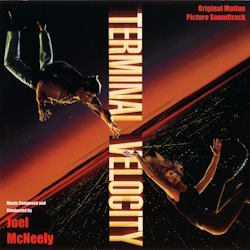
Terminal Velocity was the first of two action movies set in the world of skydiving to hit cinema screens in 1994 (the other was the much more popular and successful Drop Zone, scored by Hans Zimmer). This film was directed by Deran C. Sarafian and starred Charlie Sheen as former Olympic gymnast-turned-daredevil skydiver Richard “Ditch” Brodie. One day a woman named Christa Morrow (Nastassja Kinski) comes to Ditch’s skydiving school asking him to teach her how to jump, but then apparently dies in a freak accident, leaving Ditch in legal trouble. Later, Ditch discovers that Christa is alive and is actually part of a complex conspiracy involving stolen gold and Russian mobsters; Christa is a former KGB agent trying to stop a group of criminals from using the gold to finance a coup in Russia. Despite the film containing some admittedly rather impressive aerial stunts and action sequences – including a pivotal scene which features Sheen falling to earth while at the wheel of a Cadillac Allanté – the film turned out to be as ridiculous as the plot suggests, and flopped badly with both critics and audiences.
The score for Terminal Velocity was by composer Joel McNeely, and was his second major score of the year, the other being his mainstream debut work Iron Will. Prior to 1994 McNeely was mostly a television composer for Disney, writing music for a series of TV movies and episodic shows. It was his work writing for Lucasfilm’s Young Indiana Jones Chronicles series in 1992 and 1993 that first got people’s attention, and this led to him winning a Primetime Emmy for the ‘Young Indiana Jones and the Scandal of 1920’ episode in that second year. Much like Iron Will, Terminal Velocity is a large scale, adventurous action score, but whereas Iron Will contained a rich vein of Coplandesque Americana, Terminal Velocity is leaner, often meaner, and more contemporary in its tone and execution.
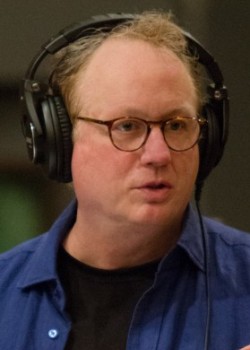 Something that followed Joel McNeely throughout the early part of his career was the assertation that he was going to be ‘the next John Williams’. Michael Giacchino picked up this mantle after the turn of the millennium, but throughout the latter half of the 1990s it was McNeely who was often mentioned in the same breath as the maestro. The comparisons were not unwarranted: as I mentioned above, he first came to prominence scoring the Young Indiana Jones Chronicles series, and then in 1996 McNeely wrote the music for Star Wars: Shadows of the Empire, a multi-media project that also involved a video game and a Star Wars book by author Steve Perry. Much of McNeely’s own music was also sort of Williams-adjacent too; he had a similar style involving rich classical orchestrations and prominent thematic content, and this is very much in evidence in large parts of Terminal Velocity.
The score’s main theme is introduced in the opening cue, “Desert Landing,” a dark motif which is initially surrounded by all manner of impressionistic and suspenseful orchestral textures, but which becomes much more prominent in the subsequent “Aerial Ballet,” which introduces one of the score’s key instrumental ideas: a moody half rock/half country guitar performed by Marc Bonilla. The guitar sounds are clearly intended to give Ditch a sheen of ‘bad boy cool,’ and as the score progresses McNeely regularly interpolates elements of the theme, or a guitar performance, to act as a recurring signifier for Ditch.
A secondary theme is introduced in “Airborne,” a more noble and patriotic brass affair that has a hint of Jerry Goldsmith’s Americana sound to it, and could be read as being either a theme for Ditch’s love of flying and parachuting, or a theme for the pro-American anti-Soviet politics of the film as a whole. Either way, it’s a nice theme, if a little brief. Meanwhile, the love theme for Ditch and Christa is a lush, seductive, romantic theme with a jazzy, sultry feel, with prominent saxophones and pianos emerging from the orchestra, and some light pop arrangements. Its appearance in cues like “Easier Ways To Die,” at the beginning of “Christa Is Caught,” and in “Desert Nocturne” is welcome, but I seem to remember it being much more prominent in the film itself (it has been three decades since I’ve seen it so I genuinely don’t remember). McNeely is as good at romance as he is at action, and the 1990s were ripe with these types of love themes for action heroes and their leading ladies.
Instead, almost everything else is action, and this is where the score really excels. McNeely’s action music here is tremendous: bold, exciting, rewardingly complicated in terms of orchestration, and strongly rhythmic, with some excellent individual elements which showcase the power and energy of the brass section especially. In its moments of downtime the score explores some sinister textures for low woodwinds and soft timpani, and these quieter sequences help make the more intense moments seem more striking. There is an explosion of guitar-led machismo halfway through “Ditch’s Dive” that wouldn’t sound out of place at a Metallica concert, and this continues through the equally vivid “The Second Plane”. Once or twice McNeely’s guitar licks have a similar vibe as Eric Clapton’s work on Michael Kamen’s Lethal Weapon scores, and this is something I appreciate.
Later cues, like the second half of “Christa Is Caught,” are similarly self-assured and engaging, but by far the standout action sequence is the brilliant 6-minute “Cadillac Freefall,” and it is here that McNeely abandons the more contemporary sound of the guitars and goes into much more traditional orchestral John Williams territory. You can clearly hear the influences from other scores, Raiders of the Lost Ark especially, but what McNeely does with that iconic sound is outstanding – he brings together layer up on layer of intricate instrumental lines, heavy brass pulses, rapped snares, swooping strings, and so much more, resulting in a cue which is intelligently structured, vigorously exciting, and superbly satisfying from a musical point of view. Snippets of both Ditch’s theme and the Americana motif weave in and out of McNeely’s dashing, bombastic orchestral arrangements too, which adds another layer of excellence onto an already ample cue.
The penultimate “Russian Gold” offers Ditch’s theme arranged as a sweeping hero moment full of warmth and with a sense of gratifying resolution, before the “End Credits” brings together all the main themes and ends the album with a rewarding flourish.
Terminal Velocity is an excellent action score, one of the best of this type in Joel McNeely’s entire career. It would provide the template for several other works later down the line, including The Avengers and Soldier in 1998, Virus in 1999, and the additional music he wrote for Jerry Goldsmith’s Air Force One in 1997, and it’s just disappointing that he wasn’t given a chance to write more music like this in his career (and why his work on the TV show The Orville was such a breath of fresh air when that came out). The album was released on the Varese Sarabande label, as one of their ‘thirty minute specials,’ and although that album is hugely enjoyable, I for one would enjoy an expansion, as I’m sure there are other nuggets of McNeely musical excellence that remain unreleased. Charlie Sheen’s career may have gone into freefall in recent years, and the film itself may have crashed and burned, but the Terminal Velocity score remains blue skies all the way.
Buy the Terminal Velocity soundtrack from the Movie Music UK Store
Track Listing:
- Desert Landing (2:18)
- Aerial Ballet (2:47)
- Airborne (1:04)
- Ditch’s Dive (1:45)
- Easier Ways To Die (1:43)
- The Second Plane (3:47)
- Christa Is Caught (4:15)
- Desert Nocturne (1:11)
- Cadillac Freefall (5:44)
- Russian Gold (3:26)
- End Credits (4:11)
Varese Sarabande VSD-5546 (1994)
Running Time: 32 minutes 11 seconds
Music composed and conducted by Joel McNeely. Orchestrations by David Slonaker, Chris Boardman and Arthur Kempel. Featured musical soloist Marc Bonilla. Recorded and mixed by Shawn Murphy. Edited by Curtis Roush and Thomas Milano. Album produced by Joel McNeely.

Shop at the Movie Music UK Store

Member of the

 MOVIE MUSIC UK