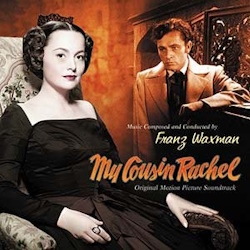
MY COUSIN RACHEL – Franz Waxman
 GREATEST SCORES OF THE TWENTIETH CENTURY
Original Review by Craig Lysy
Author Daphne du Maurier’s efforts to sell film rights for her 1951 novel My Cousin Rachel for $100,000 and 5% of the international box office was rejected by all of the major Hollywood studios except 20th Century Fox, whose counter offer of $80,000 was accepted. Nunnally Johnson was assigned production with a budget of $1.2 million, wrote the screenplay, and George Cukor was tasked with directing. Controversy arose when both Cukor and du Maurier both objected to the script, with bot departing the project when their revisions were rejected. Casting was also problematic with Cukor’s choice of either Greta Garbo or Vivien Leigh playing Rachel Sangalletti Ashley, fell through with his departure. Olivia de Havilland was instead brought in and joined by Richard Burton in his Hollywood debut as Philip Ashley, along with Audrey Dalton as Louise Kendall.
The story is set in the Ashley estate in Cornwall England owned by Ambrose Ashley. Ambrose raises his cousin Philip at the estate, but leaves for Florence in poor health believing the warmer climate will aid his recovery. While there he meets and marries his cousin Rachel, only to die shortly thereafter of a brain tumor. Philip suspects foul play due to Ambrose’s complaints about Rachel, yet it comes for naught as he inherits the estate and discovers Rachel to be a beautiful and charming woman. Philip falls in love with Rachel, eventually bequeaths the estate to her and proposes marriage. She rejects the proposal, which devastates him and he falls ill with fever and delirium. While sick he imagines that Rachel is trying to poison him and did in fact poison Ambrose. He exacts his revenge by purposely failing to warn her of an estate bridge, which collapses and kills her. Yet her dying words asking why he did not warn her plague him and he realizes that he allowed an innocent person to go to her death. The film was a commercial success, earning a profit of $100,000. Critics praised the film for its storytelling and Richard Burton’s outstanding performance. The film earned four Academy Award nominations for Best Supporting Actor, Best Cinematography, Best Art Direction, and Best Costume Design.
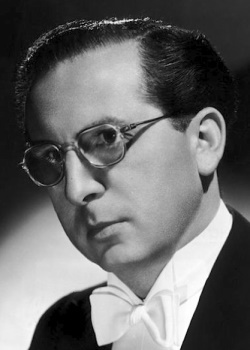 In 1952 Franz Waxman’s career was ascendant, him having won consecutive year Oscars for Sunset Boulevard in 1950 and A Place in the Sun in 1951. He was therefore Director of Music Alfred Newman’s choice for a film in many ways kindred to another of Waxman’s finest scores – the 1940 classic Rebecca. Waxman understood that the film offered a classic tale of unrequited love by a passionate and anguished younger man for an unreceptive older woman. Her rejection begins to drive Philip mad, and he ultimately becomes implicitly responsible for engineering her death when he deliberately fails to warn her of an estate bridge in imminent danger of collapse.
I believe Waxman understood that this story was at its core, a psychological drama, and that he would have to speak to Philip’s passion, Rachel’s elusive allure, and the mistrust that develops between them. He would also need to drape the setting of an ancient cliff perched manor house set along the restless Cornish coast, with dark and foreboding Gothic auras. To that end, two primary, and two secondary themes dominate his soundscape; the Main Theme offers a dire, repeating, three-note construct, often draped by eerie tremolo violins, which sets a grim and somber tone of the film. The theme is pervasive and I believe operates as a portentous harbinger of doom. Waxman constantly manipulates its expression, and entwines it within the very sinews of the musical narrative. Rachel’s Theme offers the score’s only feminine construct. Long lined, and string borne its notes flow like tresses in the wind. It offers tenderness and beauty, yet we also discern within its notes an elusive, and intangible quality, a mystery hidden to the eye, and obscure. Ambrose’s Theme offer a simple, yet forthright declaration by warm French horns nobile, which speak to his good nature. The Love Theme, is first rendered as a wondrous nocturne borne by a breezy solo flute pastorale, before shifting to a romanza by strings romantico. We note that this is unrequited love, with the theme expressed from Philip’s perspective and expressing his ardent feelings. Also woven withing the score’s tapestry are a spritely riding and travel motif, sunny Italian accents while in Florence, and mysterious orchestral auras borne by harp glissandi and arpeggios, tolling bells, and dark, ominous chords. A harpsichord would seem to express the quaint essence of the manor house. What is interesting is how during times of stress and discord, its sound becomes twisted and distorted. Lastly, the traditional Christmas carol “Deck The Halls With Boughs of Holly” (1862) by Thomas Oliphant is used to support the holiday, yet, the undercurrent of tension and mistrust between Philip and Rachel manifests within its notes, distorting its festive melody.
“Main Title” offers a dramatic score highlight. It opens grimly with dire horn declarations of the Main Theme, which replaces Alfred Newman’s iconic 20th Century Fox fanfare. At 0:13 we flow atop a foreboding strings tremolo into the film proper where we see Ambrose Ashley walking along a country road with his ward, his boy cousin Philip. They reach “The Four Turnings” crossroads where narration informs us, murderers are hung. Ambrose relates that a moment of passion brought Tom to this terrible end. Waxman sets a grim and somber tone of the film during this opening scene with repeating iterations of the dire three-note Main Theme, draped by eerie tremolo violins, which I believe operates as a portentous harbinger of doom. We close with a terrifying abyssal crescendo as narration by the adult Philip relates that he should have remembered that death is the price for murder. At 0:59 the flow of the opening credits commences with repeating, brighter renderings of the Main Theme. At 1:22 we are graced by a grand exposition of Rachel’s Theme, which sweeps us away with exquisite romanticism. At 1:44 a stirring crescendo dramatico ascent carries us ever upward, only to dissipate into eerie nothingness at 1:57 as we return to the film proper with a distant shot of the imposing Ashley estate perched on a Cornish seaside cliff. A forlorn flute supports narration by Philip describing his childhood at the mansion, where he was raised by his older cousin Ambrose.
“Pie Break” reveals the butler Seacomb serving Philip a large bin covered by a hard cookie crust. To his surprise when he breaks the lid, out pops a puppy! Bubbling flutes felice voice his joy, joined at 0:07 by harpsichord when Ambrose wishes him a happy birthday as Philip jumps into his arms for a hug. At 0:15 we shift to the sea where Ambrose oversees Philip retrieving a star fish. Narration by Philip informs us that his parents died at the age of two and Ambrose became his father, and best friend. Strings tenero and a forlorn meandering flute with harp adornment offer a sentimental musical narrative, yet it is tinged with an intangible sadness, joined by harpsichord as we shift to the present. Ambrose advises Philip, now a young man, that his doctor has advised him to seek out the warmer climate of Italy to help recover his health. “Crossroads” opens with a galloping motif of syncopated horns and spritely strings, which propel Ambrose’s departure, followed by Philip, and Louise Kendall on horseback. At 0:10 a diminuendo supports their stop at “The Four Turns” crossroads, where they exchange good wishes and farewells supported by warm French horns and flute tenero. I discern foreboding undercurrents woven within the musical narrative. At 0:45 we shift forward in time to next Spring with narration supporting a troubled Philip at the cliffs. He is worried at Ambrose’s long absence and eerie tremolo strings and woodwinds minacciosi sow a foreboding musical narrative of unease. At 1:17 family executor Nick Kendall arrives by carriage and inquires about Ambrose. Philip relates that he has met and is spending time with a Countess Sangalletti, who is of English and Italian parentage. Waxman again sows a disconcerting musical narrative, a misterioso of unease led by an oboe doloroso. Something is wrong, and Waxman portentous music renders it elusive.
In “Bells” church tower bells are ringing supported by a twinkling, refulgent musical narrative as Philip reads a letter from Ambrose advising of his marriage to cousin Rachel and honeymoon in Naples. Yet at 0:11 a diminuendo of sadness usher in forlorn horns as Philip confirms the news to the butler. Later Philip visits Ambrose’s executor Kendall with news of another disturbing letter complaining of mistreatment by Rachel and distrust of the physician’s ministering to him. When he shows the letter tortured script to Mr. Kendall, he says that he believes Ambrose may have become unsound of mind, and raises the possibility that he has inherited his deceased father’s brain tumor. Waxman masterfully sow disquieting unease, his music, full of foreboding. “Crossroads #2” reprises the galloping motif of the earlier Crossroads track; however, its happiness has been shed, replaced by anxiety and a disconcerting sense of urgency. A diminuendo gives rise at 0:12 to a forlorn oboe as he orders the coachman to stop so he may speak to the postman. He retrieves a letter from Ambrose and a dire musical passage of wailing strings and a grim Main Theme supports its script; “Come to me quickly Philip. She has done for me at last. Rachel, my torment.” At 0:44 a dire Main Theme swells on a tortured crescendo as Philip orders the coachman to quickly make for the port. The crescendo dissipates into harp glissandi and a nautical motif by languorous strings as we see a ship sailing on the high seas. At 1:01 Waxman bathes us in sunny Tuscan auras as a carriage bring Philip to the estate Ambrose is residing. At 1:15 he arrives and rings the gate bell carried by a fleeting quote of Rachel’s Theme.
“The Caretaker” reveals Philip barging in and demanding to know the status of his brother. After repeated deflection, the caretaker finally discloses that he died three weeks ago. Tolling bells and strings funebre drape us is grief as the caretaker relates his final days, joined at 0:45 by elegiac French horns, which offer a mournful last reprise of Ambrose’s Theme, adorned by bell tolls and shifting chords religioso. Clearly distraught, the musical narrative slowly darkens as he discloses that due to fever, delirium and violence, that he would have to restrain Ambrose. At 1:52 a grim Main Theme supports the caregiver’s disclosure that Mrs. Ashley departed taking his personal effects except for his walking cane, to which Philip was welcome to take. We flow into an eerie misterioso as Philip confirms that Ambrose’s lawyer, Guido Rainaldi, was a true friend and of great assistance to Rachel in comforting Ambrose. Philip asks for his address, and the misterioso with repeating quotes of a foreboding Main theme is sustained as he departs and travels to the Rinaldi residence. We close darkly, with uncertainty as he arrives at the Rainaldi Residence.
In an unscored scene a polite a polite and gracious Guido Rainaldi, accommodates Philip’s request for proof of the cause of death. He is advised that Ambrose died of a brain tumor, and offers him a death certificate as proof. He adds that he sent Philip and Mr. Kendall copies, and then discloses that he also read Ambrose’s Will as requested by Ambrose himself. When Philip inquires as to what the Will stipulated, Guido informs him that Ambrose bequeathed the Cornwall estate to him in trust upon his 25th birthday. He adds that Rachel, inherited nothing, and left without making any claim on the estate. Philip is unconvinced, and uses the letters, which he shares with Guido, to level accusations of maleficence. Guido is calm, and offers a medical text book that affirms that brain tumors often cause pain and delusions as their growth impinges on the brain. When Philip insists on seeing Rachel, Guido informs him that she left yesterday and is unaware of her location.
“Leaving Rinaldi’s Office” offers a masterfully conceived and executed score highlight. It reveals Guido ringing the servant bell, indicating the meeting is over. As Philip departs, he insists that Guido inform her of his visit, and to disclose the contents of the letters. Guido consents, advises of the location of the cemetery where Ambrose is buried, and offers further assistance if needed. Music enters darkly as Philip departs and visits Ambrose’s grave. As he kneels the musical narrative becomes menacing with fleeting echoes of Ambrose’s Theme as his narration informs us that of his promises a terrible retribution to avenge Ambrose’s death as he does not believe Rainaldi’s medical report, but instead Ambrose’s letters. We close the scene with a dire quote of the Main Theme. At 0:37 we shift to the Cornwall countryside propelled by a galloping musical narrative by spritely strings felice, warm French horns and harpsichord as we see Philip and Louisa racing home. A diminuendo at 0:50 led by a flute delicato supports as they enter the Kendall residence. Louise goes upstairs to freshen up, and Philip joins her father in his study. The music darkens joined by a foreboding Main Theme, which dissipates as Kendall informs Philip that Rachel has arrived with apparently no knowledge of his visit to Florence, only wishing to return his personal belongings. He hands Philip a letter and counsels him to read it, which he refuses. Philip is unreceptive and defamatory toward her and Kendall counsels to be mindful that she would be well within her rights to sue him for slander. Undeterred when Kendall advises that he will out of courtesy allow Ambrose’s widow to stay with him, Philip offers us a less than cordial invitation for her to meet him, and visit the estate.
“Countryside” opens with a propulsive Main Theme rendered as a travel motif as a carriage traverses the countryside. A grandiose Rachel’s Theme joins as she arrives and is greeted by Seacomb. A dramatic statement of the Main Theme supports a transition to the cliff where a contemplative Philip gazes at the restless waves crashing ashore. Waxman achieves a poignant confluence speaking to this restlessness musically. At 1:20 a pensive, woodwind lead musical narrative unfolds as Philip returns home to find it decorated with flowers, and well lighted with fireplaces aglow. At 1:52 foreboding horns resound as he prepares to summon Seacomb, only to have him join and advise that Mrs. Ashley is resting in her room. He struggles to contain his anger joined by plaintive quotes of the Main Theme by oboe as Seacomb advises that she took dinner in her room as she was tired by the journey. Philip dines alone and afterwards Seacomb informs him that Mrs. Ashley advised that if he wanted to visit her after dinner in her room, that she would be receptive. A restless musical narrative of occult anger empowered by repeating quotes of the Main Theme voice what is unsaid by Philip as he pours a cordial to fortify himself, and then ascends to her room carried by a crescendo irato, which dissipates at 3:16 as he knocks on her door. As he enters the vestiges of his anger dissipates, shifting to a Main Theme borne by a tentative flute.
In “Philip Smokes Pipe” Louise greets him with genuine, unanticipated warmth, which seems to disarm Philip who accepts her invitation to sit with her. He is surprised when she relates a number of intimate stories about himself as she could have only gained knowledge with Ambrose’s confidence. Seacomb arrives with a tea service and departs. She serves them both and invites him to smoke as we see him now relaxed, his anger transmuted to genuine fascination as she offers stories of his Aunt Phoebe to which he was unaware. Music enters as he lights his pipe, supported by a misterioso borne by tremolo violins with harp adornment. After 0:12, an intervening scene (*) “Sunday Services” reveals a church where the pastor leads the congregation, which includes Nick Kendall and his daughter Louise, singing the traditional hymn, “Rock of Ages” supported by a hand-pumped organ. The pastor and congregation become distracted as Philip escorts Rachel into the chapel. After the service Rachel carries on an Ambrose tradition, by offering, with Philip’s permission, an invitation to the Kendalls and Pascoes for Sunday luncheon, which all graciously accept. Rachel then suggests she ride with Mr. Kendall, while Louise rides with Philip. We resume track 9 “Philip And Louise” at 0:13 with a string ostinato trotting travel motif as Louise inquires as to why Philip has not yet confronted Rachel regarding Ambrose’s death. He is defensive and deflects with repeating quotes of the Main Theme joining an undercurrent of tension in the musical narrative. At 1:12 a plaintive oboe supports as Philip joins Rachel in the dining room after the guests have left. Waxman weaves an undercurrent of tension as she asserts that he and Louise are a good match, and that she departs in the morning. At 1:53 the musical tension surfaces, becoming overt as he declares; “Why did Ambrose not make another Will?” Her response: “What does that matter now?” She adds that she must find a means of supporting herself in London. The Main Theme empowers a foreboding musical narrative of tension with his admission of dishonesty, saying Ambrose wrote him letters, and at his urgent request came to Florence. At 2:18 her beleaguered theme joins as she is taken aback, becoming tense as she was unaware of both. Clearly something lies hidden and Waxman weaves a disconcerting narrative of agitation.
“Rachel At The Fireplace” offers another testament of Waxman’s mastery of scoring scenes where powerful emotions intersect, and we witness the transmutation of hate into romantic longing. It reveals Philip giving her the two letters to read. She walks to gain the light of the fireplace and reads them, and as he watches her intently Waxman offers a dark, monstrous low register rendering of her theme by strings sinistri. Yet at 0:24 the music softens with vulnerability as she offers a surprising response when she looks up to him, saying that he must have hated her. He answers yes, adding that he wanted to confront her, and make her suffer for her murder of Ambrose. The musical narrative writhes atop a crescendo of anguish embedded with foreboding quotes of the Main Theme as she weeps, overcome, and offering to accept whatever he wishes to do. Yet the horrific tempest dissipates at 1:22 as Philip grabs the letters, tears them, and throws them into the fire. He drops all pretenses, saying he believes now that she is not the woman described in those letters, but instead the imaginations of a diseased mind. She is gracious for his change of heart and a misterioso unfolds to support as she walks away, brightening at 2:15 atop a solo flute and harpsichord as she begins to disclose to him her married life with Ambrose. She relates that his love for her opened up his eyes to the world, that they were at first happy. The harpsichord usher in and joins with her theme borne by strings tenero to support her storytelling. But at 3:07 aching strings tristi with harp adornment support as she says that he began to change, becoming argumentative and suspicious. She asks the rhetorical question; “Was it due to his illness, or me? At 3:44 she asks that he light a candle for her to take to her room. Waxman weaves a string ostinato and woodwind agitato undercurrent of bemusement as he walks her to the foot of the stairs and gives her a trifold candelabra. At 4:01 a harp arpeggio, strings and harpsichord support her asking; “Are you sure you do not hate me?” To what he responds; “Why should I?” She thanks him, and as she ascends, his eyes are affixed, supported by a crescendo dramatico romantic rendering of the Main Theme, which informs us of a nascent romantic longing.
In an unscored scene the nest day Kendall confirms that her former husband before Ambrose left the estate indebted and that she was penniless. Philip orders an annual stipend of £5,000, which Kendall asserts is over generous. But Philip is insistent and Kendall makes the arrangements. “Christmas Eve” reveals a joint toast of Philip and Rachel by his Christmas tree, supported by a rendering of the Christmas carol “Deck The Halls With Boughs of Holly” by harpsichord and flute. A diminuendo at 0:26 supports him grabbing a gift box from the tree. At 0:34 ethereal harp joined by refulgent, sparkling effervescence supports him gifting her a family heirloom – a beautiful pearl and gemstone necklace. She is overcome by its beauty and as she dons it in front of a mirror at 0:53 a violin d’amore with a quote of the Main Theme informs us that for Philip, this is a romantic offering. Yet a foreboding coda ends the scene as she turns to thank him only to be pulled into a passionate kissing embrace. (*) “Christmas Eve Party” reveals the partygoers singing the Christmas carol “Deck The Halls With Boughs of Holly” accompanied by harpsichord. Kendall sees Philip eyes affixed to Rachel and summons him to accompany him to the dining room where he informs him that Rachel has overdrawn her account by nearly double. Philip is untroubled by this and orders her stipend increased. Kendall then drops a bombshell, which he learned from trusted friends; that Rachel and her husband were profligate spenders and lived a ‘loose’ life style, which resulted in her husband, the Duke dying in a pistol duel to defend her honor. Kendall states that the necklace he gifted was a family heirloom, and not his do give as his 25th birthday had yet to arrive. He demands that he retrieve it from her, or that he would. Unknown to both, Rachel had been listening and graciously returns the necklace to Kendall, thanking Philip for allowing her to wear it tonight. Philip is furious, rebukes Kendall and storms upstairs to his room.
“Philip’s Room” reveals Philip stewing in his room supported by a forlorn bassoon. He answers the door and at 0:11 Rachel enters carried by a harpsichord tenero as she tries to console him with a hug. At 0:47 the string borne Main Theme full of longing with interplay of a dissonant harpsichord supports his recitation of the women ancestors of his family, who have worn the necklace, and then asks, do you not know why I gifted it to you? She kisses him and then a diminuendo of sadness carries her quick departure. As he watches her walk away, the forlorn bassoon reprises his discontent joined by a fleeting reprise of the harpsichord motif. We close at 1:29 with an ethereal celeste lead misterioso as Rachel writes a letter in her room using Italian script. (*) “Rachel and Guido” reveals Philip descending the stairs to the main floor carried by the forlorn bassoon motif of discontent. He discovers Rachel and Guido having a conversation in Italian. Guido apologizes for arriving without an invitation, but Philip is gracious and welcomes him, as Rachel expresses surprise at Guido’s unannounced visit to England. Philip is clearly unsettled by this visit and declines a drink saying he needs to bathe before dinner. As he departs, Guido and Rachel resume their conversation in Italian. Later, after dinner Rachel serves Ti Sana, an Italian green tea medley. Rachel interrupts Guido’s lecturing of Philip on his health and excuses herself saying she has business to discuss with Guido in her room. Guido remains and informs Philip that a second will, bequeathing the estate and fortune to Rachel was drawn up, but that Ambrose died before executing it. This agitates Philip, which Guido purposely exacerbates by declaring that his interest in Rachel is romantic. Philip is provoked, yet he steels his composure and is gracious as the two bid each other good night.
As Guido departs, we flow into “Rachel Turns And Goes”, which offers a masterpiece composition, one of the finest in Waxman’s Canon. Philip clearly stews with jealousy and as he stares up from the courtyard to her lighted bed chamber, Waxman unleashes this emotion in an angry musical narrative, which at 1:16 is buttressed by a grim Main Theme. At 1:37 Rachel’s Theme entwines with a bassoon misterioso, which further unsettles us. The next day she joins him on the cliff edge where his jealousy is revealed. She asks him to hug her and then dispels his agitation by saying that after she sent Guido off, she waited for him, adding that Guido had returned to London this morning. Philip reacts with shame and embarrassment, apologizing for his behavior. She then admits that with each day she becomes fonder and fonder of him, while he declares that with each day, he becomes more determined to keep her here. The music is dialed out after 1:54, which is a shame. At 1:55 the music crests atop a tortured crescendo dramatico empowered by raw passion, which erupts, cresting powerfully at 2:19. We close darkly at 3:03 with a grim Main Theme and foreboding musical narrative. The final film music version is less prominent, which I surmise was intended to play under the dialogue. Waxman’s version which I believe was intended to voice the raging desire, passion and jealousy of Philip’s heart was probably judged to be too powerful and prominent.
“There Are Some Good Women” offers yet another masterpiece composition, one of the finest in Waxman’s Canon. It reveals that Philip has impulsively decided to transfer ownership of Ambrose’s estate to Rachel over the objections of Kendall who issues a warning empowered by a foreboding Main Theme draped with dark chords; “There are some good women through no fault of their own, who impel disaster. Whatever they touch turns to tragedy.” It is night and at 0:13 we shift to Rachel’s bedchamber bathed in soft swaying strings romantico. She hears Philip calling for her to come to the window and walks out onto her balcony supported by his Love Theme, rendered as a wondrous nocturne borne by a breezy solo flute pastorale, and kindred woodwinds with harp adornment. He has been drinking, and tosses a rope with a sack attached, coaxing her to pull it up, which she does. He is love struck, and climbs to her balcony like Romeo to share the wonder of the luminous Moon and sweet fragrances of night. She is surprised as he declares that it is his 25th birthday, marked at 1:25 by tolling midnight bells and shifting portentous chords. She says, now this is all yours, to which he replies, no, it is yours. She is cold, and he takes her to the fireplace as the now refulgent Love Theme blossoms and shifts sumptuously to violins d’amore. At 2:18 the Harpsichord Motif joins as he retrieves the sack, the gift he has brought her. At 2:42 refulgence and the Love Theme borne by solo violin d’amore support him emptying the sack, revealing the family jewelry heirlooms, of bracelets, rings and a jeweled tiara, which one by one he places on her, the pearl necklace supported by a luminous harp glissando. At 2:58 gives her the deed to the estate marked by repeating iterations of the Main Theme. He adds that he would gift her the world if he owned that too. She is overwhelmed and strings bear a tender rendering of her theme as she caresses and thanks him with a kiss. The two themes entwine romantically as he confesses his undying love. We close with a solo violin d’amore tinged with an elusive sadness as they kiss and the scene fades to black
“Rachel Rises” reveals Kendall offering a birthday toast after dinner to Philip, his God Son, as Louisa and Rachel watch. Philip then offers a toast to Rachel, announcing that she is to be his wife. Everyone is stunned as Rachel states “Philip, have you lost your sense?” Music joins with repeating, foreboding statements of the Main Theme joined by a dissonant “Deck The Halls With Boughs of Holly” quote. Rachel apologizes, says there has been a misunderstanding, and that the wine must have gone to Philip’s head. Philip is stunned as she asks the guests to join her in the drawing room. Later that night as she ascends the stairs Philip emerges from the landing shadows. He confronts her saying she agreed to marry him last night. She denies it, which angers him and declares was it all pretense? To which she responds, it was not love, but thankfulness for the jewels and deed. He snaps and begins to strangle her, relenting as she collapses on the stairs. She is horrified, and as she moves past him to go to her room, he utters with a crazed look; “You are mine and must never leave me”. Waxman sow an eerie, and unsettling musical narrative repeatedly punctuated by a menacing Main Theme, joined at 1:25 by repeating, fear evoking harp arpeggios, which dissipate into nothingness atop dire low register strings.
“Philip Rushes Out Of The Church” offers a well-conceived and executed score highlight. It reveals Philip joining Louise in church where he apologizes to her, while she consoles. But then all pretenses are dropped as she asserts that he has been played, by Rachel using his genuine emotions to obtain both all his money and the estate. She asks how he can be so blind and to allow himself to be torn, shamed and humiliated? To which he shouts, because he loves her with all his being! Music enters, surging atop a fierce ostinato by strings irato as he storms out. The storm subsides as he returns home to discover Seacomb setting a dinner placement for three at the mistress’ command. An angry string motif carries Philip upstairs to Rachel’s room, dissipating at 0:31 after his knock elicits his entry where he finds Mary Pascoe revealing Rachels plans for a new flower garden. The Main Theme joins as a misterioso yet descends grimly in register with menace when Philip asks to speak to Rachel alone. Rachel agrees but only if the bedroom door is left open. After Mary departs Rachel advises that because of the violence she suffered, she will never allow herself to be alone with him again. The Main Theme becomes dire, brooding, and filled with unease as he objects to Mary moving in. He then objects to Mary joining for dinner, threatening to banish her At 2:11 a crescendo irato surges when Rachel skews him by saying “She cannot believe he would order her guest to leave her house.” At 2:21 a brooding Main Theme joined by slithering violins supports Seacomb entering Philip’s room saying the women await him in the drawing room. He is lying in bed and advises that he has a headache and will not be joining for dinner. Later that night, he is sweating from fever and exits his room carried by a woeful Main Theme. The theme joins with an anguished Rachel’s Theme, offering a tortured musical narrative as he knocks repeatedly at her door, calling her name. He gives up, returns to his room, to lay in bed. At 3:55 he becomes delirious as ghostly voices and apparitions plague him supported by a grotesque surreal musical narrative of woe buttressed by repeated Main Theme quotes and eerie ethereal effects as he envisions her in a wedding gown agreeing to marry him. At 5:33 he takes her arm and approaches a priest at the altar carried by an organ religioso rendering of the Main Theme, which swells on a crescendo grotessco. At 6:18 the music dissipates suddenly, shifting to a dirge by organ solenne as we behold Guido, Rachel and a priest holding vigil of Philip on his death bed. We conclude with dramatic power as the camera shifts to crashing waves, returning to Philip waking in his bed to a harsh quote of the Main Theme, which slowly dissipates.
In unscored scenes we see Rachel coming to his bed, kissing him on the forehead, and saying he had been out for three weeks. He requests a drink and then stuns her by saying he apologizes for having to take care of a husband such as this. After he drinks, he kisses her hand and we see in her eyes, confusion. The next day Philip strolls the ground and is advised that Rachel had traveled to Plymouth. As he travels the grounds, he finds a crew repairing a bridge across the gorge and is advised by the foreman that no one should cross it until they and reinforce the rotting supports Monday. At the Plymouth Inn Rachel bids farewell to Guido in Italian as she boards her carriage. Back home she admits upon questioning, that she is indeed returning to Florence for the winter, and will depart only after he has fully recovered. Philip is taken aback, asking if this is how she intends to live with long absences from him, to which she replies, she misses her life and friends of her homeland, and that she will discuss this further when he is fully recovered. When he says he feels tired, she tenderly takes him to his room to rest.
“Philip Sits At The Window” reveals him sitting by the window declaring his intention to place a plaque commemorating the place he first saw her. He then asks her to come sit with him and music enters atop tentative violins with harp tresses voicing his Love Theme. When he again confesses his love and thankfulness that they are married, her eyes reveal the truth, that they are not married, and that he only imagined it while he was delirious. He is devastated and as she tries to console him, Waxman supports with a Pathetique of pain buttressed by quotes of the Main Theme. His accusations of her loving Guido are countered by a steadfast assertion that they are, and have always been friends. At 2:13 a forlorn oboe joins and usher in a rising tension as he reads a letter address from an inn in Plymouth while she is not looking. At 3:05 a menacing crescendo irato swells as he asks where Guido is, and she lies, saying that he is in Florence, which causes him to angrily leave declaring that everything she has said to him from their first meeting has been a lie. A foreboding cadence supports her closing her door, shifting to a forlorn bassoon as we see a dejected Philip siting in his room. A misterioso empowered by the Main Theme unfolds as he grabs a key ring from the top drawer of his dresser and departs by candlelight. He unlocks Rachel’s door, extinguishes the candle, and enters. A bassoon led musical narrative of tension buttressed by a repeating Main Theme and dire muted drum strikes unfolds as he sneaks to her dresser, and searches the drawers as she sleeps. He pries open the second locked drawer, retrieves the letter and disappears into the shadows as she wakes, comes out, and says who’s there?
“Philip Moves Away” reveals him departing her room unnoticed carried by foreboding bassoon and a harp arpeggio misterioso. Tension builds borne by repeating grim repetitions of the Main Theme as he returns to his room. At 0:43 the music becomes dire as he discovers the envelop does not contain a letter, but instead poison seeds from the tree the gardener was removing because of their danger to the cattle. At 0:59 a three-note ostinato of tension draped by a violin tremolo rises as we see the gears churning in Philips head. The foreboding motif is sustained in the morning as he descends and is greeted by Kendall and Rachel returning from Sunday services. She informs him that she departs later for Florence, having booked passage on a ship. She asks that he agree to have their last hours together be happy ones, to which he consents. She then asks to kiss him, does so, and declares there are times she sees Ambrose in him. She departs and he greets the Pascoes who have arrived for Sunday brunch. He pulls Louise aside and asks that she make an excuse to remain as he has something important to tell her. She agrees as Rachel returns to escort them to brunch.
Afterwards in “You Drink It”, Philip asks Louise to translate a letter written in Italian, only to be interrupted by Rachel’s arrival and preparation of Ti Sana tea. An unsettling and foreboding misterioso joins as she hands him a cup, yet he declines saying she should drink it. She says she has her own, and pours the cup into the bushes. Seahome then advises her that the banker has arrived as requested, and Rachel departs to meet with him. At 0:51 the music darkens atop low register strings grave utterances of the Main Theme as he declares that he is convinced Rachel killed Ambrose and is trying to also kill him. At 1:22 we segue into “Finale” with eerie dissonance as Rachel returns, gifts Philip a container of tea, and advises that he should drink before turning in. She says she desires to see a statue she loves one last time in the lower garden, but Philip declines saying he has to see Louise off, and so Rachel heads out alone. Philip knows that she must cross the bridge to reach the lower garden and that this will result in her death. At 2:00 a foreboding woodwind borne Main Theme draped in a dark chord carries Rachel’s departure. Urgent strings energico carry Philip and Louise’s run to Rachel’s bedroom to retrieve the letter. Waxman sow a growing tension with ominous statements of the Main Theme buttressed by a string ostinato agitato as we shift to and fro between the bedroom and Rachel walking to her doom. Philip discovers a letter to the bank disclosing she has returned all the jewelry, which he believes is a ruse. A frightful crescendo builds, yet dissipates at 3:35 when he finds the letter at her desk. The letter from Guido advises of his enduring friendship, and given she cannot release the young man from her heart, that she should bring him back to Florence to assist him regaining his health. At 4:13 he realizes that he has misjudged her, and a desperate musical narrative of urgency propels his run to reach her before she crosses the bridge. He reaches the bridge at 4:35 where a horrific voicing of her theme crowned by a dire proclamation of the Main Theme is declared as he sees her body below on the rocks. He frantically climbs down, and lifts her head up as he repeatedly cries out Rachel as the Main Theme portends death. She looks up, says, “Why did you do it?” and then expires. At 5:21 the music brightens as we look upon crashing waves. Slowly the music ascends with hope for brighter days as the Main and Rachels themes entwine in refulgence as narration by Philip speaks of the burden, and aching torment he must now carry to the end of his days, never knowing if she was innocent, or guilty. We close with “The End” empowered by a final grand declaration of the Main Theme, which ends the film in a flourish.
I commend the late Nick Redman for this wonderful reissue of Franz Waxman’s masterpiece score, “My Cousin Rachel”. The stereophonic remastering offers good audio quality and a rewarding listening experience. In the film the contrast between Philip and Rachel is striking; with his persona volatile, impulsive and mercurial, while hers is gentile, serene, and unflappable. Throughout the film there is a pervasive and intangible ambiguity, which ultimately confounds us, forcing the following questions; Is Rachel a gold-digging opportunist and murderess, or an innocent woman whose beauty, demeanor and allure arouses Philip’s desire? Are Philip’s heartstrings purposely ensnared by Rachel who is in reality a deft manipulator, or is he a villain, propelled by a paranoic tortured psyche to dark purpose? The film ends with this ambiguity unanswered, and Waxman brilliantly uses his music to create a consistent undercurrent of unease and tension borne of the ambiguity. Brilliance in film score music is sometimes realized with simplicity, and Waxman’s three-note Main Theme reveals his genius. The theme permeates the entire film, repeating in many different guises; ominous, foreboding, eerie, angry and mysterious. The fact that it never resolves, perfectly embodies the film’s narrative of ambiguity. Rachel’s Theme offers exquisite Golden Age romanticism and a perfect juxtaposition to the oppressive Main Theme. Yet it is the auras in which Waxman drapes the film, and the tense, mysterious and ambiguous undercurrents, which ultimately elevates Koster’s storytelling, allowing him to realize his vision. Folks, this score stands as one of the finest in Waxman’s canon, brilliant in conception and execution, one which ultimately transcends its film. I highly recommend this quality album for your collection as well as taking in the film.
For those of you unfamiliar with the score, I have embedded a YouTube link to the Main Title: https://www.youtube.com/watch?v=kpaRezsgWrw
Buy the My Cousin Rachel soundtrack from the Movie Music UK Store
Track Listing:
- Main Title (2:23)
- Pie Break (1:22)
- Crossroads (1:51)
- Bells (1:23)
- Crossroads #2 (1:30)
- The Caretaker (3:23)
- Leaving Rinaldi’s Office (1:33)
- Countryside (3:38)
- Philip Smokes Pipe / Philip And Louise (3:31)
- Rachel At The Fireplace (4:38)
- Christmas Eve (1:14)
- Philip’s Room (2:06)
- Rachel Turns And Goes (3:30)
- There Are Some Good Women (4:28)
- Rachel Rises (2:19)
- Philip Rushes Out Of The Church (6:47)
- Philip Sits At The Window (5:25)
- Philip Moves Away (1:25)
- You Drink It / Finale (6:09)
Varese Sarabande CD Club VCL-0608-1078.2 (1952/2008)
Running Time: 58 minutes 35 seconds
Music composed and conducted by Franz Waxman. Orchestrations by Edward B. Powell. Recorded and mixed by XXXX . Score produced by Franz Waxman. Album produced by Nick Redman.

Shop at the Movie Music UK Store

Member of the

 MOVIE MUSIC UK