THE ADVENTURES OF MARCO POLO – Hugo Friedhofer
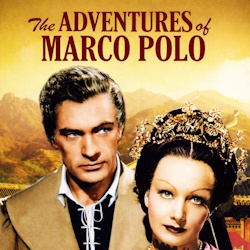 GREATEST SCORES OF THE TWENTIETH CENTURY
Original Review by Craig Lysy
The genesis of The Adventures of Marco Polo lay with actor Douglas Fairbanks, who conceived the story in 1936 and wrote a script based on Marco Polo’s adventures. He had intended to produce the film with his son playing the titular role. However, he needed to secure financial backing and so pitched his vision to Samuel Goldwyn, who decided to move the film into production. Goldwyn envisioned Gary Cooper to star in the production, the project was derailed when Paramount Pictures initiated a $5 million lawsuit against Goldwyn for allegedly trying to lure its star away. This effectively killed the project; never the less, Goldwyn was undaunted and in 1937 purchased an original story on Marco Polo from N.A. Pogson. Goldwyn and George Haight would manage production with a massive $2 million budget, with Archie Mayo tasked with directing. Goldwyn was insistent on Gary Cooper playing the titular role, which in hindsight was an error as Cooper felt he was miscast, and critics greed saying Cooper’s persona was a poor fit for the swashbuckling adventure. Joining Cooper would be Sigrid Gurie as Princess Kukachin, Basil Rathbone as Ahmed, and George Barbier as Kublai Khan.
The film is set circa 1271 C.E. and follows the adventures of Venetian Marco Polo who sets out along the legendary silk road to secure trade agreements with Kublai Khan, emperor of China. As the adventure unfolds, we have a shipwreck, palace intrigue sown by the evil Ahmed, a romance with Princess Kukachin, and the discovery of spaghetti and firecrackers, which Marco brings back to Italy with transformative cultural and military effects. The film was a commercial disaster, losing $700,000, which nearly bankrupted Goldwyn. Critics lauded the production value; however, they believed Cooper was miscast and in the end the story never delivered the goods. The film earned no Academy Award nominations.
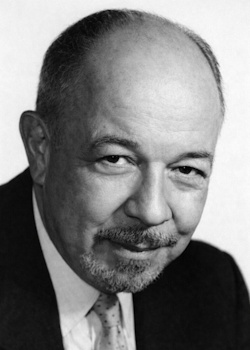 Hugo Friedhofer was viewed by Max Steiner and Erich Wolfgang Korngold as invaluable as an orchestrator and MGM Director of Music Leo Forbstein ensured his primary composers needs were met. As such Friedhofer was never assigned a film to score, his success as an orchestrator serving as both a blessing and a curse. However, opportunity knocked in 1937 when Alfred Newman recommended him to Samuel Goldwyn for The Adventures of Marco Polo as he was too busy to score the film himself. Friedhofer was ecstatic and succeeded in scoring the film on the side. Despite this, he would have to wait six more years to finally break out of orchestrator jail, again with the help of Newman, with his score to The Lodger in 1944.
Upon viewing the film, I believe Friedhofer understood that he needed a heroic Main Theme for Marco Polo to drive the epic, a grandiose theme for the Great Khan, a love theme for Princess Kukachin, a sinister theme for our malevolent villain Ahmed, and that he would have to speak musically to Chinese, Persian, Tatar and Venetian cultures. To this end he composed seven themes. Marco’s Theme supports the dashing heroic lead actor with a long lined, 12-note construct, which is bold, confident and vibrant. Empowered by rousing horns eroiche, it offers a perfect identity for our hero, which inspires our support and admiration. Kukachin’s Theme provides the score’s only feminine identity. Friedhofer offers an eloquent, and exquisite romanza for strings, often led by or voiced singularly by a yearning solo violin d’amore. It perfectly captures her heart held captive by the tall and handsome man of her dreams. As her love for Marco develops her theme when they are together transforms into a Love Theme, often providing the score’s most beautiful moments. Kublai Khan’s Theme resounds with grandiose horns reale fanfare, which speak to his power, grandeur, and magnificence as the ruler of the greatest empire on earth.
Ahmed’s Theme supports our villain, the perfect foil to Marco. Serpentine in construct, it rarely emotes boldly with overt strength, instead lurking with insidious malevolence, and sinister intent. The Chinese Theme offers ethnic drum and wooden percussion, with an array of woodwinds esotici, draped in a rich orientalism. The Tatar Theme emotes with oriental sensibilities and while kindred to the Chinese Theme, it is more militant, strident and aggressive reflecting their horse warrior culture. The Persian Theme offers a spritely musical narrative borne by an array of woodwinds esotici. There is an incredible lightness of being and vibrancy in the notes, which are draped by Middle Eastern auras. For Venetian culture Friedhofer offers refinement in the form of several dances heard only early in the film before Marco’s departure for Cathay.
The MGM logo frames are unscored. At 0:08 “Main Title” a parchment roll of the opening credits commence with a prelude of spritely strings and trumpet, which usher in at 0:19, a bold declaration of the Main Theme by trumpeting horns eroico as Gary Cooper, and then the film title is credited. At 1:08 a brief quote of the string borne, glissandi draped Love Theme joins, followed by a coda of the Main Theme. 1:25 “Forward” reveals script honoring Marco Polo as the first European to visit China and for his adventures in that land of magic and mystery, which Friedhofer supports with a danza maestoso. At 1:44 we flow into the film proper “Polo Brothers – Merchants and Importers” as narration supports a camera pan over gold, gem stones and hand-crafted jewelry. The danza maestoso plays quietly under the dialogue as patriarch Nicolo Polo explains that the origins of these treasures lie east, leagues beyond their expectations, in China. He advises that he intends to task his son Marco to journey to China to obtain more wealth for the family and to formalize trade relations.
2:59 “Marco is Summoned” reveals Nicolo’s servant Binguccio riding in a gondola repeatedly calling out “Marco Polo” to the homes of the many women courted by him in a futile effort to retrieve the wayward son. A soft, danza gentile supports until 3:59 when strings romantico support Angelina’s confirmation from her balcony, that Marco is with her, and cannot be disturbed. When he says Marco is summoned by his father, she defers and calls for Marco. At 4:08 we see him playing dice with friends supported by a playful rendering of his theme. As he goes to the balcony, and jumps down into the gondola, Angelina’s sweet gaze supported by the Love Theme carries his departure. A playful musical narrative supports their boat ride as Binguccio advises Marco that he is to be sent on a dangerous journey to China, and that he will be glad for a respite searching for him at the homes of his many paramours. Once home, Nicolo tasks him in establishing a trade agreement that will allow Venetian ships port entry. He then orders Binguccio to accompany his son to keep him straight and true. He gifts Marco a small pouch in which he is to collect treasures he believes to be invaluable. A map supports Nicolo’s description of his route, which begins by sailing to the port of Acre in the Levant.
6:29 “Sailing to Acre” reveals Marco’s ship unfurling it sail to display the winged lion of St. Mark, patron saint of Venice. A string borne, nautical rendering of Marco’s Theme carries the ship’s departure and traverse of the Mediterranean Sea. At 6:37 Friedhofer whips his orchestra into a tempest with strings furioso and trumpet declarations of Marco’s Theme as a violent storm with massive waves buffets the ship. At 7:07 a diminuendo misterioso brings us to a beach where we see four mounted Arabs. Friedhofer shifts to an exotic Arabic infused musical narrative as they ride into the waters to rescue Marco and Binguccio. 7:40 “Journey Across Persia” a camera pans a map west to east across Persia supported by a spritely rendering of Marco’s Theme as a riding motif as they traverse a desert. Marco stops, and points out the approach of a sand storm to which they try to outrun, propelled by trumpets energico declarations of his theme. At 8:12 Marco sees it is futile, and tells Binguccio that they have to lay down the horses, keep low, and try to ride the storm out. Swirling strings furioso of the storm interplay with a beleaguered Marco’s Theme as they struggle to survive.
8:30 “Journey to Tibet” reveals a camera panning a map west to east from Persia to Tibet. At 8:36 as Marco and Binguccio struggle traversing the Himalayas in a fierce snowstorm as a beleaguered musical narrative of woe carries their progress. At 8:48 a camera pans a map west to east from Tibet to Cathay with the musical narrative now draped with the orientalism of the Chinese Theme as we see Marco and Binguccio traveling overland by foot. They arrive at the Great Wall of China and pass through it. In 9:05 “Peking” dramatic horn declarations of the Great Khan’s Theme by horn orientale, which voice the grandeur of his imperial city of Peking, which covers the horizon as they descend a hill. At 9:22 we see Marco and a foot weary Binguccio walking bustling streets, which Friedhofer supports with rich orientalism of the Chinese Them with an array of ethnic percussion and woodwinds esotica. Binguccio collapses and asks that he be left to die, but Marco will not have it, and carries him on his back. A musical sense of wonderment unfolds as the two marvels at the cultural richness as well as a funny puppet show.
In unscored scenes Marco stops in his tracks when he hears Chen Tsu, an aged Chinese man known as a philosopher and fireworks-maker reciting the Beatitudes to a group of children. Marco startles Chen when he takes over the recitation, and then thankfully accepts his gracious invitation to join his family for dinner. Marco is introduced to Spaghet – a noodle staple of China’s working class. After dinner Marco breaks several in half and places them in his pouch. Shouting from the street elicits Marco to open a shudder where we see armed soldiers escorting a prisoner. At 14:13 “Chen’s Warning” reveals the host closing the shutters. Dire woodwinds lead a foreboding serpentine musical narrative empowered by Ahmed’s Theme as he warns Marco to be wary of Ahmed, a Saracen who serves as Kublai Khan’s Minister of State. Their conversation is shattered when Chen’s two sun explode a firecracker under the cot on which Binguccio was sleeping. Afterwards Chen agrees to reveal to Marco in his lab the secret of the powder. Marco immediately perceives a military application of this powder, much to the horror of Chen. He however gifts Marco a sample to place in his father’s pouch.
16:45 “Journey to the Palace” reveals Marco and Binguccio traveling on foot through a bustling street to the palace. Friedhofer supports with the Chinese Theme, which offers a rich, ethnic musical narrative of woodwinds orientale and an array of percussion esotica. They are stopped at the gate where the captain of the watch startles Marco with knowledge of his name and adventure crossing Cathay. He is offered quarters, which he and Binguccio graciously accept. We are bathed is soft Chinese auras as Binguccio soaks his aching feet in hot scented water. The royal chamberlain arrives and declares that the great Khan is ready to receive his guests. 18:32 “The Great Kublai Khan” reveals the throne room crowded with ministers and military officers. Gong strikes announce the arrival of the emperor, to which everyone bows. The grand fanfare reale of his theme empower his walk to his throne crowned with a chord of power as he sits. The khan announces that his north south and central armies have joined, and that he will soon depart to personally lead his invasion of the kingdom of Japan. A lurking foreboding undercurrent of menace joins with Ahmed’s Theme as he is summoned to approach the throne. When the khan orders him to embed spies in the camp of Warlord Kaidu of the Tartars, he is surprised by Ahmed’s revelation that he did so months earlier. His menacing theme rises as he takes a broom and sweeps away figurines of the warlord and his troops from a great floor map. Afterwards the royal chamberlain arrives and advises that the Persian ambassador has arrived, and the Roman traveler Marco Polo. The Khan grants permission for each to have an audience.
21:52 “The Persian Ambassador” reveals the summoning of the Persian ambassador by the Chamberlain. A gong strike followed by the Persian Theme borne by an array of spritely ethnic woodwinds, which carry the ambassador and two boy servants to the throne. The ambassador request fulfillment of the Khan’s marriage contract with his king, which promises the Khan’s daughter Kukachin. The Khan consents, advising that she will depart on the seventh Moon. 23:14 “A Mother of Kings” reveals Kukachin placing peony flowers at an altar of the Moon goddess. She confides to her servant Visakha that she hopes the Persian king is handsome and tall. Friedhofer introduces her amorous theme on a solo violin delicato. From his balcony Marco observes Kukachin and hears her prayers. He is clearly attracted to her and her theme shift to woodwinds as he walks to her. As she completes her prayers again asking for a tall and handsome man, we flow at 24:54 into “Marco and Kukachin”. She turns and a string ascent follows the camera’s ascent up to Marco’s face. A gentle variant of his theme supports her surprise, but also her attraction to this tall and handsome man. As they acquaint, and he compliments her on her beauty, their themes are woven into a romantic musical narrative. She is mesmerized by his charm, but the moment is lost when the chamberlain arrives and says the Khan commands Marco’s presence.
27:16 “Marco Meets Ahmed” fluttering pizzicato strings carry Marco’s arrival. We shift to a danza orientale as the Khan introduces and extols the talents of Ahmed, his Minister of State. The Khan advises that whatever you have come to take, Ahmed will see that you are denied. At 28:00 and pleasant and disarming rendering of his theme support’s Marco’s declaration that he is only here for educational purposes. At 28:26 harp glissandi tresses and soft woodwinds delicato carry the arrival of Princess Kukachin. Marco is surprised when he learns that she is the Khan’s daughter. 29:24 “The Khan’s Women” reveals Marco accepting the Khan’s invitation to review women prepared for the Khan’s pleasure. Playful woodwinds and harp glissandi carry their arrival, shifting to a misterioso as the camera follows the Khan’s eyes across the many women as Marco and Kukachin exchange glances. At 30:49 Ahmed maneuvers Marco into making a selection for the Khan and he agrees, saying he will do so posing some questions. A warm and playful extended exposition of his theme carries him to them, and is sustained as one by one he whispers a question into their ears, and they whisper back an answer. Afterwards he discloses to the Khan that he asked each the same question; “How many teeth does a snapping turtle have?” Group one he advises guessed numbers from 12 – 100. With the Khan’s approval, they are dismissed for answering untruthfully. Group two gave the correct answer, which is zero. He says that they know too much, and Marco dismisses them with the Khan’s consent. The third group answered that they did not know, proving that they are honest and reasonable. At 32:54 the Chinese Theme supports as the Khan thanks Marco and invites the women to approach him. Marco’s Theme joins as the khan tells Marco that you barbarians fascinate me, a compliment to which Marco wisely choses to accept. At 33:29 Kukachin’s Theme supports Marco and her eyes locking when the Khan says he may have the choice of any woman in his palace. Her theme is sustained as Marco departs in the care of Ahmed.
34:41 “Ahmed’s Private Quarters” reveals Marco and Binguccio surprise when Ahmed strikes a gong that elicits a draw bridge to descend so they may cross into his domain. A foreboding musical passage of wonderment supports the descent, shifting to a menacing trumpet declaration of Ahmed’s Theme. His theme empowers a malevolent musical narrative as Ahmed makes veiled threats as he displays a feeding room for his pet vultures. A spy is brought in, Ahmed demonstrates his power by having the man dropped through a trap door in the floor into a lion’s den, where he is devoured. Ahmed then advises that since you came here for education, let this be your first lesson. 39:45 “Garden Encounter” reveals Marco seeing Kukachin in the garden, and he departing his quarters to join her. A solo flute orientale voices her theme as he joins her by a lotus pool. A romance for strings unfolds as she discloses, she is betrothed to the king of Persia and will depart to join him at the seventh moon. When he remarks that if he was the king of Persia, he would be very impatient, she turns aways, troubled by his words. For a fleeting moment, the music reflects this, however her theme blossoms as she returns to the Moon goddess statue where she and Marco first met. When he says she will marry a man she does not love, she becomes defensive, saying he will plant love in her heart, and it will grow. Yet we see she does not believe these words as she turns away supported by a heartfelt rendering of Marco’s Theme, which informs us of her heart’s desire. As he confesses his feeling a molto romantico expression of his theme supports. He asks for a token to remember her, and she asks, you mean a gift? To which he replies, no, a kiss. She has never kissed and he agrees to show her and at 43:58 the Love Theme blossoms as they kiss. She enjoys it, he kisses her again, and she asks if she can initiate, to which Marco agrees and love blossoms atop a solo violin d’amore. Unknown to them Ahmed’s guard Bayan observes and makes a swift departure.
In “Bayan Alerts Ahmed” Ahmed becomes enraged when Bayan discloses that Marco and Kukachin kissed. 47:04 offers a gong strike as Ahmed and the Khan enter the throne room where Marco waits. A soft Chinese Theme plays as the Khan announces Ahmed’s plan – for Marco in the guise of a foreign traveler to spy and kill the Tartar leader Kaidu. When Marco advises that he is not a murderer, he is assured that Toctai, Ahmed’s assassin will handle the murder. The Khan assures him that if he is successful, the trade agreements he seeks will be his reward. As he departs Ahmed says his men will guarantee his safety, but Marco’s expression reveals he knows that Ahmed has instead ordered him killed. 49:25 “Kukachin Visits” reveals Marco alerting Binguccio of their mission when Kukachin burst in carried by distressed strings. She warns that Ahmed intends to kill him, and as she embraces him, the Love Theme blossoms atop a solo violin d’amore as she confesses her undying love for him. The moment is shattered by the arrival of Ahmed, who orders Marco’s immediate departure. The Love Theme borne by a solo violin d’amore resumes as he kisses her one last time.
51:26 “Journey to Kaidu” reveals a map with Peking with the camera panning northwest to the Tartar kingdom of Kaidu supported by the Tartar Theme borne by trumpets dramatico declarations, swirling strings Arabo, and thunderous drums. The energetic Tartar Theme decrescendos as we descend into the Tartar camp where three men stand bound to stakes. Dire trumpets resound as Kaidu exits his tent, greeted by pleads of mercy by the prisoners. His response is and order for his archer’s to fire. He angrily orders his men to round up spies before they enter his camp. As he returns to his tent fanfare by trumpets reale resound. 53:00 “Ambush” reveals a Tatar war party on patrol propelled by the Trumpet declared Tartar Theme. They spot Marco’s party and a shift to a gentle traveling variant of his theme carries their approach to bridge across a gorge. Bayan advises that their escort ends here, and that crossing the bridge takes them into Tartar territory. A confident rendering of his theme supports his and Binguccio’s crossing, joined by the drum empowered Tartar Theme as the war party descends to intercept. Soon the Tartars attack, causing Marco and Binguccio to flee, pursued by the Tartars empowered by a martial rendering of their theme. They are captured, much to the satisfaction of Bayan who observes from the other side.
57:15 “Marco Meets Kaidu” trumpets dramatico resound as we see Marco and Binguccio being escorted to Kaidu’s tent. Kaidu and his wife Nazama sit on thrones as Kaidu orders the first prisoner, a ruthless officer boiled in oil. We see Nazama clearly smitten with Marco and she defers Kaidu’s order for torture with a question concerning Marco’s homeland. At 58:09, as he states Venice, a city known as the home of romance, a molto romantico rendering of his theme unfolds. He states he seeks treasure and beautiful women. When she asks if he found one here, he answers, yes, much to her satisfaction. Nazama intercedes telling Kaidu that he is clearly a merchant, not a spy, and Kaidu relents ordering everyone to leave except Marco. Kaidu tells Marco that he must stay for now, and use his energies to charm his wife, inferring that such a dalliance with his jealous wife will allow him the same liberties with his new servant.
1:02:13 “The Khan Departs For Japan” offers the Kublai Khan’s Theme rendered as a royal processione militare as the great Khan’s army parades through Peking. Kukachin tries to dissuade her father of personally leading an invasion force to conquer Japan, to no avail. Outside the processione militare continues to empower the massive army’s departure. As he departs, he promises to return before the seventh moon. On a terrace Ahmed tells a confident that he hopes a China Sea typhoon ends the Khan, paving the way for him to become emperor. On another terrace Kukachin receives a parting hand wave from her father. Bayan then advises Ahmed that Polo is dead, claiming he personally killed him. We close with Kukachin going inside, unsettled by Ahmed’s leering. 1:05:34 “Kaiku and the Maid” reveals it is night and Tartars singing while huddled around a campfire. In his tent Kaiku has his maid on his bed and explains she need not fear his wife coming as he has assured, she is ‘entertained’. In Zamara’s tent Marco sits uncomfortable on her bed as she gazes at him with lustful eyes and slides to his side. Later he returns to his tent and advises Binguccio that they remain alive as long as he is able to ‘entertain’ Zamara.
1:09:27 “Defeat” reveals Ahmed receiving news that the Khan’s army has been destroyed. Ahmed’s sinister theme supports his walk to the throne, and him sitting on it with a look a satisfaction. At 1:09:44 the ethnic woodwinds and pizzicato strings of the Persian Theme bring the Persian Ambassador into the throne room. With one week to go to the seventh Moon, the ambassador presents Ahmed with a magnificent jeweled necklace for Kukachin. Ahmed agrees to escort him to see the princess, and signals Bayan of his evil plan. As they walk at 1:10:43 Ahmed’s sinister theme portends the ambassador’s doom, swelling with malevolence as armed guards seize him. Later, Ahmed presents the necklace to Kukachin in her bedchamber. She refuses and declares that her father will punish him for his impudence. He counters with the tragic news of the Khan’s death, and then provides good news – she will not be going to Persia, but will instead become his wife, as he ascends the throne. She is devastated as he departs and declares she will eventually discover that he is a suitable husband. 1:12:33 “Kukachin’s Despair” is borne by a solo weeping violin of devastation. She calls to Visakha to attach a note to an eagle to be sent to the Tatar homeland. A quote of Marco’s Theme joins her theme to inform us of her plea for Marco to rescue her. At 1:13:01 shimmering effervescence supports an eagle’s flight joined by a warlike Tatar Theme as a war party spots the eagle. An archer shooting it down and they retrieve the dead bird and ride back to camp. Tartar fanfare supports the note being passed up the chain of command until it reaches Kaidu.
In unscored scenes Marco is summoned by Kaidu and upon arrival given the note to read. His request to rescue Kukachin is denied by Kaidu with the threat of death should he try to escape. Back at the palace, Bayan advises that the Khan returns with his 100-man personal guard. Ahmed orders Bayan to allow the Khan entry and to bring Kukachin to his chambers. 1:14:46 “Ahmed’s Treachery Revealed” gong strikes announce the Khan’s arrival. He walks in dejected, a defeated man and is greeted by Ahmed. Ahmed then advises that he will wed Kukachin and gives the Khan an imperial edict to sign that designates him as the Khan’s successor. Horn’s irato declare the Khan’s outrage, worsened by the refusal of the guards to obey his commands. He refuses to sign the edict and so Ahmed has him forcibly taken to his quarters carried by his malevolent theme. Inside his chambers he opens the curtains to the vulture feeding room to reveal Kukachin chained on their feeding block. At 1:17:18 a forlorn solo violin voices Kukachin’s Theme as Ahmed advises that after no food for days, the vultures are ravenously hungry. The Khan in angry despair succumbs and agrees to sign the edict, demanding Kukachin be released at once.
Back at Kaidu’s camp Marco advises Binguccio that they need to escape and rescue the princess. From his tent, he calls to Toctai, Ahmed’s spy, to join him in the tent. He tells him that Ahmed has commanded that they kill Kaidu tonight. Toctai says he has the night watch, will personally kill Kaidu, and then they can escape through the north pass. 1:19:47 “Marco Saves Kaidu” reveals a woman singing a folk song as Kaidu entertains Marco, Zamara and Binguccio. After the song Kaidu tries to depart to bed his maid, but Marco convinces him to listen to music of Venice sung by Binguccio. With an untrained voice Binguccio begins singing off key. At 1:22:22 drums of doom sound as Toctai prepares to throw a spear at Kaiku’s back. A musical tempest explodes as Marco pushes Kaidu out of the way, saving him and the pins Toctai’s tunic to a wood post with a dagger throw. Kaidu acknowledges a life debt, grants Marco three wishes, and agrees to attack Peking to prevent Ahmed from becoming Emperor. Marco asks for his fastest horse, and a one-hour lead. He says that will find a way for Kaidu’s men to enter the city, and reserves his third wish for later. Kaidu consents and tells Marco to ride out at daybreak.
1:25:15 “Marco Returns To Peking” reveals Zamara calling Marco, which elicits a comic, rapid departure before she can ensnare him. Horns bravura propel Marco’s galloping escape, much to Zamara’s displeasure. Kaidu promises Zamara to retrieve him, and orders the army to assemble as they are marching on Peking. In a montage, swirling strings furioso and ethnic trumpeting horns resound empowering the Tatar Theme, which propels the massive Tatar army’s departure and ride to Peking. 1:26:16 “Kukachin’s Despair” reveals Peking’s massive main gate as fanfare Cinese resound. We shift to Kukachin’s bedchamber, where Visakha places the finishing touches on her wedding dress. Soft oriental textures support but slowly descend in despair as Kukachin eyes reveal dread. In Ahmed’s quarters he marvels at his finely tailored wedding robes and orders that Chen Tsu be instructed to make many fireworks for the wedding. As Chen prepares firework crates, Marco enters, much to Chen’s surprise. He asks for Chen’s assistance entering the castle and we later see him disguises as a Chinese laborer entering unnoticed among a throng of people through the main gate.
1:28:15 “Marco Reunites With Kukachin” reveals Kukachin at the Moon Goddess shrine bathed in woodwind orientale textures. Dire horns resound as Visakha brings Kukachin a dagger on a pillow. A tense musical narrative unfolds as Kukachin kneels with the dagger, ready to kill herself rather than wed Ahmed, while Marco manages to sneak away from the men cleaning the floor. At 1:29:29 Marco propelled by his theme climbs a wall to avoid detection by some guards. A sad Kukachin’s Theme supports her final prayers to the goddess for knowing Marco for too short a time. As she readies the dagger, Marco’s Theme carries his stealth arrival. When he calls to her at 1:30:25 the Love Theme blossoms emoted by exquisite string borne romanticism.
1:31:11 “Tartar’s Attack!/Wedding Ceremony” opens with massive bell strikes that signal the alarm that Peking is under attack. As Kaidu’s army approaches a strident and war-like Tartar Theme swells. Ahmed decides to lay a trap; leave open the West gate, after Kaidu and his officers enter, close the West and Palace gates, trapping him inside, cutoff from his army. At 1:32:32 Ahmed’s Theme carries the arrival of his guards and Marco flees, asking Kukachin to try and delay the ceremony. She accepts their escort and departs. Outside at 1:33:08 Kaidu orders a charge announced by trumpet militare declarations. An orchestral maelstrom propels their charge into the city. At 1:33:40 Bayan orders the Palace gate closed and Marco propelled by his heroic theme runs to stop it. Next the West gate is closed trapping Kaidu as Ahmed’s men rain down arrows from the surrounding walls. Ahmed then departs carried by his evil theme to be wed, leaving Bayan in charge. Kaidu leads his men down a side street as Chen arrives with the fireworks. Marco leads the carts to the palace gate. At 1:36:04 a monk begins the wedding ceremony with Kublai Khan in attendance, supported by soft, yet solemn oriental auras. 1:36:18 Marco’s Theme supports the placement of all the fireworks crates at the palace gate. The shift back to the wedding reveals Kukachin doing her best to delay saying “I do”, is again supported by soft and solemn oriental auras. A return to the fight at 1:37:39 is propelled by a heroic Marco’s Theme as he prepares the gunpowder for detonation, reunites with Kaidu, and advises that his best men be dispatched to take the West gate guard tower empowered by a ferocious Tatar Theme. At 1:38:22 Marco lights the fuse as Kaidu’s men overwhelm the guards. Dire horns portend doom as a massive explosion rocks the palace and brings down the palace gate. Celebratory horns resound as Tartars open the West gate and their army pours in and takes the palace, their rousing theme ascendant!
1:39:56 “Marco Fights Ahmed” reveals Marco reaching Ahmed’s drawbridge as the guard begins pulling it up. Carried by a rousing, heroic rendering of his theme, Marco leaps, manages to climb over the rising drawbridge, and slays the guard. 1:40:36 reveals Marco breeching the wedding ceremony with Kukachin crying out “Marco!” He runs towards Ahmed, who draws a dagger empowered by his sinister theme. A dagger duel empowered by a ferocious, kinetic musical narrative ensues with Ahmed slowly gaining advantage. He opens the trap floor to the lion’s den, and the two men end up fighting on the floor next to it. Slowly Marco positions himself to gain leverage and forces Ahmed to fall to his doom, devoured by his own lions. 1:41:48 “The Khan Rewards Marco” reveals horns maestro empowering the approach of Marco and Kaidu to the enthroned Khan. Musical pleasantries support the Khan assuring that the injustice Kaidu suffered from Ahmed has been remedied and will never happen again. The music shifts to harp adorned playful comedy as the Khan gifts Kaidu 100 beautiful women, and Marco cashes in his final wish, supported by his theme, saying that Kaidu must accept this most generous gift from the Khan. As Kaidu happily departs, Marco instruct Binguccio to draw up the trade agreements. 1:42:46 “Finale” reveals Kukachin advising that she must soon depart to Persia. Marco agrees to personally take her on a ship sailing the long route through the south seas. She is most happy and we conclude atop the love theme that blossoms as they kiss, with “The End” supported by a grand orchestra flourish.
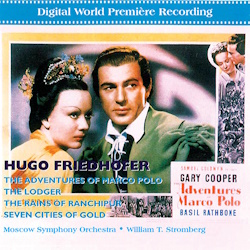 The only legitimate commercial recording of Friedhofer’s score for The Adventures of Marco Polo is a 13-minute suite on a 1997 album released by Marco Polo Records, recorded by conductor William Stromberg with the Moscow Symphony Orchestra & Chorus. We open with rousing refulgence with an ornate prelude from which is launched at 0:25 a heroic Marco’s Theme. At 1:08 we are graced by the Venetian theme, a wonderful danza elegante. At 1:52 we flow into the Chinese Theme, which offers ethnic drum and wooden percussion, with an array of woodwinds esotici, draped in a rich orientalism, joined at Kukachin’s Theme borne by woodwinds delicato with delicate harp glissandi tresses. At 2:59 the grandiose Kublai Khan Theme is declared with all its grandeur and magnificence. At 4:02 the eagle flight motif launches a playful Marco’s Theme borne by spritely strings and bubbling woodwinds. At 4:55 drums bellicoso, swirling strings furioso and horns bellicoso empower the strident and war-like Tartar Theme. At 6:00 flute delicato, kindred woodwinds, harp and strings tenero voice Kukachin’s Theme. The melody’s transition to solo violin d’amore is exquisite. At 7:45 we are graced by an amorous solo cello romantico voicing Marco’s Theme. At 9:27 a tempest erupts propelled by trumpets bellicoso, with interplay of a heroic Marco’s Theme. This subsides at 10:00 as we flow into an exotic danza Arabo. At 10:35 strings energico and trumpets launch Marco’s Theme, which becomes beleaguered in a dire musical narrative. A decrescendo usher in soft and delicate Chinese auras, joined at 11:56 by grandiose declarations of Kublai Khan’s Theme. At 12:15 with a solo clarinet tenero adorned with ethereal harp glissandi, joined by a blossoming Kukachin’s Theme by sweet strings romantico. We close with a grand declaration of Marco’s Theme to conclude the suite.
The Marco Polo album provides excellent audio quality and I commend Stromberg’s suite construction and his performance conducting the Moscow Symphony Orchestra. Yet I would give anything for a reconstruction and rerecording of the full score. This should have been Hugo Friedhofer’s breakout score, but because the film bombed, his wonderful music failed to make an impression, sinking with the ship. Sadly, it would take six more years before he escaped from his orchestrator straitjacket. I believe his score provides everything you desire for an adventure film; a heroic theme for our hero Marco, a graceful and romantic theme for Kukachin his love interest, a malignant theme for Ahmed our villain, imperial pomp, grandiosity and magnificence for Kublai Khan and his court, rousing action music, and cultural identities for the Venetians, Chinese, Tatars and Persians. I believe his score was masterfully attenuated to each scene, the emotional dynamics between the characters, and helped this truly flawed film’s pacing and forward momentum. Although Friedhofer never achieved the same recognition of his golden age peers, Max Steiner, Alfred Newman, Dimitri Tiomkin and Miklós Rózsa, I believe his canon, which includes one Academy Award win and nine nominations, impressive, and well worth your further exploration. I highly recommend this compilation album, which also includes suites from Friedhofer’s scores for The Lodger (1944), The Rains of Ranchipur (1955), and Seven Cities of Gold (1955).
For those of you unfamiliar with the score, I have embedded a YouTube link to William T. Stromberg’s wonderful suite; https://www.youtube.com/watch?v=R_s02g-1YTI
Buy the Adventures of Marco Polo soundtrack from the Movie Music UK Store
Track Listing:
- The Adventures of Marco Polo Suite (13:09)
Marco Polo 8.223857 (1938/1997)
Running Time: 13 minutes 09 seconds
Music composed by Hugo Friedhofer. Conducted by William Stromberg. Original orchestrations by Edward B. Powell. Recorded and mixed by Edvard Shakhnazarian and Vitaly Ivanov. Score produced by Hugo Friedhofer and Alfred Newman. Album produced by William Stromberg and John Morgan.

Shop at the Movie Music UK Store

Member of the

 MOVIE MUSIC UK