THE CLIENT – Howard Shore
 THROWBACK THIRTY
Original Review by Jonathan Broxton
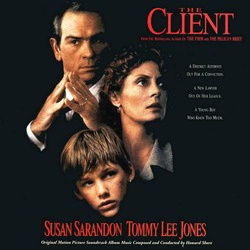
The 1990s were full of John Grisham legal thriller adaptations. Following hot on the heels of The Firm and The Pelican Brief, both of which were released in 1994, comes The Client, directed by Joel Schumacher. The story follows an eleven-year-old boy named Mark Sway (Brad Renfro) who, along with his younger brother Ricky, witnesses the suicide of a lawyer named Jerome Clifford. Before dying, Clifford reveals to Mark that he knows the whereabouts of the body of a recently murdered U.S. Senator, which could implicate a powerful mob figure, Barry “The Blade” Muldano (Anthony LaPaglia). As Mark becomes the target of both the mafia, who want to silence him, and the authorities, who want his testimony, he seeks the help of a feisty lawyer named Reggie Love (Susan Sarandon). Despite being initially reluctant to get involved, Reggie decides to take Mark’s case and protect him from all threats – one of whom is the ruthless U.S. Attorney Roy “Reverend Roy” Foltrigg (Tommy Lee Jones), who wants to exploit the case to further his own political ambitions.
The film was both a critical success and a box-office hit, grossing $117.6 million against a $45 million budget, and earning Sarandon a Best Actress Oscar nomination. It also briefly made Brad Renfro one of the most acclaimed young actors in the world; he had been discovered by Schumacher’s casting director while living in a trailer park in Knoxville, Tennessee, and he brought a real sense of truth and authenticity to the role, despite having never acted in any capacity before. Unfortunately, Renfro’s story was a cautionary tale in Hollywood – after The Client he made several other films, including both The Cure and Tom and Huck in 1995, Sleepers in 1996, and Apt Pupil in 1998, but by the end of the decade the pressures and excesses of fame began to catch up with him; he suffered with drug and alcohol addiction, was arrested several times, and in 2008 he died of a heroin overdose at the age of just 25. A sad end for a talented but clearly troubled man.
 The score for The Client was by composer Howard Shore, although interestingly Hans Zimmer was attached to the film during pre-production in 1993, but had to back out to work on The Lion King instead. At this point in his career Shore had firmly established himself as an A-list composer who could have his pick of any prestige drama, comedy, thriller, or horror he chose; his work in the preceding couple of years had included Oscar winners like The Silence of the Lambs and Philadelphia, and box office smashes like Mrs. Doubtfire. The Client was the first and only collaboration between Shore and director Joel Schumacher – Schumacher’s prior composer of choice was James Newton Howard, on films like Flatliners, Dying Young, and Falling Down – but it was nevertheless a memorable one, a stylish and intelligent drama/thriller score with some flavors of the American south.
The score is written for the full orchestra, with featured solo performances by percussionist Steve Jordan, Mike Lang on piano, Danny Kortchma and Tim May on guitar, and even a guest appearance by a young Simon Franglen, who designed some of the score’s electronic elements. It’s not really a score that is built around memorable recurring themes – it’s more textural and scene-based than that – but there is a bluesy theme for Susan Sarandon’s character Reggie, a more sympathetic theme for Mark, and a rather intimidating idea for the gangster Barry “The Blade” Muldano, whose sinister presence looms over the film.
The first cue, “The Client,” introduces the main theme for Mark, and is a soft, inviting piece for warm horns backed by strings, which as it develops picks up some jazzy piano textures, subtle percussion, and even a bluesy Hammond organ to add a contemporary touch as well as an oblique acknowledgement of the film’s geographic setting. It’s an unusual theme for an 11-year-old boy – it feels more mature than that – but rather than speaking to his youth and innocence, it instead speaks more to his bravery and his determination to see justice done, with Reggie’s help. As I mentioned earlier, the score as a whole is not especially thematically dense, but the theme for Mark does come back once or twice in other parts of the score; you can hear it very subtly among the moody woodwinds and string sustains of “Have You Told Me Everything?” and then again later moving around within the hopeful-sounding brasses and tremolo strings of “I’ll Take The Fifth,” as well as in the surprisingly upbeat and steadfastly positive horn and string writing of “Jailbird”.
The other main recurring theme is “Reggie’s Theme,” the musical representation of Susan’s Sarandon’s character, the no-nonsense former alcoholic lawyer who takes Mark’s case. Her theme starts out as a piece of sweaty, sexy Southern blues, all guitars and Hammond organs, but it soon develops into something more sympathetic, speaking to Reggie’s integrity and good heart with acoustic guitars and strings. The relationship that develops between Reggie – who has no children – and Mark – who is neglected by his trailer park mother – is then captured by a lovely, tender, gentle theme for guitars and harps in “Unfit”. The woodwind writing that ends the cue is clearly inspired by the theme for Clarice Starling from The Silence of the Lambs, albeit without some of that score’s darker and more disturbing overtones.
Speaking of The Silence of the Lambs, “Romey’s Suicide” uses shifting textures and an oppressive orchestral palette to create an uneasy mood; at times, the music has a sound similar to both Lambs and The Fly, while also foreshadowing some of the darker and more serious parts of The Lord of the Rings. The music becomes increasingly potent as it builds up to the moment where the desperate lawyer puts the gun in his mouth, while Mark and his brother watch in horror; the finale of the scene is frantic and intense, with some notably excellent writing for blaring brass. Other significant moments of drama and suspense include the unsettling string passages of “Barry the Blade,” the intense stabbing strings and frantic electronic percussion of “Kill Them All,” the unusual spiky string textures and creative use of different electronic percussion sounds in “The Morgue,” and the notably strong writing for high strings in the dark and sinister “I Know Where The Body’s Buried,” which is perhaps the most Middle Earth-esque part of the score.
The climax of the movie is the 9-minute sequence in “The Boathouse,” which underscores the exciting set-piece where two groups – Reggie and Mark, plus Barry “The Blade” Muldano and his accomplices – arrive at the dead lawyer Clifford’s house on the same night as each other, with both parties trying to locate the body of the murdered US senator first. Shore scores the scene with an atmosphere of increasing tension and dread, thickly laying on layers of oppressive strings and ominous woodwinds as only he can, ratcheting up the sense of dread with each passing minute. What’s always impressive to me about this music – and this might sound blindingly obvious – is how musical it all is. These aren’t dull sound effects, drones, or stingers; this is proper, interesting, fascinatingly-arranged orchestral music, which just happens to be written with the intent of making the listener feel uneasy.
The guitar-led relationship theme for Mark and Reggie comes back with a lovely warm lilt in “Bye Reggie,” and then in “The Flight to Phoenix” Mark’s theme returns in its most emotional statement, as the Sway family leaves to restart their lives under new identities as part of the FBI Witness Protection Program. The conclusive “The End” opens with a reprise of the outstanding sequence of high Herrmannesque string writing from “I Know Where The Body’s Buried,” before moving on to a final statement of Reggie’s theme to end the album.
It’s interesting to note that The Client is a mostly overlooked work from a period in Howard Shore’s career where he was very prominent in mainstream Hollywood film music, and this is especially puzzling considering how popular the film was at the time. My theory is that it’s because it isn’t as thematically strong as some of the other similar scores he was writing at the time, which means that it didn’t remain in the memory of regular cinema-goers as much as others did. Of course, all this is still pre-Lord of the Rings too, so a lot of his work remains under-discovered by the mainstream, but even with that in mind anyone who appreciates his darker writing on scores like The Fly and The Silence of the Lambs, or some of his later scores like Seven, will find the overall tone of The Client to be an appealing one.
Buy the Client soundtrack from the Movie Music UK Store
Track Listing:
- The Client (1:35)
- Romey’s Suicide (8:22)
- Have You Told Me Everything? (2:23)
- Reggie’s Theme (1:57)
- Barry the Blade (3:50)
- I’ll Take the Fifth (2:04)
- Unfit (2:25)
- Kill Them All (1:33)
- Jailbird (1:23)
- The Morgue (4:53)
- I Know Where the Body’s Buried (3:37)
- The Boathouse (8:52)
- Leaving Memphis (0:53)
- Bye Reggie (1:27)
- The Flight to Phoenix (1:47)
- The End (3:39)
Elektra 61686-2 (1994)
Running Time: 50 minutes 40 seconds
Music composed and conducted by Howard Shore. Orchestrations by Howard Shore. Featured musical soloists Steve Jordan, Danny Kortchmar, Mike Lang, Tim May, and Simon Franglen. Recorded and mixed by John Richards. Edited by Ellen Segal. Album produced by Howard Shore.

Shop at the Movie Music UK Store

Member of the

 MOVIE MUSIC UK