RIO GRANDE – Victor Young
 GREATEST SCORES OF THE TWENTIETH CENTURY
Original Review by Craig Lysy
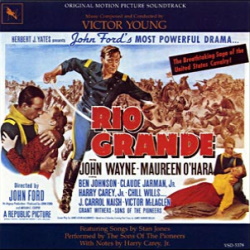
Director John Ford’s plan for his next project was “The Quiet Man”, a story set in Ireland. However, to secure the services of John Wayne and Maureen O’Hara from Republic Pictures he had to agree to CEO Herbert Yates insistence that he shoot the final installment of his now famous Cavalry Trilogy – “Fort Apache” (1948), “She Wore A Yellow Ribbon” (1949), and “Rio Grande” (1950). Ford grudgingly agreed and his Argosy Pictures and Republic Pictures would manage production with a $1.2 million budget, he would direct, and James Kevin McGuiness would adapt a Saturday Evening Post story “Mission With No Record” (1947) by James Warner Bellah to write the screenplay. His cast would consist of John Wayne as Lieutenant Colonel Kirby York, Maureen O’Hara as Kathleen Yorke, Claude Jarman Jr. as Trooper Jefferson Yorke, Ben Johnson as Trooper Tyree, and Harry Carey Jr. as Trooper Sandy Boone.
The film follows to fortunes of Lieutenant Colonel Kirby Yorke who commands the 2nd Cavalry Regiment, which is assigned to border security with Mexico and defending against Apache Indian attacks. His son is assigned to his command, followed by the return of his estranged wife Kathleen who demands that their son Jefferson resign from the army and return with her. Against this backdrop follow battles with the Apache in which Kirby is ordered by General Sheridan to pursue the Apache into Mexico and destroy them once and for all. He succeeds in his mission, and is reunited in love with Kathleen and their son Jefferson. The film was a huge commercial success earning a $1.04 million profit.. Critical reception was favorable but the film failed to receive any Academy Award nominations.
 Director John Ford’s usual composer Richard Hageman was not available and so he brought in Victor Young. Ford decided that he wanted a different type of soundscape than the first two films of the Cavalry Trilogy. Instead of using military marches to empower the drama, he instead directed Young to infuse a number of folk songs into the tapestry of his score so as to provide a more intimate sensibility. To that end the Sons of the Pioneers were hired not only to sing the songs, but to appear as characters while doing so in the film. The songs by Stan Jones included; “My Gal Is Purple”, “Footsore Cavalry”, “Yellow Stripes”, “Aha, San Antone”, with other traditional songs joining, including, “Low Bridge” (Fifteen Miles On the Erie Canal) by Thomas S. Allen, “Down By the Glenside” by Peadar Kearney, “Cattle Call” by Tex Owens, “I’ll Take You Home Again Kathleen” by Thomas Payne Westendorf, “The Girl I Left Behind Me”, “Dixie” by Daniel Decatur Emmett, and several forms of bugling Reveille.
For the score itself, provided five primary themes, gracing us with his trademark eloquence and melodicism. I believe that the Rio Grande or Main Theme offers one of the finest in the Western genre, and in Young’s canon. It has a wistful quality and is empowered by a rousing prelude of trumpeting fanfare, unfolding as a four phrase, long-lined theme borne sumptuously on warm strings nobile. It perfectly established the romanticism of America’s westward expansion to achieve its Manifest Destiny. The Kirby and Kathleen Love Theme offers a string borne romanza with an ABA construct. Young imbues its beautiful and tender A Phrase with a dance-like lyricism, while its B Phrase offers yearning. Yet we also discern in the notes a tinge of sadness, and regret as our lovers are estranged for fifteen years. Kathleen’s Theme uses the melody of the traditional Irish song ““I’ll Take You Home Again Kathleen”. Which speaks of a husband comforting his distressed homesick wife. The choice offers a perfect fit as she bears within her heart sadness. She misses the plantation life of her Virginia Shenandoah Bridesdale estate, and her family, as now both husband and son have abandoned her for army life.
The Indians have two identities juxtaposed to the western identities of the white settles. The first, a collective theme, offers a pentatonic sensibility, which embraces nativist drums of war and horns bellicoso, which empower a strident and defiant musical narrative. When rendered as an anthem of war, its ferocity is formidable. Their culture is expressed with chanting in their native tongue, joined by ceremonial drums and dance story-telling. The lush string borne Mexican Theme offers a sumptuous and embellished rendering of the “La Cucaracha” song melody. Draped with Spanish auras, it clearly establishes Mexican cultural sensibilities, and their sovereignty on the opposing riverbank. The film received criticism for being too studio-bound, and for having too many songs. However, Harry Carey Jr. (Trooper Daniel Boone) defended the inclusion of songs as authentic, since cavalrymen did sing on a regular basis.
Cues coded (*) contain music not included on the album. “Main Title” offers a wonderful lyrical score highlight, in which Young, again with exemplary style, perfect sets the tone of the film. It opens with ascending fanfare dramatico, which support the Republic Pictures logo. At 0:11 the opening credits commence empowered by field drums militare with trumpeting fanfare joining to support the display of the film title. At 0:34 Young introduces his wistful Main Theme borne warmly and forthrightly by strings nobile. The extended rendering offers one of the score’s finest moments, as we see a convergence of cavalry brigades at the Rio Grande River. (*) “Reveille” reveals a bugler sounding the military call against the magnificent background of Monument Valley. We flow seamlessly into “Return From Patrol” where a dramatic musical narrative propelled by horns militare carries a cavalry regiment riding into the fort. At 0:14 playful strings felice and bubbling woodwinds of delight carry children running out of the fort school to greet their returning daddies. At 0:24 we see Lieutenant Colonel Kirby York leading his men into Fort Stark carried solemnly by the Main Theme as women watch to see if their man returned alive. We conclude sadly, with reverence as liters bearing the wounded arrive. A bugle call supporting Sergeant Quincannon shouting “Sick Call” is omitted from the album.
In an unscored scene York commends his soldiers and Indian scouts for a job well done, offering beer to all, after they feed and water their horses. Bugling supports York’s arrival at his command tent where Lieutenant General Philip Sheridan awaits . He debriefs, informing Sheridan of a thirty-mile skirmish with the Apache with him halting pursuit at the Rio Grande River as ordered. Both men criticize the State Department policy, but understand that as soldiers the carry out policy, not make it. Sheridan then informs York that his son, who he has not seen in fifteen years flunked mathematics and was discharged from West Point. (*) “We’re In The Army Now” opens with reveille as men march singing the traditional army song.
(*) “Roll Call” reveals Sergeant Quincannon calling off roll call for the fort’s new cadet arrivals. Inside his office, York gets up and departs the meeting when he hears the name York called. Plaintive strings of disappointment carry him out where he sees his son as one of the new eighteen cadets. He lays down the law, his tough expectations, and then dismisses the cadets. Later trooper York reports to Colonel York’s command tent. Kirby again lays down the law, his more stringent personal expectations for his son, advising him that he will receive no special treatment. Jefferson affirms his understanding, and counters that he expects that he be treated no different than the others. As they salute, warm horns emote the Main Theme, which offers paternal pride that carries Jefferson’s departure. “Soldiers Fight” reveals troopers Heinz and York fist fighting, which is broken up by Quincannon. Heinz confirms he believes York is getting special treatment and is the ‘Mick’ sergeant’s pet. Quincannon orders preparation tonight at 9:00 for a proper soldier fight. Later, the two men fist fight within a circle of soldiers. Dire music ushers in a grim and foreboding musical narrative, which supports the arrival of Colonel York. Heinz, Quincannon and York all refuse his order to explain the reason for the soldier fight. The Colonel departs and at 0:56 the music warms as trooper York apologizes to Heinz and the two men shake hands. At 1:14 a piccolo lead Irish jig, punctuated with jabs at 1:31, supports Quincannon giving Heinz a punch for calling him a “Chowder-headed Mick”. We close with a celebratory reprise of the jig.
The next day in (*) “Kathleen York Arrives” bugling reveille wakes up the fort joined by a forthright rendering of the Main Theme, as a wagon train arrives at the fort. Captain Prescott advises the lady passenger that unauthorized women are not permitted, to which she replies, “I am not unauthorized, I am trooper Jefferson York’s mother”. As she gets off Colonel York arrives, their eyes lock and Young graces us with their Love Theme borne tenderly by strings d’amore. He welcomes her, orders her luggage brought to his quarters, and the Love Theme plays softly underneath the dialogue as they stroll together. She advises that she has brought $100 to terminate Jeff’s enlistment and take him home, and Kirby advises that it would also require his signature. After he compliments her figure, she agrees to dine with him as he departs. Reveille sounds as she explores the bedroom area of the tent. While unpacking, she opens her music box, which plays the Irish traditional song “I’ll Take You Home Again, Kathleen”, which serves as her theme during the film.
“Yellow Stripes” reveals Kirby and Kathleen finishing dinner as reveille sounds. Afterwards men’s chorus accompanied by two guitars, serenade them by singing the traditional army song. “I’ll Take You Home Again, Kathleen” Sergeant Donnelly leads the chorus in singing the traditional Irish song, which speaks to a husband lovingly comforting his homesick wife, while playing his guitar. “Dispossessed”, afterwards in the privacy of his tent, the song melody plays tenderly and wistfully as we see that it has stirred feelings often felt during their fifteen-year estrangement. At 0:35 and a solo violin triste carries his departure. In “Cattle Call” Sergeant Quincannon pays a visit to Kathleen and escorts her to her son Jeff as Kirby prepares to turn-in in a covered wagon. Tex Owens supports by singing the traditional cowboy song. (*) “Indian Chanting” reveals Indian prisoners chanting and dancing at nightfall in their native tongue. We shift to a trooper tent where Jeff joins in singing the traditional song “Aha, San Antone”, sung by Dale Evans.
“Reunion” reveals Quincannon arranging the reunion of mother and son. As she enters the tent, the three other troopers depart. Warm celli bearing maternal love open and usher in violins emoting her theme. She is thankful, happy to see him, and kisses him. He then asks what kind of man his father is, and she says, lonely. When she says she has come to take him home, he says he refuses to be a quitter and adds that he will refuse to sign the papers. The song melody, while tender, is tinged with sadness as we see in her eyes the fear that the army will take her son away as it did her husband. “Indian Raid/Escape” offers a tour de force score highlight, which supports a surprise Indian night raid. It reveals a growing unease as Quincannon and three troopers hear disconcerting dog barks and coyote howls. Young sow unease with shimmering ethereal auras, joined with trilling woodwinds, and harp glissandi. The musical narrative slowly darkens as Quincannon departs to check the fort’s status. The Indian prisoners resume their chanting, and Quincannon finds a guard killed by an arrow. At 0:36 dire three-note declaration of the Indian fanfare empower a surprise night raid as their war party charges the encampment propelled by their forceful four-note war anthem. The bugler declares “Call to Arms” (not on the album), and the regiment takes up arms and begins to fire back. The Indians free their compatriots, and set a number of fires as they flee the fort. In the tumult, the army horses panic, break out of the stockade, and stampede. At 2:58 Young unleashes a ferocious torrent with the Indian Anthem ascendent as Colonel Kirby orders a counterattack. At 3:13 a distressed Kathleen’s Theme carries her being escorted to a safer location, followed by a collapse motif as she faints after an Indian is killed in front of her. At 4:14 the music darkens as Colonel York races to find Kathleen. When he finds her safe at 4:22, her theme joined by a fleeting quote of “I Dream of Jeanie with the Light Brown Hair” voices his thankfulness. He orders Jeff to take his mother back to his command tent. We close with a grim musical narrative as Colonel York rides off to assess the damage to his command.
During a damage assessment, Colonel York becomes concerned that a formidable coalition has formed when bodies of three Indian tribes are revealed; Cherhawkowee, Mescalero, and White Mountain. York orders two brigades to leave at once so as to try to intercept the Indians before they escape across the Rio Grande River The bugler declares the “Call to Arms” as the cavalrymen mount their horse. Kirby says goodbye to Kathleen, who is clearly worried about his safety, and takes his uniforms to launder. He mounts his horse, orders columns of two, and departs without musical support. I believe musical support with a cavalry march would have enhanced the scene. “Erie Canal” reveals Colonel Yorke leading his column across the vast expanse of Monument Valley. He calls for a tune, and men’s chorus begin singing the traditional folk song.
“Laundresses’ Row” reveals Kathleen washing clothes on the river bank with the other women supported by a parade of classical Irish song melodies. “Yellow Stripes Reprise” reveals Colonel Yorke’s column walking their horses, with him calling for another tune. Men’s chorus reprise the traditional song sung at a strolling pace to carry their progress. “Meeting At The Rio Grande” reveals his column approaching the great river with Young offering Mexican auras with a sumptuous and embellished rendering of the “La Cucaracha” song melody. He halts his column and proceeds to the river bank with the bugler and Captain St. Jacques whose binoculars reveal the approach of Mexican officers. The song melody shifts to a maestoso sensibility buttressed by trumpets. York orders the horses watered and for the bugler to declare honors with three flourishes for the Mexican delegation. The Mexican bugler returns the honor as the two delegations arrive at mid river to parley. After a friendly and cordial meeting, York orders his surgeon to tend to the Lieutenant’s wounded men. The Lieutenant is gracious and York makes him an offer; to jointly hunt down the Indians. He will place his men under the Lieutenant’s command if he allows, he and his men to cross into Mexico. The Lieutenant declines, citing his standing orders and York compliments him on his fidelity to duty and departs. Mexican auras carry the departure of both delegations to their respective river banks.
That night, as troopers sit around a camp fire, one of them, with guitar accompaniment, and men’s chorus, sings the traditional folk song “My Gal Is Purple”.The song is full of longing, with a man yearning to return to the woman he loves. After the opening bars, the camera shifts to Colonel York walking along the river bank, clearly moved by the song. (*) “Love Reborn?” reveals a weary Kirby returning to the fort and his command tent. Strings full of longing support him lighting the gas lamp whose light reveals Kathleen. He impulsively takes her into a kissing embrace empowered by strings appassionato. Yet, he pulls back, apologizes, and says he will escort her back to her tent. As they walk, she discusses the destruction of Bridesdale (Her family manor burned by Kirby and Quincannon during the Civil War), and their marriage. Again, Kirby cites duty, yet she persists saying that if he releases Jeff to her, she will resume her place as his wife. Although tempted, he asserts he must support Jeff’s decision to stay, and they part ways, their differences irreconcilable. Young scores the scene softly under the dialogue as a lamentation.
Bugling supports the ride of General Sheridan into the fort, and his request that Kirby join him for coffee. The next evening, they, their officers, and Kathleen formally dine in the command tent. Kathleen offers a toast to the US Cavalry – “her only rival”. Both she and Kirby empty their glasses and lock eyes. Quincannon arrives and announces a regimental serenade, which begins with the Irish ballad, “Down by the Glenside”. The song choice, while appropriate for the scene, offers an incongruity in that it was written in 1916, or thirty-six years after the movie’s setting in 1880. It is sung with a tenor lead, men’s choral support, and guitar accompaniment. The general is thankful, and allows the fort store to serve beer until midnight. The men are happy and march off singing the traditional army song “Footsore Cavalry”.
In the film the singing fades as they march further away. (*) “Tyree Escapes” reveals that trooper Tyree waiting to be remanded to the U.S. Marshall to stand trial for manslaughter in Texas. While the Marshall is presenting Colonel York with paperwork to sign, Quincannon lets Tyree slip out and Young sow tension as he goes to the stable, steals York’s horse, and escapes. Later, General Sheridan issues York orders with grave consequences – he is to proceed in violation of State Department policy, to cross the Rio Grande River, violate Mexican sovereignty, and slaughter the Indians once and for all. “Confederate Dollars and Yankee Gold” reveals Kathleen ironing as Kirby shows up in his dress uniform with a bouquet of flowers. He tells her that Jeff will accompany her to Fort Bliss while he wages a protracted winter campaign. She says he will hate you for it, but that she will love you for it. A soft and tender rendering of her theme supports as she retrieves his clean and ironed uniform. She says that will cost you four bits, and he hands her a Confederate $10 bill. At 0:35 a fleeting moment of tension joins as she empties a bag of gold coins. However, her theme resumes as she asks for her flowers, receives them, and then asks if he is going to kiss her goodbye. He takes her into his arms, says he never wants to kiss her good bye, and as they kiss, her theme blossoms, their love, renewed. “Departure For Fort Bliss” reveals the departure of four wagons with the women and children to Fort Bliss accompanied by cavalry escort. Young empowers their departure with a vibrant rendering of “The Girl I Left Behind” song melody, rendered as a marcia orgogliosa.
“Tyree Meets Wagon Train” offers a magnificent score highlight with a majestic and expansive exposition of the Main Theme buttressed with horns gloriose. It reveals Tyree on a hill gazing at the approaching wagon train. He travels down and hides behind a great boulder, and confirms that the Texas Marshall is not travelling with them. He comes out of hiding and is warmly greeted by Jeff and fellow troopers. At 1:35 the music darkens and becomes foreboding with quotes of the Indian Theme as Tyree advises the muddied water hole up road suggest a large Indian war party. They give Tyree a can of beans and at 1:55 ride off empowered by a buoyant and spritely Main Theme. At 2:12 we segue into “Indian Attack”, a score tour de force highlight, atop a menacing Indian Theme, which supports them preparing to ambush with rifles from an overlooking hill. At 2:16 string furioso unleash a maelstrom of violence as they open fire and the wagon train flees. The Indian anthem is ascendent with the soldiers’ suffering casualties. When one of the wagons loses a wheel, they are forced to stop, turn over the wagons, and make a stand as the women and children are unloaded and moved to safety. Strings furioso swirl with the Indian Anthem still dominating, against repeated surges by the Main Theme as the tide of battle begins shifting as soldiers begin withering return fire behind the safety of their wagons. At 3:20 an aggrieved Kathleen’s Theme voices her concern a Jeff is dispatched to alert his father of the ambush. Propelled by the Main Theme Jeff rides with Indians in pursuit, empowered by their theme. Tyree joins him, takes his pistol and engages the three pursuing Indians so Jeff can escape. At 3:46 descending declarations of the Indian Theme, which dissipate mark Tyree killing each of them, his triumph crowned at 4:02 by horns trionfonti. The music for the remainder of the cue, from 4:12 – 6:34 must be attached to a deleted scene or was dialed out of the film. It reprises the exciting battle music with contesting Main and Indian Themes, and embedded respites of Kathleen’s Theme.
(*) “Colonel York Arrives” reveals his arrival with the regiment, much to the relief of the survivors. They advise him of four casualties, and the loss of the wagon containing the kids. He vows to rescue the kids and departs carried by a sad musical narrative with a quote of Kathleen’s Theme as she watches his departure. With nightfall descending they find a burnt-out wagon that carried the kids. They remain missing, but they discover the burnt body of Corporal Bell’s wife. York restrains him and they depart with Young sowing a tense and foreboding musical narrative. “Call Your Volunteers” reveals Tyree’s arrival with York placing him under arrest. When he debriefs him regarding the captured children’s location, York offers him a rescue mission to redeem himself, which Tyree accepts. He picks his team; Sandy, and Jeff. Music enters grimly as Kirby realizes he may lose his son, and forever earn Kathleen’s hatred. However, he does his duty, not permitting himself to show favoritism, wishes the team success, and dispatches them. We see a father’s love in York’s eyes and Young’s music warmly expresses his paternal love, saying everything that must be said. (*) “Indians Celebrate” reveal them chanting, beating wood drums, dancing, and drinking Tequila in preparation of the children’s death ceremony in the morning.
“Nighttime Approach” reveals York leading his men on a nighttime stealth approach through the river, an approach expressed by the Main Theme. At 0:33 a fleeting quote of the Mexican Motif supports the crossing of the Rio Grande River into Mexico. Young sow unease and tension with a repeating four-note motif as Tyree’s team surveys the mission church holding the children. The Indians celebrate in front, while York orders his men to dismount and approach on foot while walking their horses. At 1:31 strings emote trepidation as Tyree’s team secures the church and prepares to signal York. The church bell is rung and we segue at 1:58 into “Rescuing The Children” on a dire Indian Theme as they charge the chapel front door. The three men are successful killing many Indians by shooting through a cross cutout in the wooden door. York orders the bugler to declare ‘Charge!’ (not on the album) and Young unleashes a ferocious torrent of attack as they charge and sweep through the mission. Wagons arrive to provide cover, while the Indian horses are stampeded out of the corral. At 3:39 the Indians have regrouped and their theme surges to life as a fierce gun battle ensues while the children are evacuated. At 4:18 religious solemnity supports Quincannon and a girl genuflecting as the exit the chapel. The battle of Indian and Main Themes resurges ferociously until 5:10, when a diminuendo descent of pain supports York being felled by an arrow to his right chest. His men encircle to protect him and with Jeff at his side. The last part of the cue from 6:06 – 6:52 was apparently dialed out the film. It offered a reprise of the warm and loving father-son narrative heard in the cue “Call Your Volunteers”, intended to support Kirby ordering Jeff to pull out he arrow and then help him to his horse.
Colonel York orders the bugler to declare ‘Recall’, and they set off to return to the fort. We flow into “Coming Home”, which reveals Kathleen watching the return of the regiment to the fort. She is fearful when Kirby is not seen leading the column, and Jeff is nowhere to be seen. She races to the rear of the column where she discovers, to her great relief, Jeff, who then points to a liter carrying the wounded Kirby. Young supports the scene, from Kathleen’s perspective with a warm, and thankful extended exposition of her theme, which achieves a very moving cinematic confluence. We open with a bugling call for assembly (not on the album). “Dixie” reveals a ceremony with the regiment assembled, where Corporal Bell, Trooper Boone, Trooper York, Trooper Tyree, Navaho Indian Scout Son of Many Mules, are commended for their gallantry and action beyond the call of duty. When the Marshall shows up to arrest Tyree, Colonel York grants him a seven-day furlough, and the young man runs off, commandeers the General’s horse and rides off with a gracious sweep of his hat. As the Captain orders a procession parade in front of the stage, the band, at General Sheridan’s command, plays the proud Confederate anthem “Dixie”, in honor of Kathleen. The anthem concludes the film and ends in a horn flourish as “the End” displays.
In my judgment Robert Townson should be commended for the reissue of Victor Young’s wonderful score to “Rio Grande”. The audio quality of this reissue using the 50-year-old source tapes is excellent, and provides a wonderful listening experience. Ford sought a different musical approach to the final film of his Cavalry Trilogy, insisting on a more intimate approach to support his storytelling. The use of the Sons of the Pioneers was a masterstroke, which perfectly met this expectation. Their folksy songs and ballads brought the characters to life and grounded the film in classic Americana. Young’s score wove together these song vignettes with a sumptuous romantic score, which offered some of the most beautiful and eloquent in the genre. His sumptuous Rio Grande Theme is stunning in its beauty, warmth and empowerment of Americana, with its exposition in track “Tyree Meets Wagon Train” a masterpiece of the genre. What is also praiseworthy is that the score offers a number of tour de force battle scenes, where Young provided what I believe may be the most dynamic, intense, and kinetic action music of his career with the Indian and Cavalry musical identities matching the ferocity unfolding on the screen. While I enjoyed and appreciated Hageman’s use in the first two films of traditional songs rendered as marches to support the cavalry, I understand Ford’s change of approach and believe traditional ballads supported his vision. Folks, I highly recommend this album for your collection, a gem of cinematic Americana, that provides some of Victor Young’s finest compositions.
For those of you unfamiliar with the score, I have embedded a YouTube link to the Main or Rio Grande Theme: https://www.youtube.com/watch?v=Da14Q4XVyZ8
Buy the Rio Grande soundtrack from the Movie Music UK Store
Track Listing:
- Main Title (2:17)
- Return From Patrol (1:52)
- Soldiers Fight (1:45)
- I’ll Take You Home Again, Kathleen (traditional, performed by The Sons of Pioneers feat. Ken Curtis) (2:34)
- Dispossessed (0:54)
- Cattle Call (written by Tex Owens, performed by The Sons of Pioneers) (1:10)
- Aha, San Antone (written by Dale Evans, performed by Ben Johnson, Harry Carey, Jr. and Claude Jarman, Jr.) (0:44)
- Reunion (2:33)
- Indian Raid/Escape (5:03)
- Erie Canal (traditional, performed by The Sons of Pioneers) (0:30)
- Laundresses’ Row (0:56)
- Yellow Stripes (written by Stan Jones, performed by The Sons of Pioneers) (0:53)
- My Gal Is Purple (written by Stan Jones. performed by The Sons of Pioneers) (1:31)
- Down By The Glen Side (traditional, performed by The Sons of Pioneers feat. Ken Curtis) (2:06)
- Footsore Cavalry (written by Stan Jones, performed by The Sons of Pioneers) (0:47)
- Meeting At The Rio Grande (1:18)
- Confederate Dollars And Yankee Gold (1:44)
- Departure For Fort Bliss (The Girl I Left Behind) (0:53)
- Tyree Meets Wagon Train/Indian Attack (6:33)
- Call Your Volunteers (0:42)
- Nighttime Approach/Rescuing The Children (6:52)
- Coming Home (1:33)
- Dixie (End Title) (1:03)
Varèse Sarabande VSD-5388 (1950/1993)
Running Time: 46 minutes 13 seconds
Music composed and conducted by Victor Young. Orchestrations by Sidney Cutner and Leo Shuken. Recorded and mixed by XXXX. Score produced by Victor Young. Album produced by Robert Townson.

Shop at the Movie Music UK Store

Member of the

 MOVIE MUSIC UK