SPEED – Mark Mancina
 THROWBACK THIRTY
Original Review by Jonathan Broxton
Pop quiz, hotshot. There’s a bomb on a bus. What do you do? What do you do?
One of the landmark action movies of the 1990s, and one of my favorite action movies of all time, Speed is a hyper-kinetic thrill ride film directed by Jan de Bont, starring Keanu Reeves, Sandra Bullock, and Dennis Hopper. Reeves plays Jack Traven, a young and resourceful LAPD SWAT officer, who thwarts a bomb threat in an elevator orchestrated by the vengeful ex-bomb squad member Howard Payne (Hopper). Infuriated by Jack’s interference, Payne then rigs a city bus with a bomb that will detonate if the bus drops below 50 miles per hour. Jack boards the bus and teams up with Annie Porter (Bullock), a passenger who takes over driving after the normal bus driver is injured; together, Jack and Annie must work together to keep the speed above the critical limit by any means possible, while figuring out a way to save the passengers and thwart Payne’s plans.
The film was the directorial debut of de Bont, a seasoned cinematographer from the Netherlands who previously worked on high-profile projects like Die Hard and Lethal Weapon 3. Reeves’s performance as Traven was his second significant role that summer – whereas Little Budda showed his more serious and thoughtful side, Speed helped to establish him as a credible action star – and it was also the breakout role for Sandra Bullock, who in the wake of Speed moved from supporting roles in films like Demolition Man to true lead material. The film overall also set a new standard for action movies in the 1990s, emphasizing practical stunts, real locations, and a constant sense of urgency. Its success demonstrated that high-concept action films with a simple yet compelling premise could resonate with audiences, although it did unfortunately inspire a series of knockoffs marketed as “Speed on…” various other types of vehicle. The film was a critical and commercial success too, grossing over $350 million worldwide on a budget of around $30 million, and winning two Academy Awards for Best Sound Editing and Best Sound.
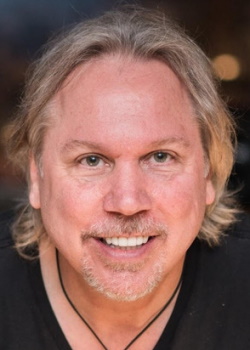 Speed was the breakout score for composer Mark Mancina. Trained as a classical guitarist and pianist, Mancina originally rose to prominence in the rock music world; he released his own solo album, “Dancing on the Borderline,” in 1983, and then went on to work with Trevor Rabin and Yes on their album “Union” in 1991, and with Emerson Lake & Palmer in 1992, co-producing the album “Black Moon”. Mancina had actually been dabbling in film music since the late 1980s, working with composer and songwriter Steven McClintock on a series of ultra-low budget action movies, before becoming associated with Hans Zimmer’s fledgling Media Ventures organization in the early 1990s. He wrote additional music for Zimmer scores like Days of Thunder and True Romance, before being given his chance on Speed. The fact that de Bont chose Mancina over the protests of the studio heads is testament to how much faith was placed in him.
In many ways, Speed is one of the prototypical scores that would help define what eventually became the ‘Media Ventures Sound’ over the course of the rest of the 1990s. Speed, alongside Zimmer efforts like Black Rain, Days of Thunder, Backdraft, and Point of No Return, was pivotal in establishing the iconic blend between orchestral and synthetic instruments, prominent keyboards, and elements from pop music and prog rock, that would come to dominate Hollywood action movies for years afterwards – and, some might argue, still does. As such, Speed is a very important score in film music history.
Musically, Mancina’s score is effective and exciting, and features a rousing central power anthem, but sometimes the underscore is a tiny bit underdeveloped, and perhaps a little on the unsophisticated side, highlighting Mancina’s relative inexperience in mainstream film music at the time. Mancina’s basic remit was to provide the film with tension, release, and relentless energy; to make the initial sequence inside an elevator nerve shredding, and to support the subsequent breakneck high speed demolition derby through LA’s city streets, relentlessly ploughing forward like a bus through a Fiat Punto. The music also provides some emotional catharsis in moments of respite, as well as offering hints of the tentative romance that develops between Jack and Annie, despite the fraught nature of their meet-cute.
The “Main Title” is one of the standout cues, a rousing anthem for strings and horns bouncing around on top of an unusual staccato syncopated synth pulse, and with a smoother and more elegant lyrical bridge tying the two parts of the theme together. Aspects of this memorable main theme are prominent throughout much of the score; there are several a heroic reprises of the main melody at key moments, notably in “The Rescue,” “Entering Airport,” “Rush Hour,” “The Gap,” “Choppers,” and especially the “End Title” where it is performed with a satisfying symphonic sweep. Sometimes Mancina bolsters the theme with a subtle electric guitar idea to ramp up the feeling of swaggering cool, and in those moments the score really shines. Not only that, “The Gap” is one of the few cues led by the bridge section of the main theme, which makes it a standout for a different reason.
Equally important to the score is the six-note synth pulse, which appears in virtually every major cue, underpinning the action and tying the score together. All the score’s main action set pieces – “The Rescue” (which is actually the climax of the bus sequence on the tarmac at LAX), “Rush Hour,” the superb “The Gap,” “City Streets,” the kinetic “The Dolly” – feature it prominently, surrounded by banks of relentless complicated percussion patterns, swirling string figures, and sometimes purposefully synthetic ‘throwback’ electronic sounds which recall some of the great 1980s action scores written by Brad Fiedel, Harold Faltermeyer, and others.
However, I will say that at times some of this action music has an unfocused, jumbled, haphazard feel, almost as though Mancina was never quite in full control of what he wanted his music to be doing, and let it all go off the rails. The layers of electronics churn and bubble away in a way that comes close to being chaotic, and there are moments where you feel as though you want someone to step in and just calm things down a little.
One other thing worth mentioning is the fact that Dennis Hopper’s villain character Payne is somewhat under-served by the score; he does have a theme of sorts, a set of clustered dissonant electronic textures that sort of moan and groan, but never coalesce into an actual identifiable motif. You can hear these textures bookending the “Main Title,” and then later throughout cues like “Pershing Square” the agitated-sounding “Fight On Train,” “Move,” and the eerie and unnerving “Pop Quiz”.
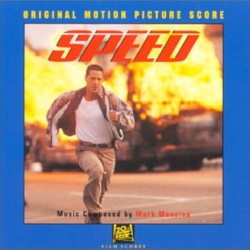
The original album for Speed was a crisp 40-minute presentation of all the film’s important cues, although I do want to point out that it is presented in a bizarre non-chronological order which places one of the climactic action cues (“The Rescue”) second, and the first cue after the main title (“Elevator Stall”) last before the end titles, among many other such weird sequencing ideas. I am not a stickler for the strict chronological presentation of cues, but I do like my albums to at least have some sense of narrative and dramatic development, and the original Speed CD doesn’t do that at all, which is to its detriment .
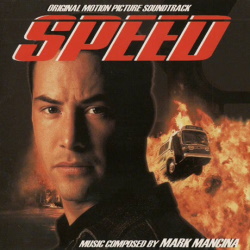 In 2012 La-La Land Records and producers Nick Redman and Mike Matessino released a remastered and expanded 3,000-unit limited edition of Speed which presented its tracks in film order, included for the first time the end titles song “Speed” performed by Billy Idol, and featured in-depth liner notes by film music writer John Takis. Die hard fans of the movie, or of early Media Ventures scores, will probably find plenty to enjoy, but I actually found the 70-minute presentation of the score a chore, with a great deal of the middle section of the album given over to redundant repetition of the same ideas, alongside longer passages of some of the score’s most abrasive Payne electronica.
I like the score for Speed, and enjoy listening to it a great deal, but my affection for the score may be clouded by my nostalgic love of the film itself, which as I said is one of my favorite action movies of all time. Truthfully, despite its many moments of satisfyingly macho musical heroism, large parts of Speed do feel somewhat raw and underdeveloped, and this combined with the fact that it is so heavily steeped in the still-divisive early-1990s Hans Zimmer Media Ventures sound means that it will not appeal to everyone. Having said that, for me, it’s still a worthwhile purchase to hear the genesis of the sound that Mancina would later go on to hone in scores like Con Air, Twister, and the musically superior 1997 sequel Speed 2: Cruise Control, and for its importance in the chronological development of music of the 1990s action genre.
Buy the Speed soundtrack from the Movie Music UK Store
Track Listing:
- ORIGINAL RELEASE
- Main Title (3:37)
- The Rescue (4:01)
- Entering Airport (1:00)
- Rush Hour (6:04)
- Helen Dies (2:19)
- The Gap (2:49)
- Choppers (1:00)
- Pershing Square (3:18)
- Elevator Peril (0:28)
- Fight On Train (1:19)
- Dangling Feet (0:34)
- City Streets (1:41)
- Wildcat (1:04)
- The Dolly (1:28)
- Move (2:05)
- Pop Quiz (2:23)
- Freight Elevator (2:29)
- Elevator Stall (1:50)
- End Title (1:49)
- EXPANDED RELEASE
- Main Title (4:03)
- Elevator Stall (0:57)
- Elevator Peril (0:29)
- Move! (2:10)
- Pop Quiz (3:37)
- Dangling Feet (0:39)
- Freight Elevator (2:32)
- Payne Explodes (2:41)
- Payne Watches Awards/Payne Calls Jack (2:36)
- Jack Driving Jeep/Bus Enters Freeway (0:23)
- Rush Hour (6:08)
- Jack Jumps Onto Bus (1:35)
- Choppers (1:04)
- Bomb Reveal/Payne Watching Football (0:34)
- City Streets (2:23)
- We Have Trust (0:53)
- Helen Dies (2:36)
- The Gap (2:52)
- Entering Airport (1:05)
- Payne Excited (1:53)
- Jack Leaves Bus/Jack On Dolly/Payne’s Picture (2:03)
- The Dolly (1:31)
- Jack Under Bus/Harry Searches House/Harry Didn’t Make It (3:47)
- Wildcat (1:07)
- Payne Twisted (0:42)
- The Rescue (4:07)
- Pershing Square (3:23)
- Annie’s Loaded/Getting On Train (2:06)
- Fight On Train (1:24)
- Runaway Train (1:45)
- End Title (1:53)
- Speed (written by William Broad and Steve Stevens, performed by Billy Idol) (4:27)
Fox/Arista Records 07822-11020-2 (1994) – Original
La-La Land Records LLLCD 1200 (1994/2012) – Expanded
Running Time: 41 minutes 18 seconds – Original
Running Time: 69 minutes 25 seconds – Expanded
Music composed by Mark Mancina. Conducted by Don Harper. Orchestrations by Don Harper, Bruce Fowler, Ladd McIntosh and Yvonne S. Moriarty. Additional music by John Van Tongeren. Recorded and mixed by Alan Meyerson and Jay Rifkin. Edited by XXXX. Score produced by Mark Mancina. Expanded album produced by Nick Redman, Mike Matessino, MV Gerhard and Matt Verboys.

Shop at the Movie Music UK Store

Member of the

 MOVIE MUSIC UK