BEYOND THE FOREST – Max Steiner
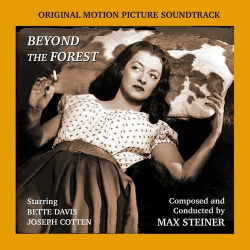 GREATEST SCORES OF THE TWENTIETH CENTURY
Original Review by Craig Lysy
Warner Brothers Pictures purchased the film rights to the 1948 novel Beyond The Forest by Stuart D. Engstrand believing the film noir tale would translate well to the big screen. Studio star Bette Davis was assigned the role of Rosa Moline, much to her displeasure. She continuously fought against the director throughout shooting and halfway through filming threatened studio executive Jack L. Warner to walk out unless he agreed to void her contract after the film was completed. For Warner, this was a deal he was happy to make, thus ending her eighteen-year contract. Henry Blanke was assigned production with a $1.589 million budget, King Vidor would direct, and Lenore Coffee was tasked with writing the screenplay. Bette Davis would star as Rosa Moline, joined by Joseph Cotton as Doctor Lewis Moline, Davide Brian as Neil Latimer, and Minor Watson as Moose.
Rosa Moline is a middle-aged woman who feels restless and trapped in an unfulfilling marriage to small town doctor Lewis Moline. She desires to leave rural Wisconsin for a glamorous life in the big city where she can live as a rich and pampered socialite. To achieve these aspirations, Rosa embarks on a truly sordid journey of self-destruction, replete with deception, adultery, betrayal, treachery, and murder. Although Davis caused numerous delays and overruns during filming, the film was a commercial success, earning $1.5 million. However, critical reception was decidedly unfavorable, with some critics offering very harsh if not scathing reviews. Despite this, the film received one Academy Award nomination for Best Film Score.
Director King Vidor had worked with Max Steiner seventeen years earlier on “Bird of Paradise” in 1932. This film would be the first of three films from 1949 – 1951 on which the two men would again collaborate. Steiner was renown in Hollywood for his mastery of scoring women dramas, and this film was yet another of the many in which Bette Davis starred. Upon viewing the film, I believe Steiner understood that this was Davis’ story playing an unsympathetic, truly repulsive and irredeemable woman whose lust, greed and selfishness sowed the seeds of her personal destruction.
 For his soundscape, Steiner sets the tone of the film with idée fixe, a repeating two-note fortissimo declaration, which first ascends, but then with each repeated declaration, descends a half-step, portending Rosa’s descent into self-destruction. In terms of her personal theme, Steiner interpolates the first six-notes of a song she sings, “Chicago” (1922) by Fred Fisher; Chi–Cah-go, Chi-Cah-go. Steiner emotes this it with piano, celeste, harp and vibraphone, and it serves as the dream life she hopes to realize. Her lust for Neil permeates the film and these two themes slowly become more grotesque and frenzied as she seeks divorce from her husband and small-town Wisconsin for an opulent life in Chicago. The city of Chicago, however is musically juxtaposed to Rosa’s aspiration for a new and opulent life. Instead Steiner insightfully depicts it as a dark, unwelcoming and threatening domain at odds with her fantasy life’s conception. Lewis’ Theme speaks to his gentle, dutiful, and altruistic nature. The ten-note, string borne melody is borne by strings tenero, which offer both warmth, kindness, and serenity. Lastly Steiner interpolated a number of musical pieces, including the 18th Century Folk Song “For He’s a Jolly Good Fellow”, some jazz, and two wonderful waltzes.
The digital album lists eleven cues, Part 1 – 11. I will use scene descriptors and cue time indices to break down each part into its constituents. 0:00 Beyond The Forest, Part 1 “Main Title” reveals Steiner’s genius in grabbing the audience and setting the tone of the film’s narrative. It opens with the Warner Brothers Studio logo, supported by a dire declaration of the Fate Theme. We flow into the opening credits supported by an anguished and portentous musical narrative, empowered by additional quotes of the Fate Theme. 0:53 “Narrative Script” opens dramatically atop a resounding dire reprise of the Fate Theme, which fuels an anguished, torturous musical narrative of woe as narrative script appears;
“This is a story of evil. Evil is headstrong – is puffed up. For our souls, it is salutary for us to view it in all its naked ugliness once in a while. Thus may we know how those who deliver themselves over to it, end up like the scorpion, in a mad fury stinging themselves to external death.”
A diminuendo of unease takes us into the film proper at 1:44 with “Loyalton”, a score highlight where Steiner uses The Fate Theme, and Rosa’s Theme to empower a grim and foreboding musical narrative as narration sets the stage of the story. A narrator describes the town of Loyalton Wisconsin’s deserted main street, as the camera takes us to the life blood of the town, its saw mill, crowned with a fire topped chimney. We come to the office of Lewis Moline M.D., and then shift to the train station where Rosa eyes the train going to Chicago daily. Steiner weaves a foreboding musical narrative of unease, which become grim at 2:16 as he introduces Rosa’s personal theme, which interpolates the first six-notes of the song “Chicago” rendered instrumentally as Chi–Cah-go, Chi-Cah-go. At 2:43 strings tristi voice the Fate Theme as we see Rosa’s house, said to be the best in town. The camera follows the maid Jenny into town, joined by a dire declaration of the Fate Theme, which launches an agitato at 3:11 as we shift to a packed courthouse. At 3:23 Steiner weaves a misterioso embedded with the Fate Theme and dire chords as we see the faces of people waiting intently to discover the hidden ugly truth, long suspected of Rosa, who is on trial for murder as a jury is sworn in to determine the validity of the coroner’s report. The scene ends darkly as Rosa screams “I didn’t kill him! It was an accident!” At 4:11 a saxophone sardonica leads an ethereal passage, which ends in a misterioso as narration takes us in a flashback to five months earlier. We see Lewis and Moose are fly fishing in a stream as a bored Rosa looks on from the shore.
6:08 (*) “Journey to the Cabin” reveals Lewis and Moose paddling a canoe across a lake to Moose’s cabin, which Steiner supports with the idyllic gentility of Lewis’ Theme. Ashore, Rosa goes in to freshen up, but instead takes a fifth of whiskey and hides it on a shelf behind a glass container of coffee. She returns and lays on a rock as Lewis examines her feigned sprained ankle. As he moves in amorously to kiss, she deflect and hands him a note. He reads it and then declares that he has to return for a difficult delivery. He asks Moose to bring her back tomorrow since she cannot keep up with him due to her ankle. At 10:15 as Lewis departs in the canoe, he reminds Moose to stay sober as his gentile theme reprises. At 10:55 “Moose and Rosa”, we shift to a soft tango like melody as Moose asks if fried potatoes and trout are fine for dinner, and she answers yes, along with strong coffee. At 11:10 a crescendo of suspense supports his discovery of the whiskey, which culminates with a descent by woodwinds sardonica as he pauses, but then pours himself a shot. At 11:30 chirping woodwinds support Rosa being startled by an opossum climbing a tree. A weeping violin joins as she grabs a gun and shoots the animal. When Moose joins, she says she does not like pokies, and he replies, that she doesn’t like life. Later after dinner at 13:33, pathetic strings of regret join as we see the bottle almost empty. Rosa pours the last of it in his cup as he voices regret for some of the things he had done. He passes out and she lifts him from his chair with a kerplunk motif supporting his landing on his bed as she pushes him.
13:56 (*) “Rosa Goes to the Lodge” opens with ethereal harp and a violin tremolo as she goes to the key rack and pulls the lodge master key. A woodwind misterioso with pizzicato textures carries her run to the lodge with a dark piano chord punctuating her entry at 14:19. An optimistic rendering of the Fate Theme launches a spirited musical narrative of anticipation as Rosa turns on the lights, lights the fire place and sets up a whisky decanter. Overhead we see the arrival of a seaplane as she turns off the lights, lays a pillow on the floor next to the fireplace, and lights a cigarette. The dashing Neal walks in and she explains how she got rid of both Lewis with a fake note, and Moose with a planted bottle of whisky to setup this rendezvous. He is pleased with her seduction, takes her into his arms for a kissing embrace, and the scene fades to black. In unscored scenes Lewis delivers Mildred’s baby, and Rosa discloses to Neal that what she wants is him. When she says that she intends to marry him, however when he laughs, she slaps him, and after a pause, he takes her passionately into a kissing embrace.
21:51 (*) “Lewis Ministers to Mildred” reveals Lewis providing blood and penicillin as Mildred had a very difficult delivery. Steiner supports tenderly, channeling her husband’s love and Lewis’ altruism as Sorren could not afford to pay for the blood and penicillin. The tender, but sad musical narrative is sustained in 22:32 (*) “Lewis Returns Home”. He returns home to an apparently empty house, as he calls out to Rosa. His weary theme, now tinged with sadness supports. Rosa comes out of the bedroom nonchalantly with no apparent loving regard for him as she descends the stairs, ignores his concern about her ankle, and calls out with disgust – “What a dump”. He says he hasn’t eaten all day, but instead of cooking him a meal, Rosa directs him to leftovers in the ice box as she goes outside to the porch. He joins her, but she mocks his work, and voices contempt for her life here, which distresses him causing him to go upstairs to bed. The sound of Neal’s seaplane flying overhead stirs her lust as she gazes upwards.
27:22 Beyond The Forest, Part 2 opens with “The Train Station”, which reveals Rosa gazing longingly at the train departing to Chicago – the vehicle to escape her dreary life. As it departs, the cue opens with a plodding Fate Theme. At 0:28 a string bridge ushers in Rosa’s Chi – Ca – Go Theme as we see her eying a mink stole and luggage. She hears the depot steward telephoning a taxi, saying he has a woman going to the lodge. The woman tries to speak to her, but Rosa initially says nothing, her theme becoming bitter, and darkening with menace as the woman departs. As she gets into the car, she asks if she will be staying long, and she says yes, so I probably see you again. At 1:35 a woodwind borne Fate Theme supports Rosa’s indifference to Mildred’s newborn and the camera reveals her pulling out a letter from the post office box addressed to her, postmarked from Chicago. At 1:46 her theme rises with happiness as she opens the letter but descends into disappointment as she crumbles it, as it bears a solicitation letter for a charity donation. A Fate Theme variant carries her disappointment as she walks home. At 2:46 a crescendo irato swells as she becomes enraged that the house is dirty and Jenny does not answer her calls. They have words, Rosa fires Jenny, but then relents when she is told that the house is not yet cleaned, there are dirty dishes in the sink, and Mr. Moline’s dirty laundry awaits. At 2:55 a weary Fate Theme carries her to the porch where she sees the sawdust flames and smoke being vented from the mill chimney and says if she does not get out of this place, I hope I die. As she frets and lays down on the porch couch the music becomes torturous, grotesquely dissonant, and filled with despair. At 3:56 the music softens and ends on a harp diminuendo misterioso as we see Lewis arrive home at dusk with Moose and a young woman. He introduces Rosa to Carol, Moose’s daughter her – the lady she saw at the train depot. She is surprised, and they accept Lewis’ invitation to stay and have dinner.
In 35:36 (*) “Rosa and Jenny” reveals Rosa after dinner admonishing Jenny for stacking the dishes when clearing the table. A descent by woodwinds sardonica support Jenny’s irreverent unstacking, contemptuous stare, and departure carrying just one dish. Film time 35:55 Beyond The Forest, Part 3 reveals that after Lewis, Moose and Carol go out on the porch, Rosa walks to the couch and begins covetously caressing Carol’s mink stole supported by lush strings emoting her theme. The melody shifts at 0:33 to a lyrical solo violin as she drapes herself in it and then gazes at herself in the mirror. Strings again take up the melody, but it slowly darkens as she takes it off, realizing that to have the fine things in life, she must leave and seek them in Chicago. At 1:27 her theme shifts grimly to bassoon, joined by kindred woodwinds in a crescendo grottesco, which crests after she lights a cigarette and lays back on the couch, her hand stroking the mink stole. Later at 1:57 as she lays awake in bed with a cigarette, the Fate Theme emotes darkly. As she looks out the window at the saw dust chimney alight with flames, an agitato swells, as she angrily tries to pull down the shade, only to have it slip and wake up Lewis. The music stops as he tries to fix the shade, and she frets that she needs to go to Chicago to buy some descent clothes, and have fun. Then she rages that he cannot give her $400 as they are broke because his patients never pay in cash. Lewis tries to console her, but she instead asks for $200, which causes him to turn away as a cold Fate Theme closes the scene.
From 2:21 – 3:00 we lose album-film synchrony as Lewis’ warm theme supports his stroll to work, in which townsfolk respond coldly or spurn him. From 3:01 – 4:21 of the album track, the music seems to have been edited out of the film. It offers a reprise of the tango motif, which rises on a crescendo, which dissipates. Sardonic woodwinds follow in a descent at 3:29, before shifting to a piccolo, and then solo violin, as the music flows into a descending and distorted utterance of the Fate Theme. Album and film resume synchrony at 4:22 as a repeating seven-note ethereal motif with growing menace is joined by textural ambiguity, and later, prancing pizzicato strings as Rosa reviews Lewis’ Accounts Receivable ledger. A dark piano chord crowns as she hatches her plot to coerce money to fund her trip to Chicago from Lewis’ patients. We close with a frenetic rendering of the Fate Theme. Beyond The Forest, Part 4 seems to have been intended to support Lewis’ discovery in his office of the bounty received due to Rosa’s shameless coercion of his patients, but it was evidently edited out of the film. It’s a shame because the composition is excellent. We open with a solo violin triste and cello. At 1:07 Lewis’ Theme struggles to find solace, only to descend in despair as he is stunned by all the monetary and goods he finds in his office. At 1:39 a woodwind borne Fate Theme informs us of Rosa’s hand in this plot. We shift at 1:50 to a misterioso, which resolves in pizzicato energy. At 2:08 Lewis is devastated and we close with a molto tragico exposition of his theme.
41:53 (*) “Lewis Is Angry” reveals an angry Lewis arriving home and yelling for Rosa, who sits in the kitchen sowing an outfit as she hums the melody of her theme. In the kitchen he throws the bag of money she coerced from his patients, and angrily says; “If you take it, don’t come back!” He storms out in a huff and we flow into Beyond The Forest, Part 5 at film time 42:25. The cue begins with frenetic strings felice as Rosa gleefully scoops up the money. We flow into a shot of a train churning south to Chicago with Rosa’s Theme rendered as a propulsive locomotive motif, which entwines with a dire Fate Theme. Her theme becomes celebratory as we see her entering the Lakewater Hotel. A diminuendo on her theme supports her looking up Neal Latimer in the phone book. Steiner sow misgivings as she calls and his secretary promises to advise him that she had called. At 0:39 a weary Fate Theme full of disappointment joins hours later as we see her agitated because Neal has not called back. Frustrated, she looks up his firm’s address, and dresses to find him. At 1:56 the music brightens carried by a danza felice with twinkling adornment as she buys a corsage outside the Neal R. Latimer building. In his office reception, the receptionist and his personal secretary will not permit her to see him right now as he is very busy. At 2:24 the Fate Theme, borne by a solo violin triste is again laden with disappointment to support her weary wait in the reception area. At 2:40 the melody shifts to a dispirited cello triste with harp adornment as his secretary advises Rosa that he has left for the day using his private entrance. This forlorn narrative carries her return to her hotel.
46:37 (*) “Rosa is Betrayed” reveals her taking off her corsage in the hotel café. Her weary theme tries to break out of its sadness as she mutters that he cannot be that busy, and it is just a stall. A crescendo disperato supports her mind’s angry and fretful dialogue of how she must break free of her life in Loyalton. When the overhead speaker announces her name, the Fate Theme surges with anticipation as she rushes to find a phone. When she at last finds one, she is informed by the operator that the caller hung up and left no message. She is devastated and the Fate Theme descends into anguish as she fights back tears. In unscored scenes, later that night as she lays in bed, the telephone rings. It is Neal, who says he’ll pick her up at 10:30 as he has something to tell her personally. She orders a double Martini from room service, and later waits at the hotel street entrance. He picks her up, and then drops a bombshell, that he met a girl, is in love, and intends to marry her. Rosa responds with a sardonic laugh. When she tells him that she left Lewis, she turns and shows him what he is missing with an aggressive kiss, to which he responds passionately. She then pleads with him to which he responds with an offer of money, which enrages her. Her pride is wounded, she demands that he stop the car, and excoriates him with a bitter verbal barrage as she steps out into the rain.
52:28 (*) “Alone” reveals her walking into a bar, which is supported by slow jazz. She takes a table, but is asked to leave by the owner as she has no escort. She departs, is propositioned by an old fat man on the street, and runs away. At film time 53:33 we flow into Beyond The Forest, Part 6, a stunning score highlight. On the street she is accosted by a number of unsavory men and panics. She runs, propelled by the Fate Theme rendered horrifically as a crescendo terrore. She finally flags down a taxi and finds refuge. At 0:32 of the cue we shift to her riding a train back to Loyalton with the Fate Theme transformed into a locomotive motif. The music slowly dissipates into nothingness as we see her with sad resignation, arriving at the Loyalton train station. She rings the Doctor’s Night Call doorbell at home and Lewis opens the door to find her in a pathetic state. At 1:04 a dispirited and anguished Fate Theme caries her into the house and upstairs to the bedroom. He assists her with her night gown and tenderly gives her milk and brandy to help her sleep, joined at 1:56 by a warm, and loving exposition of his theme replete with French horns nobile. At 2:15 tension enters as she asks him to kiss her. He hesitates, but when she says don’t you want to kiss me, he takes her into his arms for a passionate kiss.
The track Beyond the Forest 6 is split by three intervening scenes one unscored, and two scored. We see Lewis and Rosa having a picnic in the forest. She informs him that she is pregnant and while he is happy, she however feels ambivalent. He assuages her by saying like every other woman, having a baby will make her happy. Dejectedly she responds that she thought she was different, but in the end, she is just like every other woman. She asks to go home and as they walk to the car; he encourages her to socialize more and join Moose and Carol for his birthday party. At film time 59:07 (*) “Birthday Party” reveals Rosa and Lewis attending a birthday party, which Steiner supports with a valzer gentile. Later, at 59:42 as they bring out the birthday cake a four-man band of accordion, violin, bass and guitar offer “For He’s a Jolly Good Fellow”, joined by the people singing the lyrics. As Carol wheels in the cake, the candles are extinguished by a wind blast caused by Neal’s front door arrival. After Moose introduces him to Rosa and Lewis, Carol brings back Moose’s relit birthday cake. At 1:00:24 a caller begins prompting the couples as they all square dance to a traditional tune. After the dance, Rosa accommodates Neal’s request to meet him privately in the gun room.
1:02:15 (*) “Marry Me” reveals Neal asking Moose to gather up a deer hunting party, to which he agrees. A shift to a valzer gentile carries Neal and Rosa to their rendezvous where after a kissing embrace, he tells her that he called off the wedding, wants only her, and proposes saying she is the only woman around which he can be himself. Moose surprises them and Neal feigns that he was just choosing a rifle for Rosa tomorrow. The next day as they prepare to hunt, Neal tells Rosa to circle back in an hour so they can leave before anyone else notices. Moose surprises her and confronts her saying, how are you going to explain the baby to Neal, adding, “You’re not going to get away with it”. She is dismissive, and at 2:26 the track Beyond The Forest, Part 6 and film resynchronize with an ominous stepped descent motif supporting Moose’s threat; “Either you tell Neal about the baby, or I will”. A dissonant Fate Theme joins as Rosa slams her fist atop the bar in anger. Steiner sow malevolence with a menacing passage empowered with dire quotes of the Fate Theme as Rosa conceives a diabolical plan to murder Moose while hunting. At 3:24 a lurking Fate Theme full of menace sounds as she waits in ambush. She uses binoculars, successfully locating Lewis, Neal and Moose. Ominous auras join the musical narrative and launch at 4:06 a menacing Fate Theme, which swells on a crescendo minaccioso as she tracks Moose’s’ movement through the rifle scope, cresting horrifically as she shoots and murders him.
Beyond The Forest, Part 7 opens with the jury foreman announcing a verdict of death by accident. Steiner offers a musical ascent as we see Rosa smile with relief, crowned by quotes of the Fate Theme. We are draped with religioso auras by organ solenne as we segue to Moose’s funeral during a rain storm. As Lewis attends to Carol who has collapsed in grief, Neal pulls Rosa aside and says it is best to put their plan on hold for two months as it would look suspicious if she left town now. She is unhappy, but acquiesces. At 0:39, as Neal says goodbye to Lewis and Rosa, an aggrieved Fate Theme supports reflecting Rosa’s silent anger of having to spend the year end holidays with Lewis. Its iteration swells ominously as Lewis and her depart. At 1:25 Lewis’ Theme supports with warmth and tenderness as they arrive home and he offers to make her coffee. Yet the music darkens and grows angry as she yells aloud; “I can’t go through with it!” Lewis tries to console her and she, with callous and hurtful disregard, wounds him with the revelation that she and Neal are longtime lovers and that she has accepted his proposal to marry. As he walks away saying she will stay until she delivers his baby, she doubles down and shatters him with the revelation that she deliberately murdered Moose to silence him. Lewis, who is stunned goes upstairs with an angry retort – you will stay until you deliver the baby, then you can go where you please. In the aftermath, a monstrous and mutated Fate Theme resounds at 1:53 as she shouts, “I’ll kill myself first!” The next day after Jenny leaves, a pizzicato led agitato carries Rosa downstairs where she dons a man’s shirt. At 2:28 a dire Fate Theme resounds as Lewis looks out his office window and sees Rosa board an out-of-town bus. Steiner sow discontent and unease as we see Lewis clearly distracted as he treats Mildred. At 2:31 muted horns maestoso support a display “Herbert McWilliams Attorney at Law”. The music darkens as Lewis enters the office and escorts her out. They drive back with silent tension between them as Rosa repeatedly eyes the road’s cliff drop-off. Steiner supports this tension with a dire musical narrative with embedded quotes of the Fate Theme, full of foreboding.
Beyond The Forest, Part 8 reveals Rosa saying she is cold and asking Lewis to retrieve a blanket from the trunk. As she fixates on the cliff, Steiner sow a repeating portentous descent motif. Lewis stops the car, and at 0:37 as he opens the trunk, Rosa bolts from the car propelled by a flight motif. At 0:43 the Fate Theme resounds horrifically as she leaps of the edge and tumbles down the embankment, followed by Lewis who comes to her rescue. The track from 1:23 – 2:18 features a sad rendering of Lewis’ Theme, which I surmised was meant to support his gallant rescue of Rosa, however it seems to have been edited from the film. At 2:19 a sad Fate Theme supports Rosa waking up in her bed. At 2:42 it swells atop a crescendo, cresting with her theme as she hammers the floor with a shoe to summon Jenny below. Her theme glows with happiness as she looks at herself with satisfaction with a hand mirror. She then imperiously gives Jenny orders with condescension, and insists Lewis allow her to get out of bed. He orders Jenny to take her temperature twice more and continue to have her take her medicine.
In Beyond The Forest, Part 9 he departs with clear disdain and a malignant Fate Theme resumes as we see in her eye’s, contemplation of a new malevolent plot. Later she is sweltering in her room and moves to open the window supported by a truly grotesque and torturous musical narrative crowned with a repulsive Fate Theme. At 1:35 the music warms atop Lewis’ Theme to support his return home. The music is tinged with sadness as he dutifully goes up to the bedroom to assess Rosa. She accuses him of making her ill and attempting to kill her for all the horrible things she has done. She rages against her life and angrily slaps a bottle of medicine from his hand from which he was filling a syringe. In (*) “Rosa’s Delirium”, Lewis orders Jenny to stay until he returns with medicine he has to purchase at the local hospital. In her bedroom Jenny finds her delirious and packing to catch the train to Chicago. Rosa is abusive and demands she help her pack. She collapses into a chair, begins singing “Chicago, Chicago”, and then slaps Jenny again and demands her coat.
Film time 1:24:42 Beyond The Forest, Part 10 opens with a menacing Fate Theme as Rosa slaps Jenny a third time and orders her out. The Fate Theme dissociates into a truly grotesque form, joined in unholy communion with her theme as Rosa applies her makeup. At 1:05 the music descends, with the two themes entwined and emoted molto tragico as she stuporously descends the stairs. She goes outside, sees the chimney flames of the mill and stumbles down the street, carried by a torturous musical narrative empowered with a wailing Fate Theme. As she nears the train, at 1:41 the music shifts to a torturous locomotive motif with weary horn declarations of the Fate Theme. We flow seamlessly into Beyond The Forest, Part 11, as the train begins moving, empowered by torturous locomotive variant of her theme. At 0:15 a crescendo di orrore commences atop her theme as one by one we see train cars pass across the screen. The music crests and then dissipates with finality at 1:03 as the last car passes, we see her laying on the ground. At 1:23 Lewis arrives and gently turns her body, which reveals her death supported by a molto tragico and anguished Fate Theme. As Lewis stands and gazes at her dead body, the film offers a dire horn declaration of finality to end the film at 2:00. We flow at 2:02 into the Cast Credits supported by dramatic proclamations of the Fate Theme by dire horns, which conclude the film in a tragic flourish.
The score exists as a digital download of what I believe to be mastered monaural audio. Max Steiner scored over twenty films which starred Bette Davis, with her crediting him as being her composer, and knowing more about the drama than any of us. Well in this film he was tasked with supporting Davis in perhaps the most sordid and evil role of her career. He did so by providing her with two themes, the aspirational “Chicago, Chicago”, which spoke of the illusive big city light she coveted, and the portentous Fate Theme, which served as an emblem of her evil actions. The Fate’s Theme’s construct reveals genius in simplicity with dire, repeating two-note phrases expressed in descent, which alludes to choices that precipitate her self-destruction. Masterful is how Steiner intensifies and slowly mutates this theme as Rosa pursues a self-destructive road to Hell. Juxtaposed to this malevolence and darkness is the kindness, warmth and altruism of Lewis’ Theme, which served to amplify the malevolence and malignancy of Rosa’s Themes. Folks, this score will never find itself on the short list of Max Steiner’s greatest scores, however, for this sordid, film noir drama, we bear witness to his mastery of his craft, as his score in every way, and in every scene, achieves a profound confluence with Bette Davis’ acting. To really appreciate this score, I recommend you take in the film on DVD (I could not find it on any streaming service) as you will be impressed on how Steiner gets into the very sinews pf Davis’ acting performance.
For those of you unfamiliar with the score, I have embedded a YouTube link to a five-minute suite: https://www.youtube.com/watch?v=RfIR1Ojd8so
Buy the Beyond the Forest soundtrack from the Movie Music UK Store
Track Listing:
- Beyond the Forest, Part 1 (4:25)
- Beyond the Forest, Part 2 (4:11)
- Beyond the Forest, Part 3 (5:20)
- Beyond the Forest, Part 4 (3:21)
- Beyond the Forest, Part 5 (3:01)
- Beyond the Forest, Part 6 (4:41)
- Beyond the Forest, Part 7 (5:08)
- Beyond the Forest, Part 8 (3:40)
- Beyond the Forest, Part 9 (2:06)
- Beyond the Forest, Part 10 (3:01)
- Beyond the Forest, Part 11 (2:27)
Running Time: 41 minutes 21 seconds
Disques Cinémusique (1949/2020)
Music composed and conducted by Max Steiner. Orchestrations by Murray Cutter. Recorded and mixed by XXXX. Score produced by Max Steiner. Album produced by Clément Fontaine for Disques Cinémusique.

Shop at the Movie Music UK Store

Member of the

 MOVIE MUSIC UK