SHADOWLANDS – George Fenton
 THROWBACK THIRTY
Original Review by Jonathan Broxton
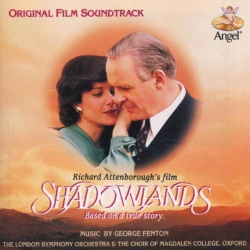
Shadowlands is a British romantic drama film which looks at the profound personal and intellectual relationship between C. S. Lewis, the author of The Chronicles of Narnia fantasy books series, and the American poet Joy Gresham. The film is set in the 1950s and finds Lewis, a reserved, middle-aged bachelor teaching at Oxford University. He meets Gresham and her young son Douglas while she is on an academic tour of England; she is unhappily married, but does not reveal her troubles. What begins as a formal meeting of two minds slowly develops into a feeling of connection and love, and after Gresham divorces they marry – but their relationship will be tested when Joy is diagnosed with cancer. The film is directed by Richard Attenborough from a screenplay adapted from the stage work by William Nicholson, and stars Anthony Hopkins as Lewis and Debra Winger as Gresham. The film is one of those quiet, reserved, impeccably well-mannered British costume dramas, but it was nevertheless an enormous critical success, receiving Oscar nominations for Best Actress and Best Screenplay, and winning the BAFTA for Best British Film of 1993.
The score for Shadowlands is by George Fenton, and marked his third collaboration with director Attenborough after Gandhi in 1982 and Cry Freedom in 1987. However, whereas those scores were steeped in the musical cultures of India and South Africa, respectively, Shadowlands is very, very English. It evokes the beauty and tranquility of the Cotswold countryside, and casts an intellectual eye and slight air of detachment on the film’s academic setting, but then often rises to present profound representations of unusually deep emotions that range from romantic love to deep despair and regret. To enhance the authenticity of the project Fenton recorded his score with The London Symphony Orchestra and The Choir of Magdalen College at Oxford (Magdalen being the college where Lewis taught), and blended his original score with orchestral settings of several traditional Anglican hymns, reflecting Lewis’s deeply held Christian faith.
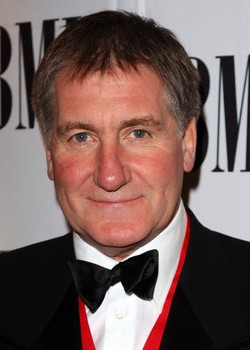 In an interview with Tim Grieving for his website Projector and Orchestra, Fenton says; “In many ways, Shadowlands was a sort of a homecoming for me, because I learned my music as a boy in church. I studied the organ, so I’m quite familiar with church music, and I went to school in Oxford, so the world of Shadowlands – many of the places, and the way that people were – was familiar to me, in a quite nostalgic way.” He also revealed that Attenborough wanted him to write a truly English score, in the style of George Butterworth, or even Elgar, in that English sense of harmony.
Fenton’s main theme is introduced in the first cue, “Veni Sancte Spiritus: Front Titles,” and was written in direct response to Attenborough’s request that the film be bookended by voices, which act as a metaphor for one of the film’s major literary and musical themes, the idea of “as a boy and as a man.” Fenton selected the Latin text (it translates to “Come Holy Spirit”) and then arranged the theme for male voice choir and boy soprano Daniel Cochlin, backed by the reverent sound of a church organ. It’s a gorgeous piece, solemn yet uplifting, and in tune with Lewis’s own religious convictions.
The second primary in the score is the theme for the relationship between Lewis and Gresham, and is appears primarily in the two “Golden Valley” cues. Fenton explained that, since the relationship between the characters isn’t a traditional love story, the melody isn’t a ‘love theme’ in the traditional sense, in that it doesn’t necessarily represent Gresham’s feelings for Lewis specifically, but instead is indicative of her love for the idea of him, and the English idyll that he represents for her. The theme is lovely, a soft, gently nostalgic piece for restrained to strings and woodwinds, which only occasionally rise to any sort of resounding statement, swelling with increasing passion as their love matures. Interestingly, the ‘downward cascading strings’ part of melody of this theme reminds me very much of one that Debbie Wiseman would write for her score for Wilde in 1998, leading me to wonder whether there was a temp-track for her in play.
Later, in “The Lake” Fenton arranges the theme for Lewis and Gresham with special emphasis in a solo French horn over pianos, and then in “The Golden Valley Part Two” Fenton intertwines the theme for Lewis and Gresham with the ‘Veni Sancte Spiritus’ main theme to excellent effect.
“Quartet in D – The Randolph” is a secondary theme for Lewis himself, representing his stature at Oxford as a well-respected don, and is a refined, classical, sprightly, albeit slightly conservative piece for a string quartet. There is also some music representing the fantasy world of Narnia that Lewis created, hard in the cue “The Wardrobe,” which underscores a scene where Joy’s young son Douglas explores Lewis’s attic in the hopes of finding the famous closet portal to another dimension. For this cue Fenton adds some other-worldly color through the use of a kantele, a Finnish plucked instrument similar to a zither to the pretty orchestra, which adds an appropriately magical sound similar to a celeste or glockenspiel.
The rest of the score is mostly a series of lovely variations on these core ideas. “The Plot Thickens” is a wry and whimsical dance, again built around plucked based and lithe strings. There is dramatic weight and poignancy to “The Friendship,” followed by summery bliss and gentle romance in “The Wedding”. “Mr. C. S. Lewis” adds a witty clarinet solo to performance of Lewis’s academic string quartet theme. There is real emotional depth and to the performance of the theme for Lewis and Gresham in “Joy Goes Home,” which reach its poignant climax in the bittersweet, sorrowful “The Silence,” which represents the aching loss in Lewis’s life after Gresham’s death from bone cancer aged just 45.
“As a Boy & As a Man” is the bookend to the score that Fenton and Attenborough discussed in relation to the opening cue, a beautifully expansive variation that blends the romantic theme for Lewis and Gresham with the main title theme, arranged the full orchestra and accompanied by a solo treble voice; it is heard in its fullest performance at Joy’s funeral where Lewis – having now resolved to adopt Joy’s son Douglas – reaffirms his commitment to be his stepfather. There is more religioso Latinate choral work in “Sanctis Solemniis,” and a reaffirmation of the tenderness between mother and son in “Joy & Douglas,” before the “Shadowlands (End Credits)” offers an excellent, fully orchestral final statement of the score’s main theme that brings the score to a pleasing conclusion.
Anyone who requires large-scale action, huge themes, or massive statements of unrestrained romance may find Shadowlands to be on the slow side, but the truth is that the tone of Fenton’s score is a perfect illustration of the relationship between Lewis and Gresham – genteel, driven by intellectual compatibility rather than fiery passion, but nevertheless imbued with a heart and a tenderness that can never be seen as anything other than genuine love. Tonally, it can be seen as a companion piece to earlier Fenton scores like 84 Charing Cross Road or A Handful of Dust, as well as later works such as In Love and War, and the quieter parts of Dangerous Beauty and Anna and the King. As such, I find it to be lovely, a perfect evocation of a particular time and period in British history, a certain type of English gentleman, and the tender love affair between two kindred spirits.
Buy the Shadowlands soundtrack from the Movie Music UK Store
Track Listing:
- Veni Sancte Spiritus: Front Titles (2:19)
- The Golden Valley (1:58)
- Quartet in D – The Randolph (1:49)
- The Wardrobe (2:39)
- The Plot Thickens (2:33)
- The Lake (3:14)
- O Little Town of Bethlehem (traditional) (2:42)
- Once in Royal David’s City (traditional) (1:37)
- The Friendship (2:09)
- The Wedding (2:43)
- Sumer Is Icumen In (traditional) (1:38)
- The Drive to the Hotel (1:34)
- The Golden Valley, Part Two (1:58)
- Mr. C.S. Lewis (1:42)
- Joy Goes Home (2:33)
- I’ll Be Here Too (1:56)
- The Silence (1:54)
- As a Boy & As a Man (3:26)
- Sanctis Solemniis (2:03)
- Joy & Douglas (1:41)
- Shadowlands (End Credits) (3:35)
Running Time: 47 minutes 43 seconds
Angel Records CDQ 72435-55093-2-1 (1993)
Music composed and conducted by George Fenton. Orchestrations by Lennox Mackenzie. Choir conducted by Grayston Ives. Featured musical soloists Rod McGrath, Paul Silverthorne, Janice Graham, Michael Davis and Nicholas Rodwell. Special vocal performances by Daniel Cochlin and Daren Geraghty. Recorded and mixed by Keith Grant. Edited by Kevin Lane. Album produced by George Fenton.

Shop at the Movie Music UK Store

Member of the

 MOVIE MUSIC UK