ARGYLLE – Lorne Balfe
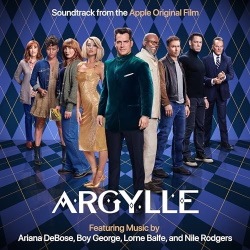 Original Review by Jonathan Broxton
Having already given the world a series of spy comedy/action-thrillers in the Kingsmen series, writer/director Matthew Vaughan is back with a new take on the genre with his latest film, Argylle. The film stars Bryce Dallas Howard as Elly Conway, the introverted author of a series of popular espionage novels featuring the protagonist Argylle. While on a train journey to visit her parents, Elly is saved from an ambush by an actual spy, Aidan Wylde (Sam Rockwell), who explains to her that a shadowy organization known as the Division is targeting her because her novels seemingly predict the future. The film co-stars Bryan Cranston, Catherine O’Hara, and Samuel L. Jackson, as well as Henry Cavill, John Cena, and Dua Lipa as the ‘film within a film’ protagonists of the Argylle stories, and it starts out as a fun, breezy, enjoyable action comedy – but as the film drags on, with plot twist after plot twist, double-cross after double-cross, some unexpectedly ropey special effects, and a large number of action set pieces which become increasingly ridiculous, it all falls apart. There is a really great film lurking within the mess that Argylle turned out to be, and it’s a shame because with this cast, and this director, it should have been so much better.
Ultimately, one of the best things to come out of Argylle is the score, which was written by Lorne Balfe. Balfe is no stranger to the action spy genre, having written the scores for the last two Mission Impossible movies, but Argylle offers a new and fun twist on that sound which is very enjoyable indeed. But, before I get into all that, I want to talk about the two original songs written for the film, which are outstanding, and have been stuck in my head ever since I first heard them.
The first, “Electric Energy,” was written by Balfe and Vaughan with super-producer Stuart Price and Gary Barlow of Take That, and is performed by Ariana DeBose with guest vocals by 1980s pop star Boy George. The song is a terrific throwback disco track with a killer guitar bass line by the iconic Nile Rodgers, a catchy central melody, and a toe-tapping beat that has wormed its way into my ears and not let go; it’s just fantastic. The second, “Get Up and Start Again,” was written by Balfe and Vaughan with Stuart Price and Giles Martin, is again performed by Ariana DeBose, and is a genuine contender to be one of the best Bond songs not to appear in a Bond movie. It initially has a smooth, silky, intimate sound, but slowly grows into a sensational soaring power ballad, with a knockout vocal performance by DeBose and outstanding orchestral arrangements – that brass countermelody! The movie is probably coming out too early for this to happen, but I would love for one or both of them to pick up an Oscar nomination in 2025. Yes, they are that good.
 The score is also interesting for the way that Balfe incorporates the brand new Beatles song “Now and Then” into the score as the theme for Elly. The song – dubbed “the last Beatles song” – was written by John Lennon in 1977 but was shelved after his death for more than three decades, until it was completed by his surviving bandmates Paul McCartney and Ringo Starr in November 2023, and topped the charts all over the world. Giles Martin, the son of the Beatles’ longtime producer George Martin, is a friend of director Vaughan, and he offered the song to him to use in Argylle. Balfe had to keep the existence of the song secret for a year and a half – he didn’t even tell the orchestra what they were playing when they were doing the symphonic version – but its inclusion here gives Elly’s theme a real warmth and humanity. The theme gets its most prominent performance as a concert arrangement for the full orchestra and chorus in “Now and Then (Argylle Symphony),” but appears a few times within the score in scenes that specifically relate to Elly and her past, notably in the gorgeous “Elly’s Writing Theme”.
There are several other recurring themes in the score too. “Argylle’s Theme” is the theme for Henry Cavill’s story-within-a-story character, and it is a dramatic hero anthem which can be played both with real emotional depth in serious scenes, or as an action motif within several of the numerous set pieces. The melody is based on the chorus from the “Get Up and Start Again” song (or vice versa), which is wonderful as it links the two musical elements of the film together, and best of all there is a real 1990s Media Ventures throwback sound to it all – think Backdraft, or perhaps later efforts like The Rock or Armageddon – which fans of that sound will really appreciate.
It features prominently throughout the score, but has several noticeably strong performances during “Argylle in Hong Kong,” the more sensitive “Argylle in the Mirror,” and in the emotionally poignant “Do You Think I’m OK,” as well as later in the intensely dramatic “Alfie” and the sweeping “Al-Badr Palace,” which also has some luxurious Middle Eastern textures to illustrate the scene’s geographic setting. Interestingly, there’s a cascading string motif in several of these cues that reminds me of Gerard McMahon’s song “Cry Little Sister” from the movie The Lost Boys, but this is probably coincidental.
The third main recurring theme is the “Division Theme,” a slow and insidious motif for sinister strings, low brass, and what sounds like a sampled or manipulated church organ, which gives the organization at the heart of the story a real sense of menace and malice. After playing a more subversive role during the first half of the score, this theme really starts to emerge strongly in the second half, acting as dark counterweight to the more energetic and exciting music for Elly and Aidan’s action adventures.
The score itself moves between large scale action sequences, moments of more understated suspense, and quiet and reflective sequences of intimacy, and Balfe handles them all well. I won’t say that Balfe was intentionally aping the John Barry James Bond sound in the score, but there are a few little licks and touches in the orchestration that give it that ‘spy soundtrack panache,’ notably the use of high woodwinds in certain moments, and the serpentine strings in cues like the dramatic “Serve the Same Master,” and personally I found these to be very tastefully done.
Of the action sequences, my favorite is probably the first one, “Mini Moke Mayhem,” which inserts the Argylle theme and the Division theme into a rollicking set piece that accompanies the titular spy as he chases Dua Lipa’s sexy supervillain Lagrange through the narrow streets of a Greek village. The string runs are wonderfully frantic, the percussion beats are propulsive and energetic, and the horn fanfares are heraldic. It’s just terrific fun – yet another example of how much more complicated, exciting, and engaging Balfe’s action music has become during the continuing lornaissance.
Other excellent action moments include the frenetic “Enjoy the Ride,” the thrilling “The Spy Who Scratched Me,” the staccato hits in the shocking “Parental Misguidance” scene, the intense “Double Crosser” with its sultry saxophones, and the dynamic “Furocious” with its increasingly rapid trilling strings and shockingly brutal processed foghorn sound. This all continues in the final quarter of the score from the brilliant and rousing “Mama’s Gotta Go to Work” through to the end of “Satellite Signals” – get your skates on! The penultimate cue, “Concluding the Argylle Saga,” sees Balfe at his most sweepingly romantic, channeling John Barry and You Only Live twice in the best possible way. “The Spy Who Scratched Me” is also notable for being one of several cues that features Balfe’s ‘cat choir,’ for which a group of actual professional singers were paid real money to make cat meowing noises as loud as they could! Oh, and I almost forgot to mention the saxophone in “Careless Whisker,” which hopefully was Balfe’s homage to the near-namesake George Michael song from 1984.
Argylle really is a perfect example of what a good excellent contemporary action score can be. It uses large orchestral and choral forces blended with an appropriate amount of electronic enhancements, acknowledges the familiar espionage movie soundtrack tropes without being a slave to them, contains at least three memorable recurring thematic ideas, and engages in some creative, propulsive, exciting action music that uses elements of one or more of those themes in a variety of interesting ways. Then when you add the two outstanding original songs into the mix – one of which is based on the film’s main theme – not to mention a brand new Beatles song in 2024, and you have a score which is a winner all the way. I just hope that the box office disappointment of the film itself doesn’t jeopardize Vaughan’s plans for future Argylle films, because even if the quality of the movie isn’t there, I want to hear Balfe playing in this litterbox again and again.
Buy the Argylle soundtrack from the Movie Music UK Store
Track Listing:
- Mini Moke Mayhem (2:20)
- Serve the Same Master (4:08)
- Argylle In Hong Kong (1:50)
- This Seat Is Taken (1:40)
- Enjoy the Ride (1:30)
- The Division Theme (2:38)
- Aiden & Elly (2:46)
- Electric Energy (written by Lorne Balfe, Matthew Vaughan, Stuart Price, and Gary Barlow, performed by Ariana DeBose feat. Boy George and Nile Rodgers) (3:16)
- Spoon Spy (1:57)
- The Spy Who Scratched Me (2:47)
- Argylle in the Mirror (2:40)
- Elly’s Writing Theme (2:59)
- Parental Misguidance (1:39)
- Do You Think I’m OK? (3:42)
- Alfie (5:09)
- Rachel’s Story (5:29)
- Al-Badr Palace (3:21)
- Double Crosser (2:07)
- Furocious (2:30)
- Mama’s Gotta Go to Work (2:29)
- Careless Whisker (0:30)
- Satellite Signals (2:50)
- You Missed (1:53)
- Concluding the Argylle Saga (1:44)
- Yellow Shirt (1:30)
- Argylle’s Theme (3:25)
- Now and Then (Argylle Symphony) (3:55)
- Get Up and Start Again (written by Lorne Balfe, Matthew Vaughan, Stuart Price, and Giles Martin, performed by Ariana DeBose) (3:26)
Running Time: 76 minutes 10 seconds
Marv Music (2024)
Music composed by Lorne Balfe. Conducted by James Brett, Gavin Greenaway, Ben Foster and Allan Wilson. Performed by The Chamber Orchestra of London and the Royal Scottish National Orchestra. Orchestrations by Harry Brokensha, Ben Morales-Frost, Aaron King, Samuel Read, Nicolo Braghiroli and Gabriel Chernick. Additional music by Peter Adams, Steve Davies, Jeremy Earnest, Dieter Hartmann, Luigi Jassen, Joshua Pacey, Adam Price, Kevin Riepl and Stuart Thomas. Recorded and mixed by Rupert Coulson and Peter Fuchs. Edited by Jack Dolman, Andy Patterson and Cecile Tournesac. Album produced by Lorne Balfe and Jack Dolman.
-
February 7, 2025 at 7:01 amMovie Music UK Awards 2024 | MOVIE MUSIC UK

Shop at the Movie Music UK Store

Member of the

 MOVIE MUSIC UK