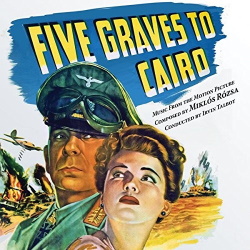
FIVE GRAVES TO CAIRO – Miklós Rózsa
 GREATEST SCORES OF THE TWENTIETH CENTURY
Original Review by Craig Lysy
Director Billy Wilder conceived of WWII film adapted from the 1917 play Hotel Imperial: Színmú Négy Felovonásban by Lajos Bíró. He sold the idea to Paramount Pictures, and secured the film rights. B. G. DeSylva was assigned production with a budget of $855,000, Wilder would direct, and he and Charles Brackett would write the screenplay. Casting was problematic as Wilder’s choice of Cary Grant and Ingrid Bergman failed to materialize. So, he cast Franchot Tone as Corporal John Bramble/Davos, Anne Baxter as Mouche, Akim Tamiroff as Farid, Erich von Stromheim as Field Marshall Erwin Rommel, Peter van Eyck as Lieutenant Schwegler, and Fortunio Bananova as General Sebastiano.
The film is set during the darkest days of WWII when German forces under the command of Field Marshall Erwin Rommel had routed the British at Tobruk. His Panzer tank corp are rolling relentlessly eastward intending to take the Suez Canal, Britain’s lifeline to India and secure the oil fields in the Middle East. Against this backdrop is espionage by British Corporal Bramble, who assumes the identity of Davos, a German spy. He gains the confidence of Rommel and with the aid of Frenchwoman Mouche obtains valuable information, which allows the British to rally and defeat Rommel at the Second Battle of El Alamein, which turned the tide of Germany’s African campaign. The film was a commercial success, earning a profit of $795,000. Critical reception was mixed, although the film did receive three Academy Award nominations for Best Cinematography, Best Art Direction and Best Film Editing.
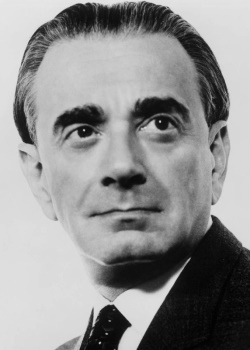 Billy Wilder’s first choice as composer was his friend Franz Waxman, who was under contract to Warner Bros. The studio refused to release him and so following an interview with Wilder, Miklós Rózsa was selected. Wilder promised him that if he did a good job on the film, that he would select him for his next project. Well, in the end Wilder loved the score and Rózsa composed a masterpiece for his next film, “Double Indemnity, for which he would be nominated for an Academy Award. Rózsa was enthused to take on the assignment as this would be his first engagement by a major Hollywood studio. Wilder informed Rózsa that he wanted as much music in the film as possible and was given four weeks to compose and record the score.
Rózsa understood that the film was at its core a suspense thriller, full of tension that involved espionage. For his soundscape he decided to support this narrative, using nuanced compositional technique, and so we discern unresolved harmonies, agitated ostinati, and melodies that never culminate, but instead end unresolved, intangible and uncertain. In regards to primary themes, Rózsa composed three; the Main Theme supports Bramble on a personal level, and the British army on a transpersonal level. It evolves from a six-note phrase which builds slowly, swelling with militaristic aggression, often assuming march form, and during battle, unfolding as an anthem of triumph. During most of the film it is subdued, and covert as Bramble has assumed the identity of the German agent Davos. Later in the film, after he rejoins the British army, do we finally experience its patriotic power. Mouche’s Theme offers the only feminine and romantic musical identity of the score. It emotes exquisitely and tenderly on solo violin d’Amore. Sadly, it only transforms into a Love Theme as Bramble kneels at her gravesite. Rommel’s Theme offers an ominous, minor modal, and pentatonic construct, which supports this imperious Field Marshall. At times it swells as a menacing marcia imperiosa replete with trumpet embellishment, which speaks to his pride, self-assurance and imperious demeanor. Associated with it is a sinister German Motif, which offers a repeating five-note construct borne by low register strings malevoli. While Wilder was happy with Rózsa’s score, Paramount Music Department boss Victor Young was not, and became furious when Rózsa refused to make the score more consonant. In the end Wilder prevailed and Rózsa’s score was not changed although sadly significant portions of it ended up on the editing room floor.
“Prelude” opens aggressively atop the strident Main Theme, which empowers the flow of the opening credits, which display as black font against desert dunes. At 00:08 a swirling crescendo dramatico erupts and initiates at 0:24 the transformation of the Mian Theme into a marcia bellicoso as a British tank approaches. At 0:47 we flow into Mouche’s Theme borne by yearning strings romantico. The strident Main Theme resumes as narrative script joins informing us that Tobruk had fallen and that Rommel’s Afrika Korps were driving towards Cairo and the Suez Canal – Britain’s life line. At 01:25 a diminuendo borne as a shimmering misterioso takes us into “First Scene” as we see a British tank churning along with its crew overcome by engine fumes and heat exhaustion. Rózsa supports with a beleaguered Main Theme and torturous musical narrative as Corporal Bramble wakes up and climbs up the shoot for fresh air. He passes out top side and falls out onto the dunes. He wakes to see the tank churning away, leaving him stranded without water. At 02:45 Rózsa sows a crescendo of urgency as he staggers after the tank empowered by a desperate Main Theme. Yet at 04:06 he collapses from exhaustion as the camera zooms in on his dog tag, which reads J.J. Bramble. At 4:48 we segue into “Walk in Desert” where we see Bramble struggling atop the dunes under the searing sun. Rózsa supports with a formless, toiling musical narrative of woe until 05:19 where he collapses to a descent motif. He then starts to crawl carried by a torturous musical narrative until 05:45 when muted trumpets support him reaching an ocean road. The music gains urgency as he staggers desperately towards a building displaying a British flag – “The Empress of Britain Hotel”. We close full of foreboding as Bramble, who is delusional from heat exhaustion, speaks to people he imagines he sees.
(*) “Bramble’s Delerium” reveals him speaking to a vacant front desk demanding to see the commanding officer. The owner Farid looks at him, bewildered. Rózsa weaves a misterioso led by a wandering flute arabo. The music softens with strings tenero as Mouche the cook looks down at him from the stairs. Bramble is rambling and does not respond to Farid’s voice or gentle touching of his arms. Farid orders Mouche to get water and salt to treat his heat stroke. A beleaguered Main Theme joins as Bramble finally begins responding to Farid. A nascent fragment of Mouche’s Theme emerges as Bramble sees Mouche. He insists on joining his regimen, stands, and a crashing descent motif supports him passing out and falling. Outside a large German regiment with tanks and half-tracks arrives and surrounds the hotel. Farid cannot rouse Bramble and drags him behind the front desk. An arrogant Lieutenant Schwegler arrives and Farid diverts him to a chair with an offer of water.
(*) “Commandeering The Hotel” reveals Schwegler commandeering the hotel for the German high command headquarters. The menacing German Motif joins on low register strings malevoli. Bramble has woken up, recognizes the German language, for which he is fluent, and continues to hide behind the desk as Rózsa sow tension. A distressed Main Theme joins when Farid and Mouche become fearful as the Germans wheel the desk across the room. Luckily, they see through the desk front lattice that Bramble concealed himself inside. He manages to sneak out, much to their relief. A menacing musical narrative joins as Schwegler orders the rooms prepared, joined by a respite of warm strings as a plucky Mouche deflects Schwegler’s unwanted advance. A musical narrative of tension carries Farid and Mouch upstairs where the see Bramble enter a service room. The music crescendos when Farid enters and discovers Bramble dressed and preparing to assume the identity of the waiter Davos. Outside, Field Marshal Erwin Rommel arrives, causing Farid to panic. Mouche chastises Bramble, relating her hatred of the British who abandoned two of her brothers and the French army at Dunkirk. Schwegler enters, and Bramble successfully convinces him that he is Davos, and they depart together.
“Herr Rommel” almost all of this cue was dialed out of the film. It was intended to support Rommel’s arrival, and him dictating a communique to the radioman for the Fuhrer saying that he has crossed into Egypt. He boasts that he will annihilate the British 8th Army and take Alexandria, Cairo and the Suez Canal. Schwegler and Bramble/Davos listen on the stairs and then Schwegler introduces ‘Davos’ to Rommel. At Rommel’s command the three exit to the kitchen storage area. The album cue opens with strings minacciosi and then at 0:10 it transforms into Rommel’s Theme rendered as a proud marcia imperiosa. At 1:24 the music darkens and becomes angry when Rommel voices his anger of ‘Davos’ not notifying him of the planned British withdrawal. Schwegler comes to his aide saying he was buried for eight hours after the German bombing. Rommel accepts this, and the three bond, and toast to victory over a glass of cognac. ‘Davos’ is relieved that he had passed another test and the cue ends darkly.
(*) “The Singing General” reveals an exterior hotel shot supported by General Sebastiano tenor voice sounding from his room as he sings the song “Mattinata” by Ruggiero Leoncavallo. Inside Rommel is meeting with his command staff and he orders ‘Davos’ to relay his order for General Sebastiano to stop his singing. Upon receipt of the order, Sebastiano expresses his outrage and disdain for the Germans to ‘Davos’. While the general is brushing his teeth, a serious Main Theme sounds as ‘Davos’ steals his pistol from its holder and discreetly exits. Rózsa sow tension as ‘Davos’ returns to his quarters to join Farid. Farid shows Bramble three Davos passports and expresses ignorance of Bramble’s reference of “the five graves”. When Farid leaves to answer a page, Bramble advises Mouche of his plan to assassinate Rommel in the morning over coffee. As she advises of her plan to use Rommel to free her brothers, an aching violin voices her theme.
“Herr Rommel Takes Coffee” reveals British civilians and soldiers being escorted down the road in front of the hotel. A dour quote of the “Rule Britannia” supports as the scene shift to Bramble who wakes with the Main Theme joining with the anthem. A crescendo of alarm erupts and unleashes a furious statement of the Main Theme after he discovers that the pistol hidden under his pillow is gone, and that Mouche has left to answer a call from room #5 – Rommel. After 1:05 the remainder of the cue is dialed out of the film. It was intended to support the following scene. Mouche brings Rommel his coffee and is told to leave as Rommel says he does not like to see women in the morning. She defies, and impresses him. She says she has something to say to him, and Rommel agrees. She discloses that she has two brothers; one died and one is in a German concentration camp. He calls in Schwegler, tells her to fill out a request to the camp commander in triplicate and then has Schewgler escort Mouche out. In the servant quarters Schwegler makes a pass and offers of a quid pro quo to assist with her brother. He suggests that she ask ‘Davos’ to leave. At the sink they whisper regarding the gun. He demands she return it, she says leave or she will expose him, which he does. As Schwegler closes the widow atop the door, it dislodges the pistol, which Bramble retrieves. The album continues with Rózsa masterfully offering a tête-à-tête between Mouche’s and Rommel’s Themes. The juxtaposition of feminine vs masculine, gentle vs stern, and pleading vs dour. At 2:36 her theme blossoms of solo violin delicato for a beautiful exposition. It is a shame such exquisite music was dialed out by Wilder.
“Bramble & Soda” was dialed out of the film after 0:12. In the scene, captured British officers stand in the lobby supported by a dour quote of “Rule Britannia”. A colonel recognizes Bramble as a Davos imposter, Bramble offers to serve him again, and the men come to an understanding. When Bramble returns with the liquor, the colonel sees his dog tag hung around the whiskey decanter. The colonel vetoes Bramble’s assassination plans for Rommel, instead ordering him to provide vital intelligence. Variations of the Main Theme joined by Arabic accents follows beginning at 0:13 of the cue as Rózsa sow unease as the colonel and Bramble whisper. At 2:03 General Sebastiano joins and sees the decanter with the Bramble tag. ‘Davos’ convinces him it is a liquor called Bramble and the Italian imbibes a glass. Rózsa supports the interaction with a classic festive Tarentella with dire interludes as the colonel watches and fears Bramble being exposed.
(*) “Twenty Questions” reveals Rommel, his staff, General Sebastiano and the British officers dining, while Bramble flirts with Mouche in the kitchen. Farid joins and is panicked as he found Davos’ corpse downstairs in the cellar. Bramble agrees to find a way to dispose of it after lunch. Rommel, with sheer bravado, agrees to allow the British officers to ask him twenty questions. When stretched supply lines come up, he discloses that in 1937 he had petrol, water and tank parts buried at five sites in Egypt to resupply his advancing army. As Rommel stands up and departs his imperious theme joining to carry his exit. As the colonel and his officers depart, the Main Theme supports as he compliments ‘Davos’ on his service. “The Professor’s Photograph” reveals Bramble looking at the salt and pepper shakers Rommel aligned on the table and attempting to discern where between here and Cairo the supplies were buried. A grim Main Theme entwines with a misterioso as he tries to unravel the mystery. The theme strengthens at 0:54 after Farid discloses an old article in the knife drawer which says “German Archeologist Professor Cronstaetter on an Egyptian Expedition”. The theme commences a crescendo dramatico at 1:54 as the two men recognize Rommel as the professor in the photo.
In “Ordered to Cairo” Schwegler escorts ‘Davos’ to Rommel who declares his troops have reached point “P”, to which ‘Davos’ compliments ‘Dr. Cronstaetter’ and his five graves. Rommel shares the map and music enters grimly and unfolds as variations of the Main Theme as he discloses to ‘Davos’ that he has been reassigned to Cairo. He gives him precise orders to have the royal suite at the Shepherd’s Hotel prepared for his Sunday afternoon arrival, with a performance of Aida in German scheduled that evening in the royal opera house. (*) “The General and Mouche” reveals General Sebastiano grooming his beard in his bathroom. He notices Mouche preparing his bed and joins her, supported by a playful rendering of the Tarentella. He makes a pass, which she deflects and he begins once again to sing “Mattinata”. We end comically as Rommel bangs on the wall to end his singing and Mouche departs as he offers her wine.
(*) “Bramble Has an Epiphany” reveals Mouche joining Bramble in their servants’ quarters. He complains to her that he is flustered that he cannot solve the mystery of the five graves coded on Rommel’s map. He states there is not a “Y” in Egypt and has an epiphany, realizing the five grave sites are coded E, G, Y, P and T. Rózsa supports with exuberant joy as Bramble celebrates. As he explains his discovery to her, the Main and her theme interplay as he relates that he needs to examine the map again in Rommel’s room. (*) “Davos Copies The Map” reveals ‘Davos’ stealthily moving through the hotel at night, supported by a tense Main Theme. A menacing Rommel’s Theme joins on muted trumpets as he looks down and see him sitting, and chatting with his officers. As he walks to and enters Rommel’s room, Rózsa sow tension, which escalates as he traces the town locations related to E, G. Y, P, T on the map. The air raid siren sounds, and Davos restores the map table, and places the tracing in his coat just as Schwegler enters. “Davos’ manages to deflect his suspicions and follows Schwegler’s order to descend to the cellar for safety.
“Davos Discovered” reveals a bomb explosion that dislodges a pile of rubble. Schwegler sees two legs, one bearing the elevated sole used by Davos. Schwegler confronts ‘Davos’, but a bomb explosion allows Bramble to punch Schwegler and flee. A hot pursuit follows with Schwegler firing multiple times. Rózsa unleashes a swirling tempest borne by strings furioso and quotes of the Main Theme to initiate the chase. As Schwegler hunts Bramble down, the musical narrative shifts to one of suspense and tension, with grim quotes of the Main Theme. At 2:11 a crescendo feroce supports Bramble preparing to ambush Schwegler. For “Lieutenant Is Killed”, most of the cue was left on the edit room floor. Bramble ambushes Schwegler in Rommel’s quarters the aggressive music and Main Theme suggest it supported a fight. At 1:45 a crescendo feroce would seem to support Bramble shooting Schwegler, culminating at 2:02 with bomb explosions masking the sound. He is joined by Farid who takes the body away with the cue closing with a grave musical narrative.
In (*) “Mouche’s Anger” the Germans ascend from the cellar after the bombing raid and Mouche joins Bramble in their quarters where he gives her the news that Schwegler is dead. He confides that he must get the map coordinates to the high command and will be long gone by the time they discover Schwegler’s corpse. She is outraged that once again the British have betrayed her family as Schwegler was her only hope of saving her brother. Bramble espouses the nobility of patriotism fighting against the Nazis, which Rózsa supports with impassioned eloquence. We flow into “Davos Departs” where Mouche’s Theme espouses anguish. At 0:41 a crescendo furioso erupts and propels her angry departure as she says that saving her brother is more important that Bramble’s map. Bramble pursues, but as she hears Rommel’s angry ravings to his officers in German, she realizes who the real enemy is, and the musical narrative of fury dissipates, now replaced by a menacing Rommel’s Theme as he orders her to come to him. He castigates her for using Schwegler and then shows her his communiques, which he says are all forgeries.
(*) “Rommel’s Fury” reveals two soldiers informing Rommel that Schwegler’s body was found in Mouche’s bed. Rommel demands to know why she killed him, and rather than expose Bramble, she takes credit, saying he got what he deserved for first using her, and then betraying her. As ‘Davos’ departs Mouche disparages him, and spits at him in contempt, thus preserving his deception. Rommel says that to show her that they are not Huns, she will be tried tomorrow under French Law. A dire musical narrative supports ‘Davos’ departure, and grim expression as he understands she will be convicted and sentenced to death. He instructs Farid to save her by giving them the proof that ‘Davos’ was the murderer, and to relay his words “God Bless You”. A warm quote of her theme supports their eyes locking, shifting to a dramatic musical narrative as he boards the German motorcycle side car. The music crescendos as he looks back, thankful that he escaped.
“Victory Montage” opens with a display of Rommel’s map and the caption; “On July 1st, 1942, Rommel and his Afrika Korps reached El Alamein, as far east as they ever got.” Rommel’s Theme rendered as a proud marcia militare supports the map sequence. At 0:20 interplay of Mouche’s Theme by warm strings romantico entwines as we see script revealing that on September 7th, Lieutenant Bramble bought a white parasol at a little Cairo shop. At 0:42 we switch to cue 31 “Bagpipes and Drums”, which supports script informing of General Montgomery’s 8th army launching its counter offensive. We resume at 0:43 atop a four-note ostinato by muted horns from this arises the Main Theme rendered as a marcia militare, which supports a montage of scenes showing the unstoppable advance of the British 8th army. One scene shows Bramble in a tank with the white parasol next to him. At 1:51 the march swells into a battle anthem as we see the Germans routed and in full retreat. We close gloriously atop a crescendo trionfante with script stating that on November 12th the British returned to Sidi Halfaya, site of the “The Empress of Britain Hotel”.
In “Finale” bramble grabs the parasol and exits his tank as we see General Sebastiano singing “Mattinata” (not on the album) as he marches with the other prisoners of war. Bramble and he have a friendly reacquaintance until a British soldier pushes the general on his way. Mouche’s Theme swells on a crescendo of sweet anticipation as Bramble runs into the hotel calling for her. At 0:20 the music darkens as he sees Farid with a grim expression. He relates that the evidence he presented exonerated her, but she was still convicted for consorting with the enemy and executed. At 0:52 Rózsa offers heartache and regret with as wistful reprise of her theme, which unfolds as a dirge, replete with tolling bells as Farid escorts Bramble to her gravesite. At 1:19, as he kneels at her grave and speaks to her, a threnody with weeping strings affanato and tolling bells unfolds. At 1:54 a sweet solo violin d’Amore voices her theme as he opens the parasol, which he places on her grave. At 2:22 we flow into a solemn hymn of victory as he relates to her that allied forces are achieving victory. At 2:56 “a proud statement of “God Save The King!” resounds (not in the edited film). We surge into a triumphant rendering of the Main Theme, which culminates in a grand flourish to end the film as Farid watches Bramble run off to rejoin his men, who are departing.
The score was stored on 35mm magnetic film copies of the original optical masters, which received audio restoration and digital mastering. The restoration, while good, and commendable, does not achieve 21st century audio qualitative standards. Despite this, I believe the listener can appreciate Rózsa’s handiwork. Miklós Rózsa and director Billy Wilder bonded during this project, and would go on to collaborate on four more films. I believe Rózsa masterfully wove a nuanced musical tapestry, which masterfully sowed the necessary elements of suspense, tension, ‘Bramble’s fear of discovery, Rommel’s imperiousness and British patriotic pride. The Main Theme and Bramble are inexorably linked, and as Bramble abandons his ‘Davos’ persona to reemerge into the light as a British soldier, so too does the theme, with some of its finest passages found during the battle scenes near the end of the film. Mouche’s Theme also experiences an evolution, transforming from her identity borne by a sweet violin d’Amore to a Love Theme. Tragically, the Love Theme only finds voice post mortem as a wistful Bramble, full of heartache, kneels at her gravesite. Folks, the conception and execution of this score by Rózsa again reveals his mastery of his craft, enhancing Wilder’s vision in scene after scene. Sadly, some of the score’s finest passages ended up on the edit room floor as several scenes were significantly shortened. I am thankful that Lukas Kendall, Frank K. DeWald and Intrada Records included these edited passages on the album. This is an impressive compilation album, which also includes Rózsa’s scores from “So Proudly We Hail!”, “The Hours Before Dawn”, and excerpts from “The Man in Half Moon Street”, and “The Woman of the Town”. I recommend this fine album for your collection.
For those of you unfamiliar with the score, I have embedded a YouTube link to a five minute suite: https://www.youtube.com/watch?v=6JS9vKMp8JA
Buy the Five Graves to Cairo soundtrack from the Movie Music UK Store
Track Listing:
- Prelude/First Scene/Walk in Desert (Abridged) (6:49)
- Herr Rommel (2:21)
- Herr Rommel Takes Coffee (5:01)
- Bramble & Soda (3:15)
- The Professor’s Photograph (2:02)
- Ordered to Cairo (1:11)
- Davos Discovered (2:32)
- Lieutenant Is Killed (2:47)
- Davos Departs (2:06)
- Victory Montage (Abridged) (2:08)
- Finale (3:51)
Running Time: 34 minutes 03 seconds
Intrada ISC-355 (1943/2016)
Music composed by Miklós Rózsa. Conducted by Irvin Talbot. Orchestrations by Eugene Zador. Recorded and mixed by XXXX. Score produced by Miklós Rózsa. Album produced by Lukas Kendall and Frank K. DeWald.

Shop at the Movie Music UK Store

Member of the

 MOVIE MUSIC UK