IRON WILL – Joel McNeely
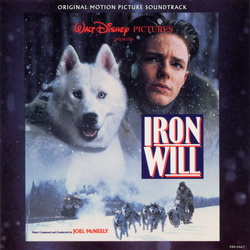 THROWBACK THIRTY
Original Review by Jonathan Broxton
Iron Will is a Disney-produced historical family adventure film, directed by Charles Haid from a screenplay co-written by John Michael Hayes, who wrote four of Alfred Hitchcock’s films in the 1950s (Rear Window, To Catch a Thief, The Trouble with Harry, and The Man Who Knew Too Much). The film is set in 1917 and tells the true story of a teenage boy named Will Stoneman who is left to take care of his mother after his father dies, and who enters a grueling 500-mile dog-sled race from Manitoba to Minnesota in order to raise money for her. Mackenzie Astin stars as the intrepid musher Will, and there is excellent support from future A-listers and stalwart character actors like Kevin Spacey, David Ogden Stiers, August Schellenberg, and Brian Cox, but the film did not set the box office alight and is unfortunately mostly forgotten today.
For film music fans Iron Will is noteworthy because it contains, essentially, the first major film score by Joel McNeely. Prior to 1994 McNeely was mostly a television composer for Disney, writing music for a series of TV movies and episodic shows. It was his work writing for Lucasfilm’s The Young Indiana Jones Chronicles series in 1992 and 1993 that first got people’s attention, and this led to him winning a Primetime Emmy for the ‘Young Indiana Jones and the Scandal of 1920’ episode in that second year. What a lot of people liked about McNeely’s music, especially in the 1990s, was how classically old-fashioned it was; he is a themes-and-variations composer, given to bold emotional statements, rich orchestrations, and powerful action. For many years McNeely was touted as ‘the next John Williams,’ not only because of his association with the Indiana Jones franchise specifically and Lucasfilm in general, but because McNeely and Williams have the same sensibility, the same film music philosophy, and this is very apparent all throughout Iron Will.
 Iron Will is a classic ‘outdoor adventure’ score written for the full orchestra, and which has a rich vein of sparkling Americana running through it all. The “Main Title” introduces the score’s superb main theme, a majestic piece that opens with a lively and playful John Williams-esque scherzo before expanding out into a glorious central melody, which is redolent of wide open spaces and wonderful landscape vistas. The orchestrations in this cue are just outstanding – McNeely makes excellent use of the entire ensemble, with each section given a moment to shine – and there are some prominent featured guest appearances for fiddles, further enhancing the Americana sound. Interestingly, rather than sounding like Williams, McNeely’s main theme actually sounds more like something Bruce Broughton might have written – there are echoes of Silverado, O Pioneers, even The Rescuers Down Under, in a lot of the phrasing. Thankfully, I love all those scores, so that is definitely a good thing.
The rest of the score develops along mostly the same tonal lines. “Jack’s Death” has an appropriately anguished and beautifully emotional sound to accompany the scene where Will’s father drowns in a mushing accident after his sled overturns into a river, sacrificing his own life to save his son’s; some of the writing here is shrill and tortured, but leaves a very positive impression. “Leaving Birch Ridge” reprises the main theme in an even more expansive version, arranged for a gorgeous solo trumpet that eventually gives way to lush, sweeping strings, and which has a sense of destiny and purpose about it. There is a hint of Jerry Goldsmith at his most majestic in this music, which of course is always something to appreciate.
The dog race sequence forms the core of the bulk of the score, and sees McNeely engaging in some energetic and sometimes quite intense action, interspersed with more statements of his main theme, and occasionally interrupted by sequences of suspense and drama, all following the ups and downs of Will’s adventures on the trail with his dogs.
“The Race Begins” opens with a tremendous elongated brass fanfare, enthusiastic and celebratory, sending the brave competitors on their way with an eager flourish. The dancing string lines underneath the horn performance of the main theme again have a definite flavor of Bruce Broughton, reminding me of his work on both Silverado and The Boy Who Could Fly. “Pushing Onward” is a little darker and more serious, and uses a tinkling cimbalom against more dramatic orchestral chords to suggest that Will’s adventure is at times a grueling and dangerous one. These dangers are enhanced further in “Gus Rescues Will,” which initially features some stark writing for solo trumpets and elegiac strings in a manner which reminds me of John Williams’s Born on the Fourth of July, but which ends with a lovely piece of warmly earnest emotion and a sentimental statement of the main theme.
“Devil’s Slide” is an excellent piece of action music, for a scene in which Will and his dogs must traverse an icy trail alongside a turbulent river, much like the one Will’s father was on when he died. McNeely increases the impact of his percussion section here significantly, underpinning his thrusting orchestral lines with an incessant rhythmic beat, rampaging brass pulses, a few moments of dissonance, and even a brief passage in the middle that recalls Raiders of the Lost Ark. “The Final Day” is split between a reprise of the anxious and despairing string-led music from “Gus Rescues Will,” and moves through some excellent recapitulations of the main theme, before concluding with another ferociously thrilling action sequence, masculine and dramatic.
“Race to the Finish” and “Crossing the Line” offer a tremendously rousing finale to the score, filled with soaring statements of the main theme and an almost impossibly inspiring sense of heroism, conveyed with relentless brass fanfares and sweepings strings. This sort of stuff might feel almost insufferably overbearing to contemporary listeners, but this is the sort of music I grew up hearing in my movies, and I love it to this day; it’s just so endearingly un-ironic, so straightforwardly sentimental, without a touch of sarcasm. This is a straight-up celebration of the human spirit, a triumph against the nature and the odds, and it succeeds because of its earnestness rather than in spite of it. The “End Credits” then reprises all the score’s main thematic material with an appropriately epic sweep, ending things on a wonderful high.
 The score for Iron Will was released by Varese Sarabande at the time the film was released, in a tight and enjoyable 30 minute package, but this is one of the releases that didn’t do justice to the full scope of what McNeely wrote. To rectify this, in 2019 Intrada Records and producer Douglass Fake released a comprehensive 80-minute special edition which expands on the original album significantly. It includes numerous extended performances of the main theme (“Gift from God”), some rich emotional sequences that add depth to the near-symbiotic relationship between Will and his dogs (“Asleep in the Woods”), and several additional knockout action sequences (“The Chase,” “Escape from the Train”), as well as pieces of source music that McNeely arranged, including excerpts from Bizet’s Carmen and several period folk songs. The whole thing is presented in an excellent package, featuring liner notes by writer John Takis, and I wholeheartedly recommend it.
Iron Will is an outstanding score, emotionally powerful, action packed, and underpinned with a rich vein of strong Americana. The compositional similarities to earlier scores by composers like John Williams and Bruce Broughton are obvious, but considering that McNeely was just 35 years old when he wrote it, and was scoring his first studio feature film, I think we can give him some leeway. Devotees of classic Disney outdoor adventure scores will find plenty to enjoy.
Buy the Iron Will soundtrack from the Movie Music UK Store
Track Listing:
- ORIGINAL 1994 RELEASE
- Main Title (3:00)
- Jack’s Death (3:47)
- Leaving Birch Ridge (2:31)
- The Race Begins (2:12)
- Pushing Onward (1:50)
- Gus Rescues Will (2:56)
- Devil’s Slide (2:25)
- The Final Day (3:46)
- Race to the Finish (2:25)
- Crossing the Line (3:17)
- End Credits (3:07)
- EXPANDED INTRADA 2019 RELEASE
- Prepix Montage/Main Title (3:00)
- The Letter/Sledding Home (2:26)
- Dad’s Death/The Funeral (4:27)
- Race Training (4:35)
- Mother’s Farewell (1:22)
- Trip to Canada (2:28)
- Winnipeg Arrival (0:41)
- The Race Begins (2:10)
- Heartbreak Hill (1:12)
- Last Leg of Heartbreak (0:50)
- Devil’s Slide (2:26)
- Gift From God (1:29)
- Asleep in the Woods (1:14)
- Gus Saves Will (2:54)
- Will Finds the Icelander (1:48)
- Big Bad Borg (1:08)
- Train Porch (0:59)
- Hero Montage (1:27)
- Phone Report (0:53)
- Harper Converts (2:16)
- Gus Attacked (1:56)
- Wounded Gus (1:49)
- Knife Fight (1:09)
- No T. in Tent (1:11)
- Escape From the Train (1:12)
- My Sled’s Busted/That Felt Good (1:40)
- The Final Day/The Chase (6:02)
- Short Cut (4:50)
- Will Takes the Final Lead (2:28)
- Finish Line (3:15)
- End Credits (3:06)
- Music from Carmen (written by Georges Bizet, arr. Joel McNeely) (2:15)
- Fanfares (0:14)
- Kaiser Bill (written by Charles Haid and Joel McNeely, performed by Henry Novotny) (1:51)
- Hard to Bid Farewell (written by Grace Marian Folger, Charles Haid, and Joel McNeely, performed by Karen Clift) (1:45)
- Columbia, Gem of The Ocean (traditional, arr. Joel McNeely) (1:37)
Running Time: 31 minutes 16 seconds – Original
Running Time: 77 minutes seconds – Expanded
Varese Sarabande VSD-5467 (1994) – Original
Intrada Special Collection Vol.427 (1994/2019) – Expanded
Music composed and conducted by Joel McNeely. Orchestrations by David Slonaker. Recorded and mixed by Dan Wallin. Edited by Curtis Roush. Album produced by Joel McNeely. Expanded album produced by Douglass Fake.

Shop at the Movie Music UK Store

Member of the

 MOVIE MUSIC UK