THE HUNGER GAMES: THE BALLAD OF SONGBIRDS AND SNAKES – James Newton Howard
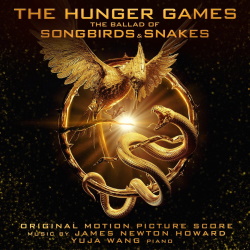 Original Review by Jonathan Broxton
A somewhat belated fifth film in the massively successful Hunger Games franchise, The Ballad of Songbirds and Snakes is a prequel set decades before the events of the first four films, which explores the rise to power of Coriolanus Snow, the Donald Sutherland character who would eventually become the dictatorial president of Panem. Here Snow is played by Tom Blyth as an ambitious 18-year-old member of the Panem aristocracy, who is hired to be a mentor for the upcoming 10th Hunger Games, a compulsory televised battle royale in which children from each of Panem’s districts compete to the death. Snow’s mentee is Lucy Gray Baird (Rachel Zegler), a tribute from District 12, the same district that Katniss Everdeen would come from 60 years later; problems arise for Snow when he starts to fall in love with Lucy, and then when he discovers that his best friend Sejanus Plinth may be secretly involved with a revolutionary movement intended to topple the government. The film co-stars Peter Dinklage, Jason Schwartzman, Hunter Schafer, Josh Andrés Rivera, and Viola Davis, and is again directed by Francis Lawrence, who directed the previous three Hunger Games films.
Also returning to the Hunger Games franchise for a fifth time is composer James Newton Howard. The Hunger Games series is now by far the biggest musical franchise in Howard’s career, outstripping the two Maleficent films, the two Fantastic Beasts films, and the two Snow White and the Huntsman films. It’s strange to me, then, that for some reason the Hunger Games scores never seem to linger in my memory thereafter. It’s not that the music is bad – on the contrary, it’s generally excellent, works perfectly in film context, and is immensely enjoyable in the moment. It’s just that, for whatever reason, the specifics of the Hunger Games scores never stay with me afterwards – the themes, the interplay between them. I can’t explain it in any logical way. As such, and true to form, I found the score for The Ballad of Songbirds and Snakes to initially be thoroughly entertaining, but subsequently oddly anonymous, leaving me with the unusual notion that I had never listened to it at all. I realize that this is entirely a wholly subjective ‘me problem,’ but it is nevertheless a problem.
 In the moment, though, there is much to enjoy. Like the other scores in the series, The Ballad of Songbirds and Snakes is a large orchestral work with multiple recurring themes and plenty of action and suspense but, unlike its predecessors, it has a more classical tone to represent the film’s earlier setting within the Hunger Games timeline. As such, Howard makes less use of keyboard textures and synths in his score, and instead uses pianos and more traditional orchestral instruments. Furthermore, the score makes use of a baroque ensemble featuring performances from a variety of period instruments (viola da gamba, fiddle, accordion, others), which gives The Ballad of Songbirds and Snakes a unique flavor when compared to the other Hunger Games scores.
Thematically, the score is built mostly around three or four new themes for the main protagonists Snow, Lucy, and Sejanus, although the theme for ‘Young Snow’ here is different from the theme for ‘Old Snow’ that came to be a major part of the second, third, and fourth Hunger Games scores. Interestingly, the theme for Snow is the least prominent of the three, which is perhaps a little unusual considering he is ostensibly the lead character; the music for him is largely absent throughout the first half of the score, and only really establishes itself as a recognizable identity during the last 15 minutes or so. Instead, there is a recurring relationship theme for Lucy and Snow that is used more frequently to represent him, until the emergence of his primary identity later.
Lucy’s Theme is a three-note idea that first appears in “Assigning the Mentors,” a cue which uses both the baroque ensemble and some Appalachian-style guitars to create an interesting atmosphere, and later uses voices and more dissonant textures to initiate a more threatening mood. In “Meet the Mentor” Lucy’s Theme blends with the first performance of the hesitantly romantic theme for Lucy and Snow, but it is far from fully developed, and instead seems to be more on the antagonistic side, clearly showing that the pair do not yet fully trust one another. Their relationship is not fully cemented until “Saving Snow,” when both Lucy’s Theme and the theme for Lucy and Snow play together as part of something warmer and more emotional.
Elsewhere, Lucy’s Theme forms the core of the dour and sinister “Strategy,” which is focused on a duet between piano and viola de gamba, and has an ominous overtone that is quite compelling. Perhaps the most satisfying statement of the theme comes in the one-two punch of “Get Her Out” and “The Sound of Snow” where Howard arranges her theme for the full, resplendent orchestra and chorus, combines it with a reprise of the classic Mockingjay theme from the prior Hunger Games scores, but then has it adopt a searingly tragic quality that is dramatically captivating.
Unexpectedly, the theme which captured my attention the most was the theme for Sejanus, Snow’s best friend, who is revealed to be secretly involved in a treasonous plot to end the Hunger Games and bring down the tyrannical Panem government. Sejanus’s Theme is tragic and mournful, and uses repetitive, almost minimalist phrases for a solo cello, ostensibly representing his tortured psyche, as well as the horror he feels regarding the cruelty of the Games. Sejanus’s Theme is introduced prominently in “Sejanus,” comes back accompanied by soft chorales in the pretty-but-anguished “Mercy,” is re-imagined for solo piano and vaguely sinister harps in “Cut the Feed” (which also contains an unintentional reference to Danny Elfman’s Batman), and also features prominently in “Powerful”.
It’s also worth noting that Howard brings back several thematic ideas from previous Hunger Games scores, including the Mockingjay motif in “Coryo in the Capitol,” and Katniss Everdeen’s ‘Victory’ theme in “Trust is Everything” and “I Can’t Stay Here,” although the thematic application of the themes in these moments seems a little odd in terms of what the themes actually represent for the overall story. This type of thematic non-specificity was an issue in Howard’s Fantastic Beasts scores recently too, with themes that appeared to represent one thing in one score being used to represent something entirely different in another, and it may annoy some listeners here.
Interspersed between all these thematic ideas are several moments of large scale action and suspense in the familiar Howard style; regular listeners of his work will be reminded of recent scores like Fantastic Beasts and Maleficent, as well as some of his classic 1990s action efforts like Waterworld. For me, the pick of these include “Happy Hunger Games,” which is tremendously exciting albeit underpinned with a sense of menacing, darkness; “Open the Gate,” which features some clever interpolation of the baroque instruments into the action; the enormously aggressive “Afraid of Water,” and the excellent “Drone Attack” which features some notably intense whooping brass phrases. Also worth mentioning here is the flamboyant fanfare heard in “Anthem: Gem of Panem,” which is this score’s version of the “Horn of Plenty” cue from the first Hunger Games.
Elsewhere, there is a sinister motif for eerie strings and voices in “Gamemaker,” which appears to be linked with Peter Dinklage’s character Casca Highbottom, who is largely responsible for the creation of the Hunger Games themselves. This is followed by several extended periods of moody string-based suspense typified by cues like “Hunger is a Weapon,” “The Arena,” “Department of War,” and “Inside the Duct”. Some of these passages do tend to be a little on the murky side, although “Hunger is a Weapon” does make interesting use of some of the Appalachian orchestrations, and “The Arena” has a curious bit of Thomas Newman about it in the bass passacaglia. I also like the lovely combination writing for baroque ensemble, voices, piano, and Appalachian drones in both “Ideas Firing” and “You Are Safe”.
Somewhat unusually the score ends on something of a dour note instead of anything resembling a clear resolution; in cues like “Cabin in the Rain, “Change of Plan,” and “Passed the Tests”” Howard allows his music to meander through several minutes of low-key suspense and drama, although did notice that “Passed the Tests” references the existing Coriolanus Snow theme from the earlier Hunger Games scores, possibly acknowledging his transformation from idealistic Panem patriot into something more sinister. Thankfully the more expansive “Snow Lands on Top” prominently features the Sejanus Theme and the classic Mockingjay Theme, and does build up a decent head of steam. Overall, though, this is an unexpectedly downbeat end to the album, which might leave some listeners unsatisfied.
The soundtrack album contains three bonus cues, “Friendship,” “Rue’s Farewell,” and “Victor,” which are listed as ‘Solos for Yuja’ and are performed by Chinese concert pianist Yuja Wang. They are lovely, but seem a little disconnected from the rest of the album. It’s also worth mentioning that there is a second album of music from The Ballad of Songbirds and Snakes featuring all the original songs performed in the film, including Rachel Zegler’s performance of “The Hanging Tree” from The Hunger Games: Mockingjay – Part 1, which is shown in film context here actually being written and performed in response to Lucy and Snow witnessing the execution of a rebel. There is also an excellent original song, “Can’t Catch Me Now,” written by pop sensation Olivia Rodrigo with Dan Nigro, and performed by Rodrigo. The song is a folk-rock murder ballad, performed with a quiet intensity by Rodrigo in a breathy falsetto similar to her contemporary Billie Eilish, blended with a little bit of the country twang that Taylor Swift brought to her song “Carolina” from Where the Crawdads Sing last year. It has an outside chance at an Oscar nomination, and it’s one of my favorite original songs of the year.
The Ballad of Songbirds and Snakes is a good and engaging score, full of excellent action sequences, lovely writing for the full orchestra, moments of deep emotion and sensitivity, and some evocative use of both the folk-rock instrumentals and the baroque ensemble. The only drawback to the score that I can foresee is the fact that the new thematic ideas are a little on the understated side, and are unlikely to implant themselves into the subconscious of anyone except the most die-hard Hunger Games fans. As I mentioned earlier, this is what happened to me following each listen to the score, where I was impressed in the moment, but couldn’t recall a note of it afterwards. This one issue aside, I still recommend the score as a competent and engaging piece of fulsome action-adventure, full of lots of James Newton Howard’s familiar touches.
Buy the Hunger Games: The Ballad of Songbirds and Snakes soundtrack from the Movie Music UK Store
Track Listing:
- The Dark Days (1:56)
- Anthem: Gem of Panem (0:44)
- Coryo in the Capitol (0:45)
- Assigning the Mentors (2:39)
- Meet the Mentor (2:02)
- Gamemaker (1:21)
- Sejanus (1:59)
- Hunger is a Weapon (2:44)
- Strategy (2:07)
- Department of War (3:40)
- The Arena (2:07)
- Saving Snow (1:24)
- Ideas Firing (4:24)
- Happy Hunger Games (3:30)
- Mercy (2:22)
- Seize the Opportunity (1:19)
- Cut the Feed (1:28)
- Open the Gate (3:47)
- Powerful (1:45)
- Afraid of Water (1:19)
- Drone Attack (3:21)
- Inside the Duct (1:04)
- Under the Flag (2:56)
- Planting the Cloth (3:38)
- Rainbow of Destruction (1:14)
- Get Her Out (3:45)
- The Sound of Snow (2:00)
- Your Life Has Just Begun (1:04)
- You Are Safe (1:47)
- Trust is Everything (1:21)
- I Can’t Stay Here (1:43)
- Cabin in the Rain (1:32)
- Lucy? (2:27)
- The Woods (1:10)
- Change of Plan (2:04)
- Passed the Tests (3:37)
- Snow Lands on Top (3:30)
- Three Solos for Yuja: I. Friendship (2:06)
- Three Solos for Yuja: II. Rue’s Farewell (2:04)
- Three Solos for Yuja: III. Victor (2:01)
Running Time: 87 minutes 24 seconds
Sony Classical (2023)
Music composed by James Newton Howard. Conducted by Pete Anthony, Tim Davies, Gavin Greenaway and Cliff Masterson Orchestrations by Pete Antony, Jeff Atmajian, Peter Boyer, Jon Kull and Philip Klein. Additional music by Michael Dean Parsons. Recorded and mixed by Shawn Murphy. Edited by Steve Durkee. Album produced by James Newton Howard and Michael Dean Parsons.
-
February 2, 2024 at 8:01 amMovie Music UK Awards 2023 | MOVIE MUSIC UK

Shop at the Movie Music UK Store

Member of the

 MOVIE MUSIC UK