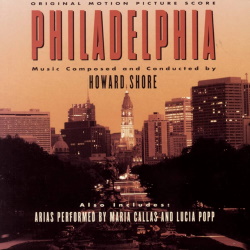
PHILADELPHIA – Howard Shore
 THROWBACK THIRTY
Original Review by Jonathan Broxton
In terms of its subject matter and how it relates to the social issues of the time it was released, Philadelphia is one of the most important films ever made. It was released in the winter of 1993 and, at the time, it quickly became notable for being one of the first mainstream Hollywood films not only to explicitly address both the HIV/AIDS crisis and the then-prevalent societal homophobia, but also to portray gay people in any sort of positive light. The film stars Tom Hanks as attorney Andrew Beckett, a senior associate at the largest corporate law firm in Philadelphia. In order to maintain his career, Beckett conceals his homosexuality and his status as an AIDS patient from others in the office, but eventually his symptoms become too obvious to ignore. However, rather than treat him with sympathy, Beckett is summarily fired by his bigoted boss Charles Wheeler (Jason Robards). Refusing to accept this, Beckett seeks out personal injury attorney Joe Miller (Denzel Washington) to help him sue his former employers, which requires Miller to overcome his own latent prejudice and homophobia.
Philadelphia was directed by Jonathan Demme from a screenplay by Ron Nyswaner, and upon its release became one of the most critically acclaimed films of the year. It went on to be nominated for five Oscars, with Hanks winning his first Best Actor award for his heartbreaking, intense, multi-layered performance. Having previously been successful mostly in comedies and romantic comedies like Big and Sleepless in Seattle, Philadelphia marked a career turning point for Hanks, who subsequently became known as one of the most popular and successful dramatic leading men of his generation. The film also spawned two hit songs, “Philadelphia” by Neil Young, and “The Streets of Philadelphia” by Bruce Springsteen, both of which were nominated for the Best Original Song Oscar, with the latter winning the award.
 Interestingly, and perhaps surprisingly, one of the aspects of the film that is often overlooked is its score, which was written by Howard Shore. This was the second collaboration between director Demme and Shore after The Silence of the Lambs in 1991, but whereas their first collaboration was bathed in a sense of oppressive dread, the score for Philadelphia is unexpectedly tonal and melodic. It is underpinned with a sense of warmth and positivity that likely represents Andrew’s personality and resolve in the face of discrimination – let alone his impending death. Shore builds the score out of a series of lovely textures for strings and woodwinds, sometimes backed by harps, acoustic guitars, light percussion items, and keyboards. The occasional use of brass in the score is limited to one or two scenes of notable emotional strength and power, and in those moments where it is prominent the score is given a significant boost.
The score is built around several recurring thematic ideas: a personal theme for Andrew himself, a theme which seems to represent Andrew’s relationship with the law, a slightly more intense recurring motif that occurs during moments of panic or anxiety, and then an ascending motif that has a redemptive quality. Each of these themes comes and goes with pleasing regularity, often leaving positive lasting emotions whenever they emerge out of Shore’s exquisite textures. I suppose tonally you can sort of consider the score for Philadelphia to be a more serious and dramatic cousin of the other major score he wrote in 1993, Mrs. Doubtfire, especially in terms of how the strings and woodwinds are phrased in lovely combinations.
The first cue, “Senior Associate Andrew Beckett,” introduces the Law Theme, and is built around a warm trumpet line backed by noble strings, refined and elegant. The second cue, “Minor Catastrophe,” introduces the Anxiety Motif, which is unexpectedly magical and is arranged for pretty xylophones and harps backed by chimes, before becoming surprisingly rich and powerful in the finale. It returns later in the “The Missing Document,” which underscores the scene where Andrew frantically searches for a piece of important legal information for an upcoming meeting which may or may not have been intentionally removed so that his colleagues have a more reasonable ‘excuse’ to fire him, as opposed to the homophobia that is actually fueling their actions. Here, the Anxiety Motif develops along more intense lines, and features a haunting cello solo in its latter moments, shrill and restless.
Both these themes feature in the subsequent “The Essence of Discrimination,” which underscores one of Joe Miller’s impassioned and intelligent legal arguments, but is perhaps more intimate, and sees both themes moving around amid some low key scoring for strings and woodwinds, dramatic but underpinned with the same sort of elegance that typifies the rest of the score. The Law Theme also comes back again later in “An Excellent Lawyer,” where it is reimagined as a gentle oboe solo backed by strings.
The personal theme for Andrew first appears in “Birth,” and sees the orchestra backed by keyboard textures and lightly tapped tambourines in what is one of the score’s most positive cues. This music represents Andrew the person, as opposed to Andrew the lawyer – his memories of his childhood and his parents, his loving relationship with his boyfriend Miguel, and more. Andrew’s Theme is prominent later in “Going Home,” which again has a warmly positive attitude, and features a superb performance of the main melody on a solo clarinet.
“The Trial” features agitated strings and slightly off-kilter woodwinds to represent the nervousness Andrew feels when bringing his lawsuit against his former employers, and the emotional toll it takes on him when they try to spin his sexuality and his AIDS diagnosis into something more sinister and dangerous than it actually is. This cue also features the first really prominent performance of the ascending ‘redemption’ motif, which in this instance coincides with the sequence where a gravely ill Andrew collapses in the courtroom. Unusually, the cue ends with sprightly, almost amusingly playful writing for dancing strings and a recurring motif which is passed between piano, woodwinds, and brass.
“Trying To Survive” is stark, emotionally wrought, and has an undertone of anguish, but then in “The Verdict” both the Law Theme and Andrew’s Theme anchor the finale where Andrew – despite being on the verge of death in hospital – wins his historic case and is awarded back pay, damages for pain and suffering, and punitive damages, totaling over $5 million. The music here is dramatic, anticipatory, and bold, but ends with an appropriate moment of reflective introspection that leads into the conclusive “I’m Ready” as Andrew dies in Miguel’s arms and Shore offers a dreamlike and wistful reprise of the ascending ‘redemption’ motif.
The score soundtrack album also includes three excerpts from operas by Mozart, Catalani, and Giordano, reflecting Andrew’s love of opera music. The standout sequence is of course the performance of “La Mamma Morta” from Giordano’s Andrea Chenier by the legendary Maria Callas, which features in the film’s famous scene where Andrew – taking a break from planning his legal strategy – plays the piece for Joe, and descends into raptures of musical ecstasy as the aria climaxes, in a way that only someone who lives and breathes this music will understand. The subtext of this scene – how this is likely to be the last time Andrew ever listens to his favorite piece of music, and how that piece talks about the life and love that Andrew will likely never know – is heartbreaking, and even now the scene elicits chills. The intensity of the scene is probably what won Tom Hanks his Best Actor Oscar, and it was well-deserved.
Philadelphia is an excellent, underrated score from a serious, important film, and it again shows how Howard Shore was contributing so much to film music before he was ‘discovered’ by the mainstream in the wake of The Lord of the Rings. Philadelphia will likely never capture anyone’s imagination in the way his more famous works do, but it is still a sensitive, appropriate, dramatically intelligent score that has some satisfying moments and works in perfect combination with both the opera sequences, and with Bruce Springsteen and Neil Young’s similarly excellent songs.
Buy the Philadelphia soundtrack from the Movie Music UK Store
Track Listing:
- Senior Associate Andrew Beckett (1:30)
- Minor Catastrophe (3:14)
- Birth (2:20)
- Non Temer Amato Bene from ‘Idomeneo’ (written by Wolfgang Amadeus Mozart, performed by Lucia Popp with the Munchner Rundfunk Orchestra cond. Kurt Eichhorn) (4:05)
- I Have A Case (4:02)
- The Missing Document (4:42)
- The Essence of Discrimination (4:58)
- Going Home (3:30)
- The Trial (3:27)
- Ebben? Ne Andro Lontana from ‘La Wally’ (written by Alfredo Catalani, performed by Maria Callas with the Philharmonia Orchestra, cond. Tullio Serafin) (4:48)
- Trying to Survive (5:54)
- La Mamma Morta from ‘Andrea Chenier’ (written by Umberto Giordano, performed by Maria Callas with the Philharmonia Orchestra, cond. Tullio Serafin) (4:48)
- An Excellent Lawyer (2:42)
- Calculated Risks (2:31)
- The Verdict (2:46)
- I’m Ready (1:20)
Running Time: 57 minutes 12 seconds
Epic Records EK 57823 (1993)
Music composed and conducted by Howard Shore. Orchestrations by Howard Shore. Recorded and mixed by John Kurlander. Edited by Suzana Peric. Album produced by Howard Shore.

Shop at the Movie Music UK Store

Member of the

 MOVIE MUSIC UK