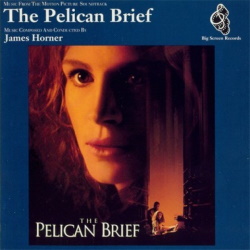
THE PELICAN BRIEF – James Horner
 THROWBACK THIRTY
Original Review by Jonathan Broxton
The Pelican Brief is a legal thriller directed by Alan J. Pakula, adapted from the best-selling novel by John Grisham. The film stars Julia Roberts as Darby Shaw, a law student at Tulane University, who becomes romantically involved with her professor, Thomas Callahan (Sam Shepard). After two Supreme Court justices are assassinated, Darby writes a legal brief speculating about the possible motives behind the murders. In this document – which she calls the Pelican Brief – she suggests a theory involving an intricate plot to control the balance of power in the United States Supreme Court; however, after it is published, it quickly becomes apparent that Darby’s speculations are very close to the actual truth, and before long she finds herself targeted by assassins hired by the perpetrators, who are determined to eliminate anyone who may know about their plans. With nowhere else to turn, Darby contacts Gray Grantham (Denzel Washington), an investigative journalist, and together they race against time to uncover the identity of the people behind the murders and bring the conspiracy to light.
The film is a superb, twisty thriller, a legal conspiracy with political implications, and was very successful at the box office, grossing more than double its production budget. It also receiving decent reviews from critics, one of whom called it “a heart-stopping, spine-chilling, adrenaline-pumping, run-for-your-life thriller”. It was a perfect vehicle for director Pakula, who made his name directing films similar to this in the 1970s and 80s – Klute, The Parallax View, All the President’s Men, Presumed Innocent. It also has a terrific supporting cast of heavyweight character actors – John Heard, Tony Goldwyn, James B. Sikking, William Atherton, Robert Culp, Stanley Tucci, Hume Cronyn, John Lithgow – playing a variety of lawyers, politicians, and federal agents, wearing smart suits in wood-paneled offices. I miss these types of star-studded legal thrillers, which appear to have essentially vanished from mainstream cinema over the last couple of decades.
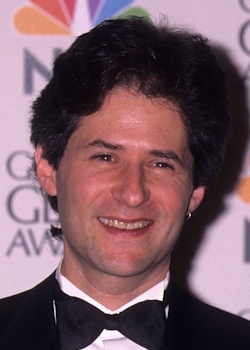 The score for The Pelican Brief was by James Horner, who was working with director Pakula for the first time. It was the last of the astonishing ten films he scored in 1993 – the others being Swing Kids, A Far Off Place, Jack the Bear, Once Upon a Forest, House of Cards, Searching for Bobby Fischer, The Man Without a Face, Bopha, and We’re Back! A Dinosaur’s Story – and while it is more subdued and less heralded than many of the others on that list, there is still plenty to take away. The Pelican Brief was one of the first scores I heard when I started venturing into the lesser-known corners of James Horner’s filmography but, for many years, I actually didn’t like if very much. It’s a score which requires patience in order for you to appreciate the payoff, and as a younger man I was more into musical instant gratification. It is only in recent years that I have come to appreciate this score and everything it has to offer.
The score’s main recurring theme is “Darby’s Theme,” which is best heard in its concert arrangement in the score’s tenth track, which I personally always program first so that it immediately ingrains itself in your memory, prior to the score proper unfolding. The theme is excellent, a quintessential ‘Horner thriller’ theme, which emerges hesitantly from a fluttering woodwind motif via warmly noble horns, into an excellent sweeping theme for strings. In terms of Horner’s then-recent filmography it shares tonal similarities with things like Searching for Bobby Fischer, Swing Kids, and Sneakers, while foreshadowing some of the things he would later do on scores like Apollo 13, Courage Under Fire, Ransom, and others. There is a seriousness to it, but that seriousness is underpinned with a sort of righteousness and almost patriotic moral authority that makes it very appealing. It speaks to the goodness in you, standing up for what’s right.
Interestingly, for a lot of the rest of the score, Darby’s Theme is only heard in fragments, cropping up occasionally in more subtle ways, continually alluding to the fact that Darby and her crusade to uncover the truth is at the heart of the story, but that this crusade is continually overshadowed by suspense, drama, and occasional moments of intense, frantic action. The “Main Title” is an excellent example of this; Darby’s Theme is there all throughout the piece, especially the undulating piano motif, but the cue is dominated mostly by minimalistic textures for strings, pianos, electronics, ethereal voices, and tapped woodblocks. Tonally, this piece has a lot in common with the music Horner wrote for Thunderheart in 1992, and it creates a mystical, moody atmosphere.
Many of the subsequent cues dwell in a similar musical place. “The Pelican Brief” has echoes of Aram Khachaturian’s adagio from the ballet Gayaneh, which Horner used to similar chilling effect in scores like Aliens and Patriot Games. “Researching the Brief” revisits the ticking woodblocks and ethereal vocals from the main title, but the piano undercurrent beneath it is more insistent and urgent, while later in “The Killing” the woodblocks combine with an insistent version of the piano motif from Darby’s Theme and some tension-filled string figures to elicit a mood of nervous anticipation and barely-contained anxiety. The version of the main theme towards the end of the cue is impressively austere, and this continues on into the equally suspenseful “Bourbon Street,” which begins with some lonely writing for solo piano, before becoming more heavily electronic as the cue develops – the tone of the synths here actually reminded me of his score for The Name of the Rose from 1986, an unexpected throwback.
“Hotel Chase” is the first of the score’s major action sequences, and it’s a doozy. It’s a dark, sometimes brutal explosion of jazzy piano licks, electronic percussion, aggressive strings, and frantic brass clusters, frenzied and chaotic but quite outstanding. The familiar ‘crashing pianos’ had become something of a trademark in Horner’s action music by this point – he used them in Unlawful Entry, Sneakers, A Far Off Place, and Once Upon a Forest, among others – but for my money The Pelican Brief offers the best and most consistent use of the technique. The first half of “Planting the Bomb” offers more moody variations on Darby’s Theme but the second half explodes furiously, the crashing pianos offset by more of those insistent woodblocks, brass triplets, dynamic and varied percussion textures, and undulating string work. I really appreciate how, at several points in these cues, there are little hints of jazz coming through in the chord progressions, alluding to the film’s New Orleans setting – it’s subtle, but very clever.
However, for me, the pick of the action cues is the “Garage Chase,” which combines all of Horner’s best early-1990s action music tendencies into one showstopper. The relentless snare drum riffs add a new dimension of energy to the cue, the ticking woodblocks maintain the sense of suspense, the strings swirl relentlessly, and the pianos range in style from expressively rhythmic to utter bedlam. Horner would revisit parts of this music almost verbatim in Legends of the Fall in 1994, and it remains one of my favorite recurring ideas.
“Darby’s Emotions” offer’s one of the score’s few prominent statements of the main theme, although here the emotional intent is much darker and more anguished than the version heard in the main title. There’s also some fantastically turbulent, dramatic combination writing for strings punctuated by shrill brass triplets that enhances the danger of Darby’s perilous situation. Everything comes to a head in “Airport Goodbye,” which is one of those extended 10 minute sequences that Horner loved to write for the final scenes of his films, segueing into the end credits. It’s a wonderful set of variations on Darby’s theme, running a gamut of emotions; at times it is filled with regret, at times it has an almost funereal sense of loss, but then as the cue develops it becomes warmer, more tonal, more conventionally romantic, and it gradually builds to a tremendous conclusive statement filled with that familiar sweeping sound; the crescendo that peaks at the 3:47 mark is quintessential Horner.
The Pelican Brief is not one of James Horner’s more beloved scores, and on the surface it’s not difficult to see why. Quite a lot of the score is quite dour, filled with percussive suspense and brutal, chaotic action. The main theme, while lovely, is not one of the ones that stays in the memory for long, and if you look at the score in terms of the totality of his entire career, most of what he is doing here he has done elsewhere, and often with more pleasing results. However, even with that in mind, I still find myself being much more drawn to this score now than I ever was in the past, and there must be something to be said for the fact that I now appreciate Horner’s efforts here greatly. For Horner scholars it is a fascinating ‘bridge’ score, linking his late-80s/early 90s style with his mid-90s golden period; for everyone else, there are probably other more important scores to explore before you get to this one.
Buy the Pelican Brief soundtrack from the Movie Music UK Store
Track Listing:
- Main Title (2:32)
- The Pelican Brief (3:51)
- Researching The Brief (1:32)
- Hotel Chase (4:02)
- The Killing (3:17)
- Bourbon Street (4:06)
- Planting The Bomb (4:17)
- Chasing Gray (3:16)
- Darby’s Emotions (3:37)
- Darby’s Theme (3:57)
- Morgan’s Final Testament (1:49)
- Garage Chase (5:00)
- Airport Goodbye (10:39)
Running Time: 51 minutes 55 seconds
Big Screen Records 9 24544-2 (1993)
Music composed and conducted by James Horner. Orchestrations by Don Davis and Thomas Pasatieri. Recorded and mixed by Shawn Murphy. Edited by Jim Henrikson. Album produced by James Horner.

Shop at the Movie Music UK Store

Member of the

 MOVIE MUSIC UK