THE JAZZ SINGER – Louis Silvers
 GREATEST SCORES OF THE TWENTIETH CENTURY
Original Review by Craig Lysy
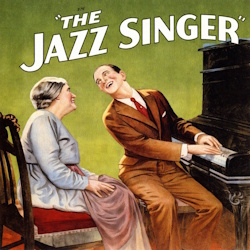
The genesis of The Jazz Singer film lay with writer Samson Raphaelson, who after seeing 30-year-old Al Jolson perform decided to wrote a short story called “Day of Atonement” about a Jew named Jackie Rabinowitz, based on Jolson’s life. He then adapted the story into a successful play titled “The Jazz Singer”, which became a sensation in 1925. Warner Brothers executives rolled the dice and bought the film rights; along with the Vitaphone Corporation they would finance the film with a $422,000 budget, Darryl F. Zanuck would manage production, Alan Crosland would direct, and Alfred A. Cohn would write the screenplay. Sam Warner, nicknamed “Father of the Talkies,” made the creative decision to synchronize the film’s music. Later, he insisted that Al Jolson’s ad-libbed speech (about two minutes) also be included in the movie. Tragically Warner did not live to see his pioneering efforts come to fruition as he died the day before opening night. For the cast, Al Jolson would star as Jakie Rabinowitz, joined by Warner Oland as Canto Rabinowitz, Eugenie Besserer as Sara Rabinowitz, and May McAvoy as Mary Dale.
Thirteen-year-old Jacob Rabinowitz is the son of a Jewish Cantor, who is grooming him to carry on the family tradition, and become a cantor at the local synagogue. Jacob likes to sing jazz, rebels and has a falling out with his father who disowns him. Jacob anglicizes his name to Jackie Robin and begins singing at cabarets where he makes a name for himself. Jack finally gets his big break, but on the night of his premiere, his father takes ill. He goes to his father’s death bed, and they reconcile with Jacob singing the “Kol Nidre”, which seeks God’s favor. His father dies thankful and in peace. Later Jack performs his show “The Jazz Singer” at the Winter Garden Theater and sees his mother in the front row. He is happy and sings the song “Mammy” for her and the world as a testament of his love. The film was a huge commercial success, earning $2.18 million. Critical reception was favorable, and the film received one Academy Award nomination in 1929 for Best Writing, Adaptation. Also, an Honorary Academy Award was awarded to Warner Brothers for producing “The Jazz Singer”, the pioneering, and outstanding talking picture, which revolutionized the industry.
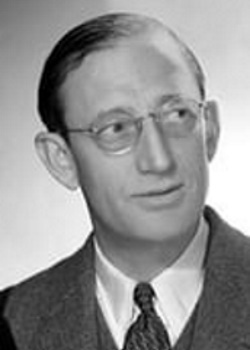 Louis Silvers was tasked with scoring the film. Upon viewing it, I believe he understood that the nexus of the story was the all too familiar father-son conflict. Papa Rabinowitz was born in the old country and is his family’s 4th generation Cantor. He values old country traditions, and insists that his son Jackie follow in his footsteps as the next Cantor. Jackie rebels, embraces the new world and jazz music and seeks to live his life as he desires, as a jazz singer. As such, the musical narrative needed to speak to this conflict where religious hymns are juxtaposed by the jazz world Jackie echoes.
For his soundscape Silvers decided to interpolate a number of classical pieces, which would serve as leitmotifs, as well as infusing the musical narrative with the requisite jazz songs. In terms of primary themes, foremost is the Disappointment Theme, which is drawn from “Sérénade Mélancolique in B-flat Minor, Op. 26” by Pyotr Ilyich Tchaikovsky. The music offers as the name states, aching violin borne melancholia; the sadness felt by Papa, and the disappointment felt by Jackie of letting his father down. The Kol Nidre Theme is drawn from “Kol Nidre – Adagio for Cello and Orchestra Opus 47 by Max Bruch. It offers a solemn melody, which supports the sacred Jewish hymn of Atonement. The theme represents both Papa as a Cantor, his desire for Jackie to follow in his footsteps, and an emblem of their Jewish faith. Silvers uses melodies from the “Romeo and Juliet Fantasy Overture” by Pyotr Ilyich Tchaikovsky to impart aural color, and a sense of tragedy, which speaks to the father-son conflict. The tender, romantic ballad “If a Girl Like You Loved a Boy Like Me” by Gus Edwards and Will D. Cobb is used as a Love Theme for Jack and Mary. Silvers often expresses the melody in dance and waltz form, and it is splendid how well it works in the film. Lastly, “Beau Soir” (Beautiful Evening) by Claude Debussy offers the aural serenity, and tranquil beauty of the sun setting over wheat fields. Silvers uses it as a threnody, as Papa lay on his death bed.
Secondary themes include the melodies of “Yosl, Yosl” (Joseph, Joseph) by Samuel Steinberg and Nellie Casman and “The Sidewalks of New York” by Charles Lawlor, which offers vibrant energy, which is used to support the bustling street life of the Jewish Ghetto and streets of New Yor City. For Jewish culture, Silver offers the minor modal, string borne Jewish Theme, which is tinged with an intangible sadness that speaks to Jewish life. The “Kaddish” (Sanctification) offers a traditional, solemn, reverential prayer hymn, which offers sanctification and magnification in God’s name. For the jazz performances sung by Jolson, we have “My Gal Sal” by Paul Dresser, “Waiting for the Robert E. Lee” by Lewis F. Muir and L. Wolfe Gilbert, “Dirty Hands, Dirty Face” by James V. Monaco, Edgar Leslie, Grant Clarke and Al Jolson, “Toot, Toot, Tootsie” by Gus Kahn, Dan Russo, Ernie Erdman, Ted Fio Rito and Robert A. King, “Blue Skies” by Irving Berlin, “Mother of Mine, I Still Have You” by Louis Silvers and Grant Clarke, “My Mammy” by Walter Donaldson, Sam Lewis and Joe Young, “In the Good Old Summertime” by George Evans, and “Give My Regards to Broadway” by George M. Cohan.
There is no commercial release of the score, so as such I will use film scene descriptors and time indices. 00:00 “Overture” offers a wonderful score highlight in the form of the Old Hollywood tradition playing an overture before the start of the first reel. Silvers interpolates the opening bars of Tchaikovsky’s Romeo and Juliet Fantasy Overture (1880), which sets a pensive mood. At 00:15 the mood brightens atop a stepped ascent by refulgent strings, crowned by a harp arpeggios. At 0:35 we flow into a solemn exposition of the Disappointment Theme. At 1:59 the melody reprises with energy and determination, attempting to soar, but unable to break free, instead settling into an extended exposition tinged with sadness. At 3:16 we close the overture with a heartfelt exposition of the “Mother of Mine, I Still Have You”. 04:30 “Main Title” reveals the display of the Warner Brothers logo and the roll of the opening credits. Silvers reprises his music from the Overture. 05:30 “Script Narration”, supported by the Kol Nidre melody offers;
“In every living sol, a spirit cries for expression – perhaps this plaintive wailing song of Jazz is, after all, the misunderstood utterance of a prayer”. The New York Ghetto – throbbing to that rhythm of music, which is older than civilization.
05:57 “The Ghetto” reveals the bustling street life of the Jewish Ghetto, which Silvers supports with the melody of “The Sidewalks of New York”. At 6:08 it assumes an animated, carnivalesque expression as boys spin on a merry-go-round, before resuming a strolling expression. 06:26 “Cantor Rabinowitz” reveals script attesting to his stubbornness holding to the ancient beliefs and traditions. He and Mama argue as he insists his son must continue the family tradition by being a cantor, and she suggest his interests may lie elsewhere. Silvers supports the scene with the Disappointment Theme. 07:25 “Ragtime Jackie” reveals Jackie at the local saloon preparing to sing with piano accompiament. We open with the melody of “In the Good Old Summertime” by George Evans, a prelude for Jackie singing the romantic ballad, “My Gal Sal” by Paul Dresser. Jackie’s performance is seen by family friend Moisha Yudelson. 08:38 “Moisha Informs Cantor Rabinowitz” reveals him running to the Rabinowitz home to give Jackie’s father the bad news. At home Mama and Papa continue to argue about Jackie with mama agreeing that he knows all the songs in his head, but that they are not in his heart. As we shift to back and forth between Moisha and the Rabinowitz’s Silvers supports with an animated rendering of the Yosl, Yosl Theme. At 09:17 a flute interlude supports Papa fretting that Jackie is late for dinner and may have to fast for Yom Kippur without eating. The Disappointment Theme joins to supports Moisha’s arrival. A dissonant crescendo supports him bringing news of Jackie singing ‘raggedy’ songs in a saloon. Papa is furious and storms out, carried by an angry musical narrative. 10:25 “Papa Whips Jackie” reveals Jackie on stage singing his next song, the happy-go-lucky “Waiting for the Robert E. Lee” by Lewis F. Muir
At 10:50 the song is severed as an angry Papa arrives, grabs Jackie by the collar, and drags him out supported by a grim Kol Nidre Theme. As Papa drags him home through the streets, the theme becomes molto tragico. At 11:19 they arrive home and Mama takes Jackie into her arms supported by a reprise of Tchaikovsky’s “Romeo and Juliet”, now emoted full of yearning. Papa has had enough and takes off his belt to whip Jackie. We shift back to a sad rendering of the Disappointment Theme at 12:06 as Jackie shouts that if Papa whips him again, I’ll run away and never come back! The theme swells on a crescendo dramatico as Papa forces Jackie into the bedroom and beats him, while Mama weeps outside. 12:39 “Jackie Runs Away” reveals a distraught and tearful Jackie running to mama’s arms carried by a molto tragico rendering of the Disappointment Theme. He kisses her goodbye and flees before Papa comes out. Mama is devastated, and Papa tells her it is time to depart for the services. We close with anguish as Papa departs and Mama stares at a portrait of Jackie, who she believes is never coming back.
14:13 “Yom Kippur Services” reveals Papa and the congregation assembled in the synagogue for the solemn services. The molto tragico exposition of the Kol Nidre Theme supports as we see Mama sobbing in a pew, and Papa informing the rabbi that Jackie, who is no longer his son, will not be singing with him. At 15:10 Papa begins singing solemnly, Kol Nidre in Aramaic, which I translate;
“All vows, renunciations, bans, oaths, formulas of obligation, pledges, and promises that we vow or promise to ourselves and to God from this Yom Kippur to the next—may it approach us for good—we hereby retract. May they all be undone, repealed, cancelled, voided, annulled, and regarded as neither valid nor binding. Our vows shall not be considered vows; our renunciations shall not be considered renunciations; and our promises shall not be considered promises”.
While Papa is singing, Jackie returns home and retrieves a photo of Mama, and then departs, dejected and sad. 17:27 “Jack Robin” reveals script saying “Years later, and three thousand miles from home”. A spritely musical narrative supports scenes of food being served and Jack, now a young man (Al Jolson) eating. New script informs that Jackie Rabinowitz the cantor’s son had become Jack Robin, the jazz singer. A festive musical narrative unfolds in a cabaret as we see Jack dining as people dance on the dance floor. The owner then declares the Jack Robin will sing “Dirty Hands, Dirty Face”, sung by Al Jolson. A tender prelude carries him on stage and at 19:06 he begins singing a loving father’s sentimental ode of his son. Mary Dale enters the cabaret and is taken by Jack’s vocals and performance. At this point Jolson ad libs, the famous line “Wait a minute. “You ain’t heard nothin’ yet”. This was never intended as part of the script, Sam Warner loved it, decided to keep it, and the rest is history.
Jack agrees to sing another song “Toot, Toot, Tootsie” as Mary and her friends are seated. 22:14 “Toot, Toot, Tootsie” reveals an animated Jack singing the playful and happy-go-lucky song. An interlude follows where Jack begins bird call whistling the song melody as Mary looks on with amazement.
24:27 “Jack Meets Mary” reveals effusive applause supporting Jack returning to his table. The host delivers a message to Jack that Mary wishes to meet him. Silvers supports with “If a Girl Like You Loved a Boy Like Me” song melody rendered as a valzer tenero, which carries Jack to her table. After introductions, Jack commends Mary on her act, which he saw in Salt Lake City. She responds that there are lots of jazz singers, but that he has a tear in his voice. He thanks her, and she offers to help his career. 26:12 “The Letter” offers a beautiful score highlight. It reveals script “For those whose faces are turned toward the past, the years roll by unheeded – their lives unchanged”. Papa is teaching a student to sing at a piano and Silver supports with the Disappointment Theme. At 26:33 the Kol Nidre Theme supports Moisha’s visit. Mama shows him a letter from Jack saying life is good and that he is making $250/week thanks to a wonderful girl, Mary Dale. He says his new name is Jack Robin, and signed it your loving son Jackie. At 28:12 the Disappointment Theme, full of regret, resumes as Moisha departs, followed by the boy who tells Mama that the cantor is angry today. A crescendo dramatico swells with anger as Mama shows Papa the letter and he shouts that he does not want to see his letters, as we have no son! As Mama bows her head in despair, an anguished coda of the theme ends the scene.
28:55 “Jack and Mary Tour The Country” reveals script showing the cities in which Jack and Mary have performed. Silvers supports with a danza vivace as we shift to the stage where Mary dances balletically, as an adoring Jack watches from side stage. We end with a flourish as the crowd erupts in applause and Mary takes a bow. At 29:51 the song melody “If a Girl Like You Loved a Boy Like Me” is rendered as a valzer romantico, which supports Mary and Jack happy moment as the next act takes to the stage. She shows him a telegram from New York offering her the leading role in a new musical. He tells her he is happy for her, but we see it is bittersweet as he adds that he will miss her. He thanks her for getting his career started, and she promises to write. As she departs, we close on a diminuendo of sadness. 32:10 “Concert” reveals a bustling street and a bill board showing a concert with Cantor Rosenblatt singing Sacred Songs, which Silvers supports with the Yosl, Yosl Theme. Jack goes in and takes a seat and at 32:37 Rosenblatt sings the traditional sanctification hymn the Kaddish. We see that Jack is wistful, clearly affected by the performance. At 33:48 we switch to the synagogue where papa seamlessly continues to sing the Kaddish – reflective of Jack recalling the past.
34:36 “Jack Writes to Mary” reveals him writing a letter to Mary at the train station in which he says he misses her, and asks how her show was going. Silvers supports with “If a Girl Like You Loved a Boy Like Me” rendered as a delightful valzer felice. At 35:17 a playful, but silly musical narrative atop the Yosl, Yosl Theme plays as a diva rave against Jack getting top billing for the show. Men run up to Jack and tell him to not board the train as his booking has been cancelled. Jack is devastated, and the diva who over heard is delighted. The musical narrative saddens until the man delivers the good news – that he was released from his contract so he could appear in a Broadway revue! Jack does not believe him until he pulls out his train ticket to New York. The music brightens and at 37:25 we flow into a joyous rendering of “Give My Regards to Broadway”. Jack is ecstatic and yells “Home!” and “Mother!” An interlude of the Yosl, Yosl Theme supports him kissing the show’s diva goodbye. “Give My Regards to Broadway” resumes as he waves goodbye to his friends.
37:58 “Papa’s 60th Birthday” opens somberly but livens up atop a festive Jewish melody as Mama and Mrs. Yudelson prepare for the feast. At 38:20 the music becomes comic as they are flummoxed when they discover that they both bought Papa the same present – a prayer shawl! The comic musical narrative continues as Moisha arrives with a chicken and a jug of wine he made personally. The Jewish Theme resumes at 38:48 as he brags about his wine, and present he brought. The women are aghast after he pulls out – another prayer shawl! They commend him on his gift and the Jewish Theme carries Moisha and his wife’s departure.
39:43 “Jack Comes Home” offers one of the score’s most tender and emotional moments. It reveals him returning home and bumping into Moisha on the street. They reacquaint and Moisha is happy that he has returned. Silvers supports with a hopeful rendering of the Disappointment Theme. At 40:32 enters the apartment carried by a sad Kol Nidre Theme. He is wistful as he looks around the apartment. He sees mama cooking in the kitchen and the Disappointment Theme swells on a crescendo di gioia. He hugs and repeatedly kisses her, supported by the joyous warmth of a romance for strings. She expresses how happy she is to see him, and he informs her he has come back to New York as he has a new job. At 42:12 a crescendo felice swells as he opens his bag and gifts her a diamond studded necklace. Silver supports the tender and intimate mother-son reunion with a musical narrative, which bathes us with joyous, string borne familial love. At 42:57 the music descends into sadness as he sees a landscape picture hanging where his portrait used to hang. She lies, saying it fell and broke instead of admitting Papa ordered it taken down. Jack is not fooled, and asks how Papa is doing. The music again brightens as he relates that he will be singing in a big show, promising to sing a song he wrote just for her.
44:10 “Blue Skies” reveals him escorting Mama to a chair by the piano, and then performing Irving Berlin’s iconic song in Jolson’s singular style. We now hear extended dialogue as he kisses her and promises to move her and Papa out of the ghetto to the Bronx where the wealthy Jews live, buy her a new pink dress, and take her to Coney Island. A piano line gently supports under the dialogue. He then tells her that he will perform this song, but in a jazzy style, and he reprises the performance. He is happy, a joyous moment that is shattered when papa arrives and yells “Stop!”
47:17 “Papa Rejects Jack” offers a poignant score highlight. It reveals Jack asking papa how is he, yet papa remains speechless. Silvers supports with a reprise of Tchaikovsky’s main melody for Romeo and Juliet, which swells on a crescendo tragico as Papa declares; “You dare to bring your jazz songs into my house! I taught you to sing the songs of Israel – to take my place at the synagogue!” Jack is defiant, saying he will live my life as he sees fit! Papa responds angrily, but at 48:54 mama tries to calm the storm, and the passion of Tchaikovsky’s music subsides as she says Jack has come home for your 60th birthday. Jack follows up pulling out a birthday present for ‘Cantor Rabinowitz’. Papa’s fury subsides and the music warms as Mama opens the box to reveal – another prayer shawl! Tension rises up atop the Romeo and Juliet Theme when Jack says he will be singing on Broadway. We shift to the Disappointment Theme as Papa criticizes singing in a theatre and Jack replies that it is as honorable to sing in a theater as it in a synagogue. The music becomes impassioned as Papa calls him a ‘jazz singer’, and orders him to leave his house as he never wants to see him again. Jack is inconsolable, bows his head and says; “I came home with a heart full of love, but you don’t want to understand”. As a sobbing Mama shows Jack out, he says; “Someday you’ll understand, the same as Mama does”. Silvers supports with the unabashed pathos of the Disappointment Theme. We close with mama saying; “He came back once Papa, but – he’ll never come back again”.
52:16 “April Follies Rehearsals” reveals the choreographer working with the women dancers on stage, which Silvers supports with a delightful, animated danza giocosa. Mary arrives with the show’s producer and assures him Jack’s singing will not disappoint him. Jack arrives and Mary rushes to greet him. As they chat at 54:19 their Love Theme, rendered as a valzer romantico supports with elegance. As she takes him to the stage to introduce him, the bubbling danza giocosa resumes. 55:42 “Papa Falls Ill” reveals that Papa has taken ill and is on his death bed. Silvers interpolates the sad serenity of Claude Debussy’s “Beau Soir”. Moisha arrives and shows Mama a newspaper saying that tomorrow is opening night for the April Follies where Jack and Mary will be performing. Silvers supports the moment with an impassioned reprise of the Disappointment Theme, which carries Moisha’s departure. 56:51 “Mary Rehearses” reveals her rehearsing he balletic dance routine, to the great satisfaction of the choreographer. Silver supports with a festive danza spiritoso. Afterwards Jack compliments her performance, and she informs him that he was going to be a big hit tonight.
58:13 “Moisha Visits” reveals Moisha’s arrival at the theater. A comic rendering of the Jewish Theme supports his intrusion and request to speak to Jack. At 59:03 Silvers voices the Kol Nidre Theme as the doorman advises Jack that he has a visitor. The music swells as he arrives and Jack embraces him in a hug. Then Moisha drops a bombshell – saying that tomorrow, the Day of Atonement, they want you to sing in the synagogue. He then informs that his father has taken ill and cannot discharge the role of Cantor. They argue and the musical narrative becomes poignant and impassioned as Jack says he cannot do it as it is opening night, a night he has dreamed of his whole life. At 1:01:18 Mary arrives to support Jack and the music becomes anguished as Moisha declares that he will be the first Rabinowitz in five generations to fail God. Jack counters that in show business we have a religion also – “The Show Must Go On!” A dejected Moisha departs, Mary consoles Jack and the producer joins to say that dress rehearsal is tomorrow at 1 pm. The music brightens and becomes vibrant atop their Love Theme as a smiling Jack and Mary say that they will be ready. 1:02:55 “Eve of The Day of Atonement” reveals Moisha and the synagogue elders meeting to discuss the reality that they have no Cantor for tonight’s services. Silver offers a pathos for strings interpolating the Disappointment Theme Theme. At 1:03:20 Mama tends to Papa who is distraught that he cannot sing tonight. Silver supports with “Beau Soir” as Papa dreams of Jack’s redemption by singing tonight. At 1:05:10 we switch back to the council of elders atop an extended energetic, albeit comic rendering of the Jewish Theme as an elder steps up and boldly says he will sing.
1:06:24 “Dress Rehearsal” reveals the dance troupe on stage performing, supported by a happy-go-lucky danza giocosa. At 1:06:58 we switch to Jack’s dressing room where he is joined by Mary supported by their Love Theme. She is radiant, but taken aback by his lack of compliments. He is clearly distracted and fragments of Kol Nidre intrude as he applies his black face make-up. He says he is going to put everything into his songs, but the music loses vitality suggesting inner conflict. At 1:08:38 the music swells grandly as he finishes his make-up and places on his head his afro wig, and smiles. Yet at 1:08:49 he looks at a picture of Mama and the anguish of the Disappointment Theme returns. Mary asks if he is worrying about his father and we shift to an oboe triste as he admits his conflict of singing in the show instead of the synagogue. The music gains determination after Mary exhorts him that the show is his life now. Yet at 1:10:00 an aching Disappointment Theme resumes as he looks in the mirror and the image changes to his father singing in the synagogue. He is distraught and tells Mary that the songs of Israel are tearing at his heart for this most solemn Day of Atonement. She counters that the theater is where God has placed him. He admits that his career means more to him than anything else, even her, and she exhorts him to not let anything stand in your way!
1:11:34 “Moisha and Mama Visit” reveals the two visiting the theater in search of Jack supported by a grieving Disappointment Theme. The doorman refuses, but Mama pleads that Jack’s father is dying, and he relents. She comes to him supported by her theme, but does not recognize him in black face. At 1:13:24 the Kol Nidre Theme joins as she tells him that Papa is very sick and calls for you. A man joins and says that you are up next Jack. The music becomes impassioned as Mama pleads with Jack to come home and sing as the sun sets in two hours to mark the beginning of the Day of Atonement. He cries and says he can’t, and she weeps as he departs for the stage. 1:15:19 “The Show Must Go On” offers a song and performance highlight where Jolson’s vocals achieve sublimity. It reveals dress rehearsal with the dance troupe on stage supported by a vibrant danza spiritoso. At 1:15:34 they depart the stage, to a diminuendo as Jack arrives and takes center stage. He sings the tender and heart felt testament of a son’s unabiding love for his mother; “Mother I Still Have You”. At this point Mary brings mama and Moisha to side stage to watch. She admits to Moisha that this is where Jack belongs.
The melody reprises with the staff’s applause and supports his exit to back stage where Mary and the troupe congratulate him. The melody swells as Mary informs him that his mother has left, and is reconciled with your career choice. We close at 1:19:43 with Jack alone in his dressing room, where he sits despondently supported by an anguished Disappointment Theme.
1:20:22 “Jack Come Home” reveals a distraught Mama fearing Papa’s time has come. An anguished Disappointment Theme supports as Jack arrives at the apartment. She asks if he came to sing, and says no, to see Papa. At 1:21:25 he enters the room supported by the tender sadness of the Beau Soir Theme. Papa awakens and caresses his cheek and the music gains emotive power as Papa says he loves him. Jack is thankful and kisses his hand. The doctor arrives and Jack exits to hug Mama, supported by the Disappointment Theme. The music becomes impassioned as Moisha begs him to sing, and Mary and the producer arrive and ask if he is quitting the show. The producer angrily threatens to black list him if he breaks his contract. Jack says that it’s a choice of giving up the biggest chance of my life, or breaking his mother’s heart. The Disappointment Theme speaks to his anguish as Moisha demands that Jack must be the Cantor tonight. The Kol Nidre Theme joins at 1:25:55 as Jack frets that he has not sung Kol Nidre since he was a little boy, but Moisha assures him that one never forgets. The music becomes tortured as Jack is torn as he is besieged by the Mary and the producer on one hand, and Moisha and Mama on the other.
1:27:22 “Opening Night Cancelled” reveals an audience member’s finger pointing to Jack Robin’s name on the opening night program of the April Follies. The tragic Romeo and Juliet Theme supports. The producer walks on stage supported by the plaintive Disappointment Theme and announces that there will be no performance tonight. 1:28:06 “Kol Nidre” offers one of the scores supreme moments. It reveals Papa on his death bed with Mama sitting vigil, along with the doctor and nurse. Papa awakens to hearing Jack sing the solemn Kol Nidre through an open window, as the synagogue is across the street. Papa’s hopes are at last realized, he smiles with joy, and then passes with Mama collapsing in grief. At the synagogue, as Jack sings, an apparition of Papa appears behind him, places his right hand on Jack’s shoulder, smiles, and then vanishes. Mary says to the producer who is with her in the apartment, that the jazz singer sings to his God.
1:30:59 “Jack Robin – The Jazz Singer” offers a moving score highlight. It opens with script; “The season passes – and time heals – the show must go on”. We see his name in lights of the Winter Garden Theater and Silvers supports with the Love Theme rendered as a valzer gentile. Jack takes the stage as we see Mama and Moisha in the audience and performs “My Mammy”, which offers a son’s fervent testament of love to his mother, and ends with the iconic line “I’d walk a million miles for one of your smiles, my Mammy”! 1:33:27 “The End/Exit Music” offers suite consisting of “Give My Regards To Old Broadway, and a sumptuous and heartfelt performance of “Mother I Still Have You”, which ends in a flourish.
Well, composer Louis Silvers was afforded an historic opportunity; to score the first film with spoken dialogue. This seminal event forever changed the course of cinema, and as a result, silent films would within ten years fade away, no longer able to compete with ‘talky’ films. The tale of the rebellious son who refuses to submit to his father’s will is one of the oldest in human history. Silvers decisions to set the tone of the film, and speak to this conflict were masterfully conceived and executed. The use of the molto tragico music from Tchaikovsky’s Romeo and Juliet perfectly set the tone of the film, while the use of Tchaikovsky’s “Sérénade Mélancolique to support the pathos of Papa’s disappointment drove home the chasm between the old and new world, between tradition and modernity, and between father and son. The use of traditional Jewish hymns and prayers to juxtapose the world of jazz, which captured Jackie’s heart exposed the chasm between father and son and clash of cultures. The use of the tender, romantic ballad “If a Girl Like You Loved a Boy Like Me” by Gus Edwards and Will D. Cobb, often expressed as a waltz beautifully underscored Jack and Mary’s romance. In terms of Jolson’s performances, this American icon just shines, performing iconic jazz songs with his singular vocals and unique delivery. It is however in the film’s transcendent finale where father and son are reconciled through the redemptive power borne of Jackie singing the Kol Nidre hymn that the score achieves its emotional apogee. Folks, I believe this score profoundly enhanced, elevated and empowered the film in every way, which allowed director Alan Crosland to realize his vision. I believe a rerecording of this score is unlikely. As such I highly recommend you hear it in film context from one of the streaming services.
For those of you unfamiliar with the score, I have embedded a YouTube link to Jazz Singer Overture: https://www.youtube.com/watch?v=x2rgWkKVb-4
Track Listing:
- NOT AVAILABLE
Music composed and conducted by Louis Silvers. Orchestrations by Edmund Ross. Recorded and mixed by XXXX. Score produced by Louis Silvers.

Shop at the Movie Music UK Store

Member of the

 MOVIE MUSIC UK