WE’RE BACK! A DINOSAUR’S STORY – James Horner
 THROWBACK THIRTY
Original Review by Jonathan Broxton
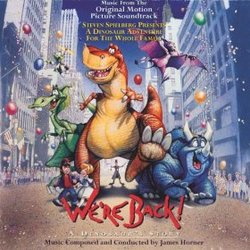
One of the sillier animated films that James Horner scored in his career was the 1993 effort We’re Back! A Dinosaur’s Story, which was adapted by Moonstruck screenwriter John Patrick Shanley from a children’s book by Hudson Talbott. The story follows four dinosaurs who are transformed into sentient beings by a time-travelling scientist named Captain Neweyes; the dinosaurs are then brought by him to modern-day New York where, inevitably, they get lost, and have to rely on their new friends (a pair of runaway children) to help them – all while also trying to avoid the clutches of Professor Screweyes, Captain Neweyes’s evil twin brother, who runs a demented circus, and wants the dinosaurs to be his star attraction. The plot doesn’t really matter as the film is largely forgotten today, despite the fact that it has the most bafflingly eccentric voice cast of any animated film I have ever come across – actor John Goodman, British sitcom star Felicity Kendal, legendary newsman Walter Cronkite, chef Julia Child, and chat show host Jay Leno, among others. It was produced by Steven Spielberg – who had a slightly more successful dinosaur movie come out in 1993 – and had four directors, including animation specialist Phil Nibbelink, and his compatriot Simon Wells, who would later go on to direct movies such as Balto and The Prince of Egypt.
Director Wells and James Horner had worked together before, on An American Tail: Fievel Goes West in 1991, and of course Horner had experience working for Spielberg and Amblin Animation via the first American Tail in 1986 and The Land Before Time in 1988, so the fact that Horner scored this film in the first place is not much of a stretch of the imagination – but for the end result to be this good certainly is. There was always something about animation which caused Horner to massively over-achieve; We’re Back is in the same league as his other 1993 animation score Once Upon a Forest in that, despite the film’s superficial childishness, the music absolutely overflows with staggering beauty and wondrous invention. We’re Back was the ninth of the ten films Horner scored that year – the others included all-time greats like Searching for Bobby Fisher and The Man Without a Face – and there have been persistent rumors that Horner’s enormous time crunch challenges at the time resulted in a lot of this score specifically being ghostwritten by orchestrator Don Davis; whether this is true or not, I have no idea, but ultimately I really don’t care because the music is so, so good.
 The two cues which, for me, are the standouts of the score, are “Flying Forward in Time” and the “Grand Demon Parade”. The former is an astonishingly beautiful, ravishingly romantic theme for the full London Symphony Orchestra and a full choir. Fans of John Barry will find the theme especially appealing – it has echoes of the long-lined melodies he wrote for things like Out of Africa and Dances With Wolves – but Horner somehow adds a new level of wondrous beauty to the style with his gorgeous brass harmonies and choral accents, and creates an atmosphere of rarified exquisiteness that even a brief interlude featuring the prancing main theme cannot spoil. The fact that Horner wrote something this overwhelmingly gorgeous for a scene involving time-travelling animated dinosaurs is mind-boggling.
Then the “Grand Demon Parade” could very well be the strangest, most eccentric, most demented, most brilliantly-orchestrated cue of Horner’s entire career – and that’s not an exaggeration. Years ago I once spent an entire week trying to deconstruct and decipher everything that was going on here, from the tempo changes to the instrumental layers, and it was just so complicated and overwhelming that eventually I just had to throw my hands in the air in despair and marvel at its genius.
The cue is almost indescribable; it’s technically a dark march, almost Elfmanesque in its rhythmic content, which builds and builds and becomes more imposing and aggressive as it develops over the course of almost 8 minutes, but it’s all the things that Horner throws at the piece that makes it so fascinating. There’s a guest appearance from the famous 4-note danger motif, deconstructed statements and variations of the flying theme, allusions to free jazz in the combo writing for flutes and muted trombones after the 1:50 mark, and even a brief passage where the brass section seems to be intentionally playing the wrong notes! Listen to what the woodwinds are doing from 3:58 onwards, frantically leaping up and down scales. Listen to how all the different parts of the brass section are doing completely different things simultaneously around the 4:30 mark. The percussion interlude reminds me of the time he wrote a similar one for Krull, for no reason other than his own amusement. The brass triplets that follow it are imposingly dark, and then the massive fanfare writing just around the 6:00 mark – heraldic trumpets backed by whirling horns – is just sensational. The dissonant, creepy ending sounds like Aliens, fading off into the ether. And then just in terms of the orchestration, Horner augments the massive symphony orchestra and choir with a truly staggering array of unconventional instruments and sound effects, from kazoos, to barrel organs, a vibraphone, and so much more. It’s just dazzling, utterly bonkers.
The rest of the score is no less engaging. The “Main Title/Primeval Times” introduces what is actually the score’s main theme, a light, playful, endlessly enthusiastic piece for a bank of dancing strings and effervescent woodwinds full of child-like energy and good humor. This then segues into more a dramatic piece for rousing horns and tribal percussion that seeks to set the scene for the film’s prehistoric location and introduce the dinosaur main characters – although this does quickly devolve into some Looney Tunes-style manic comedy stylings that do test the patience a little. The fluttery woodwind tune that crops up several times throughout the cue appears to be a theme for Captain Neweyes, and it appears later in several cues, as well as at the end of the aforementioned “Flying Forward in Time”.
“Welcome to New York” is an exciting and energetic full-action setting of the main theme, rousing and bombastic, that eventually segues into a little more reserved, but no less beautiful, reprise of the Flying theme. “First Wish, First Flight” revisits the Flying theme with the tenderness of a lullaby, just gorgeous, while also offering a more energetic brass-heavy variation on the main theme.
The first hints of the theme for Screweyes and his demonic circus actually appear in the slow, comedic, but vaguely threatening “A Hint of Trouble/The Contract,” before really emerging properly in the madcap “Grand Slam Demons,” which is sort of like a lighter and more playful initial version of the “Grand Demon Parade” before it gets dark and aggressive. The closest scores in Horner’s past I can associate this with are Honey I Shrunk the Kids, possibly crossed with the Nino Rota-ish Fellini-esque circus stylings from I Love You To Death, and the Roger Rabbit music from the cartoon short Tummy Trouble, although none of those things properly do it justice; it really is it’s own thing entirely, an energetic, comedic, anarchic, but again vaguely threatening piece of madcap circus music. “Hot Pursuit” is a terrific action variation on the main theme, upbeat and playful and deliciously orchestrated, again playing like something from Honey, I Shrunk the Kids with the scampering energy quotient turned up to the max.
“Screweyes’ Circus/Opening Act” again offers a half-menacing half-comedic statement of his theme, while the appropriately titled “Circus” is where Horner lets rip with a massive musical parody of both the big top genre and Julius Fučík’s famous “Entrance of the Gladiators” that allows him to break out a veritable panoply of bizarre instruments ranging from calliopes to kazoos, swannee whistles, car horns, duck calls, and more. This is probably the silliest and most intentionally comedic music of Horner’s entire career, and it might drive some people to distraction, but I think it’s brilliant – the speed and complexity of the writing and performance is something to behold. Ta-da! This is counterbalanced by the delightfully complex horror music in “Fright Radio” which will absolutely please fans of the score for Something Wicked This Way Comes with its ghostly chorus and spooky chills.
“The Transformation” is the score’s emotional finale, underscoring the scene where the dinosaurs – having been regressed back to their ‘animal’ state by Screweyes – have their more ‘sensitive’ side restored by the love of their friends. Horner’s music here is full of warmth and tenderness, a combination of both the main theme and elements of the Flying theme, which becomes gorgeously sweeping and deeply emotional. There is noticeably more emphasis on the brass here, built around some chord progressions that hark all the way back to the finale of Cocoon; the whole eventually thing explodes into a glorious fanfare, and goes through another moment of silly circus music (including an unexpected burst of the “Star Spangled Banner”), before offering a final coda full of aching sensitivity in the lovely “Special Visitors to the Museum of Natural History”.
The score also contains an original song, “Roll Back the Rock (To the Dawn of Time),” written by Horner in conjunction with pop musician and science lover Thomas Dolby. There are two versions of the song, one performed in character by John Goodman, and one performed over the end credits by rocker Little Richard, and it’s fine – a sort of weird rock/blues/world music/circus hybrid that really doesn’t have anything to do with the score, and honestly it can be easily skipped without losing anything from the overall listening experience. I usually do.
Really, the greatest takeaways from We’re Back! A Dinosaur’s Story are the themes and the orchestrations. As I said before, “Flying Forward in Time” is one of the most unexpectedly heart-wrenchingly gorgeous themes of Horner’s entire career, and should be experienced by all Horner fans at least once. Meanwhile, the depth and creativity and zaniness and sheer anarchy of the orchestrations – especially in the “Grand Demon Parade” cue – is astonishing, and again needs to be experienced to understand just how deep down the bonkers hole Horner went on this film. I can see how some people will find this chaotic, sometimes slapstick, sometimes childish music just too much to bear, and you do have to be in the right frame of mind to fully appreciate it, but anyone who is able to get past that initial tonal shock will find We’re Back! A Dinosaur’s Story to be enormously rewarding. This is James Horner at his most playful, most creative, magical best.
Buy the We’re Back! A Dinosaur’s Story soundtrack from the Movie Music UK Store
Track Listing:
- Main Title/Primeval Times (4:14)
- Flying Forward in Time (5:48)
- Welcome to New York (2:26)
- First Wish, First Flight (3:48)
- A Hint of Trouble/The Contract (1:49)
- Roll Back the Rock (To the Dawn of Time) (written by James Horner and Thomas Dolby, performed by John Goodman) (2:55)
- Grand Slam Demons (2:05)
- Hot Pursuit (3:18)
- Central Park (1:21)
- Screweyes’ Circus/Opening Act (1:12)
- Circus (2:29)
- Fright Radio/Rex’s Sacrifice (6:39)
- Grand Demon Parade (7:39)
- The Kids Wake Up/A New Day (2:57)
- The Transformation (5:30)
- Special Visitors to the Museum of Natural History (2:12)
- Roll Back the Rock (To the Dawn of Time) (written by James Horner and Thomas Dolby, performed by Little Richard) (2:56)
Running Time: 59 minutes 16 seconds
MCA Soundtracks MCAD-10986 (1993)
Music composed and conducted by James Horner. Orchestrations by Don Davis, Arthur Kempel and Thomas Pasatieri. Recorded and mixed by Shawn Murphy. Edited by Jim Henrikson. Album produced by James Horner.
Leave a comment

Shop at the Movie Music UK Store

Member of the

 MOVIE MUSIC UK
I was wondering if this score would get some love and thankfully, it does. One of Horner’s little gems.
You think you might revisit George Fenton’s ravishing score for 1998’s “Ever After” in the future? Beautiful score for a very enjoyable chick flick.
Absolutely going to cover Ever After. Pencilled in for some time in 2028!