MRS. DOUBTFIRE – Howard Shore
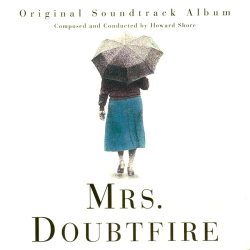 THROWBACK THIRTY
Original Review by Jonathan Broxton
Mrs. Doubtfire was one of the most popular and successful comedies of the 1990s, and is the heartwarming tale of a man who takes ‘playing dress-up’ to a whole new level when faced with a messy divorce and the threat of losing custody of his children. An unemployed voice actor, Daniel Hillard drives his more straight-laced wife Miranda to distraction with his antics, to the point where they decide to split. After falling foul of an officious social worker, and seeing that Miranda has advertised for a nanny to help her with their three children, Daniel convinces his makeup artist brother to transform him into ‘Euphegenia Doubtfire,’ an elderly Scottish grandmother. With the help of a series of rubber masks, elaborate costumes, and a ‘muddled’ accent, Daniel successfully applies for the nanny job – but soon finds that maintaining his dual identity and being a part of his children’s lives, while dealing with the complexities of family dynamics and relationships, is no easy task.
The film features a tour-de-force comedic turn by the great Robin Williams, whose madcap performance and hilarious verbal quips are a wonder to behold – especially when he locks horns with his ex-wife’s handsome new boyfriend. Williams is counterbalanced by a more restrained performance from Sally Field as Miranda, who is brought to the end of her tether by Daniel’s unorthodox and sometimes inappropriate parenting attitude. Lisa Jakub, Matthew Lawrence, and an adorable Mara Wilson play Daniel’s children, and there are excellent supporting roles for Harvey Fierstein, Robert Prosky, and especially a pre-James Bond Pierce Brosnan as Stu, the new boyfriend who is the victim of Daniel’s ire. The film was directed by Chris Columbus, and was adapted from a British children’s novel by author Anne Fine.
 The score for Mrs. Doubtfire was – perhaps unexpectedly – by composer Howard Shore. In the early 1990s Shore had become somewhat typecast as a composer of ‘dark’ movies; his most acclaimed works were for dramas and thrillers like The Silence of the Lambs, and for his extensive work for director David Cronenberg on titles like Scanners, The Fly, Dead Ringers, Naked Lunch, and M. Butterfly. However, people forget that one of the most commercially successful films of Shore’s career to that point was the 1988 comedy Big, and it appears likely that this score was what led director Columbus to ask Shore to write the score for Mrs. Doubtfire.
Much like Big, Mrs. Doubtfire is a light, tuneful, playful, sometimes emotionally poignant score that eschews all the darkness and tragedy inherent in most of his more famous works and instead goes straight for the heartstrings via the funny bones. The main theme for the film is introduced in the opening cue, “Mrs. Doubtfire,” and is a light and magical piece of whimsical fluff that layers pleasant strings against an array of ascending woodwind textures backed by sparkling percussive effects, delicate pianos, and pretty harp textures. What’s interesting – or perhaps a touch frustrating – about this main identity is that the theme is sort of all over the place; the linear progression of the melody seems to move about at random, never quite going where the previous chord indicated it should, and this makes the theme sort of difficult to grasp. Intellectually, I’m thinking that Shore maybe based his ideas on the character’s personality – Daniel himself is ‘all over the place’ and wildly unpredictable – and if so, then this musical depiction of him makes sense, but the melodicist in me still has a touch of trouble following it all.
One thing I also feel like I need to mention here is that, having become intimately familiar with Howard Shore’s compositional stylistics through and since the Lord of the Rings scores, it’s still a source of endless wonderment to me just how much of the music that ended up in those masterpieces can be heard all throughout his earlier work. There are so many clear and obvious ‘Shoreisms’ throughout Mrs. Doubtfire, from the stepwise progression of the music up through the scale, to the way some of the woodwinds are layered against each other. Coming back and discovering all this after the fact is just fascinating to me.
The main theme is present throughout much of the score; Shore presents it fully in several cues, notably the lovely “My Name Is Elsa Immelman,” the magical “Meeting Mrs. Doubtfire,” the wholesome and wondrous “Dinner Is Served,” and the pretty “Daniel and the Kids,” the latter of which underscores the scene where Daniel’s kids finally discover the truth about who Mrs. Doubtfire is – and decide to play along anyway. The sparkling percussion is often used to illustrate Daniel’s transformation into Mrs. Doubtfire (and the unmistakable twinkle in his/her eye), while the strings and woodwinds add depth to some of the more serious scenes of conflict and emotion; for example, “Divorce” has a more downbeat and bittersweet attitude, as one might expect, while “Cable Cars” explores the theme in a slightly more mature way, allowing the loneliness of Daniel’s life, and his love for his children, to emerge.
One of the other main ideas in the score is a light scherzo motif which Shore uses as underscore in the numerous scenes of Daniel being mischievous and playful around people who have no idea who he really is. The motif is led by a dancing glockenspiel, and is backed by an array of pizzicato string textures and little plucked harps; it first appears towards the end of the aforementioned “My Name Is Elsa Immelman,” and then appears prominently later in the “Tea Time With Mrs. Sellner” scene where Daniel has to disguise himself with cake frosting after the titular social worker drops by for an unexpected visit; the way the scherzo keeps increasing in speed, as Daniel becomes more and more frantic trying to maintain his ruse, is outstanding.
The whole thing climaxes in the hilarious “Bridges Restaurant” sequence where Daniel has to keep changing in and out of his Mrs. Doubtfire costume, having double booked a business meeting and a family birthday in the same location. Shore surrounds the scherzo with an increasingly panicky bank of scampering strings that get faster and faster as Daniel gets drunker and drunker, and becomes more and more inappropriate in the interactions with Miranda and Stu – “she’s got a power tool in the bedroom, dear, I’m amazed she hasn’t chipped her teeth” – before eventually climaxing when Stu chokes on a jambalaya shrimp and Mrs. Doubtfire is forced to leap to the rescue and perform a fateful Heimlich maneuver. This music is one of Shore’s few concessions to pure comedy, and although some may dismiss it as silly mickey-mousing, personally I think it’s just delightful hearing him in this mode.
The score’s finale begins with “The Show’s Over,” which is perhaps the most serious cue on the album, and underscores the scene where Daniel is outed as Mrs. Doubtfire in the aftermath of the Bridges Restaurant debacle, and is on the receiving end of a court order that could see him lose access to his kids for good. The conclusive “The Kids Need You” underscores the film’s sensible happy ending with a satisfying emotional sweep of the main theme, although the final few chords are curiously unresolved, and sort of hang in the air expectantly, as if the idea of Mrs. Doubtfire is sort of drifting away into the sunset.
I have read some reviews of the score for Mrs. Doubtfire calling it a lesser Howard Shore effort, with some criticizing it for being ‘cloying’ and ‘overly-manipulative’, and others really laying in by calling it a ‘soulless’ score for a ‘vomit inducing’ film. While I certainly wouldn’t go that far, it is true that the tone of the score is one of enduring pleasantness, and anyone whose toes curl at a score with this much of a sweet tooth may find the whole thing just too whimsical to bear. Personally, and while I acknowledge this aspect of the score, I have always enjoyed Mrs. Doubtfire a great deal. I admit that I am somewhat biased as a result of my nostalgic love of the film itself, but outside of this it’s still lovely hearing Shore embracing his more romantic, charming, endearing side, while still exploring all the musical mannerisms that make him the composer he is.
Buy the Mrs. Doubtfire soundtrack from the Movie Music UK Store
Track Listing:
- Mrs. Doubtfire (2:58)
- Divorce (2:56)
- My Name Is Elsa Immelman (2:55)
- Meeting Mrs. Doubtfire (2:14)
- Tea Time With Mrs. Sellner (3:58)
- Dinner Is Served (2:18)
- Daniel and the Kids (2:29)
- Cable Cars (4:56)
- Bridges Restaurant (6:13)
- The Show’s Over (3:26)
- The Kids Need You (3:21)
- Figaro/Papa’s Got A Brand New Bag (written by Gioacchino Rossini, performed by Robin Williams/written and performed by James Brown) (3:23)
Running Time: 41 minutes 07 seconds
Fox Records TCF 07822-11015-2 (1993)
Music composed and conducted by Howard Shore. Orchestrations by Howard Shore. Recorded and mixed by Dan Wallin. Edited by Ellen Segal. Album produced by Howard Shore.

Shop at the Movie Music UK Store

Member of the

 MOVIE MUSIC UK