ARABIAN NIGHTS – Frank Skinner
 GREATEST SCORES OF THE TWENTIETH CENTURY
Original Review by Craig Lysy
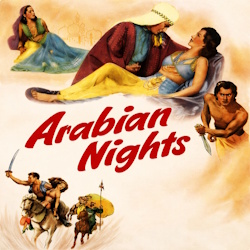
The success of The Thief of Bagdad in 1940 spurred Universal Pictures to enter the exotic adventure film genre, resulting in production of four WWII era films, including Arabian Nights in 1942, White Savage in 1943, Ali Baba and the Forty Thieves in 1944, and Cobra Woman also in 1944. The first film, Arabian Nights would be derived from the Islamic classic “One Thousand and One Nights”. Walter Wagner was placed in charge of production with a $904,765 budget, John Rawlins was tasked with directing, and Michael Hogan was hired to write the screenplay. For the cast, John Hall would star as Haroun-Al-Rashid, Maria Montez as Scheherazade, Sabu as Ali Ben Ali, Leif Erikson as Kamar, Edgar Barrier as Nadan, Shemp Howard as Sinbad, Thomas Gomez as Hakim, Tuhan Bey as Captain of the Guard, and John Qualen as Aladdin.
The dancer Scheherazade receives a prophecy that she is destined to become the wife of the caliph in Bagdad. She confides this to Kamar, brother of caliph Haroun who is covetous of the throne. Haroun initiates a coup d’état, which succeeds with the support of the Grand Vizier. Haroun is injured, flees and gets help from Ahmad’s actor troupe, where he is hidden in the circus and nursed back to health by Scheherazade, who fails to recognize him out of royal garb. When Kamar finds Scheherazade, who along with the entire circus troupe of actors is sold into slavery. Eventually Haroun, with aide from Ali and Scheherazade succeeds in retaking his throne, to live happily ever after with Scheherazade. The film was a huge commercial success, earning a profit of $2.5 million. Critical reception was mixed, however the film received four Academy Award nominations, including Best Cinematography, Best Art Direction, Best Sound Recording, and Best Film Score.
Frank Skinner was a resident composer for Universal Pictures and was assigned the project by Musical Director Charles Previn. Upon viewing the film, he realized that while this was a B film, he was being afforded a wonderful canvass on which to compose. The film presented a historic romance, set in an exotic location, with court intrigue, betrayal and heroism as two brothers battle for control of the caliphate. Given the setting in an ancient Arabian kingdom, he understood that he would have to infuse his music with the requisite cultural sensibilities and auras. The romance between Haroun and Scheherazade would also require a love theme, as would the protagonist Haroun and villain Kamar.
 For his soundscape, Skinner composed eight themes. For Haroun’s Theme, his approach was not to speak to his regality as the true caliph, but rather to his decency, nobility, and good nature. As such it is string borne, not horn borne, and exudes warmth and nobility. Scheherazade’s Theme embraces both her seductive allure and willfulness. Outwardly she is strong-willed and ambitious, yet beneath the veneer lies a very sensitive soul desperately yearning for love. Skinner string borne theme weaves both of these facets of her persona, perfectly capturing her spirit. Scheherazade and Haroun’s Love Theme offers Skinner at his sumptuous best, providing yet another of his Classic Old Hollywood melody. Skinner supports with a romance for strings carried lushly by strings d’amore.
Two of our heroes have themes; Ali’s Theme speaks to this kid’s kindness, loyalty and gentle nature. Skinner offers an incredible ‘lightness of being’, shifting his spritely narrative among playful strings and woodwinds animato. There is both a theme and sound effect associated with the rotund circus owner Ahmed. His theme offers silliness, comedy and at times, buffoonery with playful stings and woodwinds comici. In battle, he uses the girth of his protrusive belly to bounce repel attackers, which is supported comically by a ‘boing’ effect. For our two villains, we have a theme for Kamar, and by extension, his henchmen. It offers a menacing, and descending, five-note statement by strings malevoli. Our second villain Dagan is kindred to Kamar’s Theme, offering a four-note statement by strings sinistri. Unlike Kamar’s Theme, Dagan’s is lurking and covertly sinister. Rounding out the score are a number of motifs for the Circus, the Desert, and traveling, as well as some promenades, marches and several exotic dances.
There is no commercial release of the score, so I will use film scene descriptors and time indices for the review. 00:00 “Universal Logo” reveals the Universal Pictures studio logo supported dramatically by exotic Arabic fanfare. 00:10 “Main Title” offers a score highlight where Skinner perfectly sets the tone of the film. We open with the film title in boldly colored animation from which flow the animated stills of the opening credits. Skinner dazzles us with an exotic and spirited piece, which immerses us in Arabic auras. Trilling woodwinds, strings energico and horns bravura empower, excite, and enthrall us. At 1:02 we close with a fleeting statement of the Love Theme. In 01:14 “Arabian Nights” horns reale resound as concubines giggle at the Guardian of the Harem, who has fallen asleep, but wakes after he burbs. A massive book titled “Arabian Nights” is displayed before him by two boy servants and Skinner supports with a playful-comic musical narrative. He commands a reading of the story “The Dancing Girl and the Two Brothers” and the six concubines begin reciting the tale from their individual books. Skinner supports with an exotic danza Araba. At 02:55 the Guardian commands Isha to read the story of Scheherazade supported by the alluring Scheherazade’s Theme borne by strings seducenti.
03:44 “Return to the Past” reveals the Guardian interrupting an telling the concubines how she caused the two brothers to fight for her love. The camera shifts to lotus pool and harp glissandi take us to the past, joined by horn reale declarations and tremolo strings as we fly through the clouds. We descend darkly atop dire horns to a vulture perched on a billboard that reads; “This is the rebel Kamar al Zaman who would have destroyed his brother, the great and noble Caliph of Bagdad Haroun al Raschid”. A descent by strings furioso usher in a grim and foreboding musical narrative as the camera descends to reveal Kamar on display in the public square hanging by his arms. His brother Haroun, the Caliph, arrives with an entourage. After seven days of torture by the elements he feels pity, and begins to relent killing his brother, which is firmly opposed by a hostile Grand Viser Nadan. He reminds the Caliph that Kamar desire for Scheherazade is what motivated him to seize the throne.
05:56 “The Tale Begins” opens with a cascade of harp glissandi as we see a crowd attending a traveling circus demanding to see the dancer Scheherazade as a troupe of men put on a show tossing torches. Skinner drapes us with exotic auras, supporting with a small ensemble of finger cymbals, tambourine, drums and flute arabo. Inside the tent, a danza esotica joins as Ahmed, the circus owner, demands that the petulant Scheherazade dance. But she is in a foul mood, says she will dance when she is ready, and chases Ahmed out of her tent. 07:50 “Kamar is Rescued” reveals Nadan stating to the Caliph that it was Kamar’s desire for Scheherazade that brought him to this torture, and that the law demands death. The Caliph orders an end to Kamar’s suffering and an orchestral surge supports the guard raising his scimitar to strike. But Kamar moves, and Haroun mercifully lifts a ladle of water to him supported by strings affanato. Yet in the shadows we see men converging on the square and Skinner sow menace as a concerned Nadan notices. At 8:33 a descent by strings irato support Kamar spitting the water into the face of Haroun. The guard raises his scimitar to strike, but is cut down by an arrow strike in his back. Two groups of men converge and Skinner unleashes a torrent of violence propelled by strings furioso as the Caliph’s men engage in battle. Horns eroico resound as Kamar’s men slay the last of the Caliph’s guard. A flight motif propelled by racing furioso and trumpets bellicoso support Haroun’s escape with half of Kamar’s men in pursuit. Back at the square, Nadan orders Kamar cut down. The musical narrative darkens as Kamar’s men close in on Haroun.
At 9:48 “The Great Ali!” we transition to the exotic Circus Motif as we shift back to the performance stage where Ahmed introduces Ali Ben Ali, the world’s greatest acrobat. The men create a human pyramid anchored by the giant Valda, which Ali scales, reaching the pinnacle. Skinner sow an escalating tension as Ali sees Haroun cornered and yells as an assassin shoots an arrow that strikes Haroun’s shoulder. Haroun falls from the roof and the human pyramid also collapses due to Ali’s unsteadiness. 12:28 “Ali Discovers Haroun” offers woodwinds energico, which propel Ali’s run to Haroun. A danza esotica supports the extended scene as he determines by Haroun’s ring, that he is the Caliph. He takes the ring off his finger, and places it on the assassin who has a smashed face and lays dead beside him. He then runs back to the circus, retrieves Scheherazade and brings her to Haroun. She places one of her veils over his wound and we see in her eyes that she is attracted to him with their nascent Love Theme joining atop violins romantico at 14:10. Back at the circus, men cause an uproar when they arrive yelling Kamar has escaped!
15:34 “Scheherazade and Ali Return” offers a solo oboe arabo, which carries Scheherazade and Ali’s return to the circus. The Circus Motif resumes as a frantic Ahmed complains to Sinbad that he desperately needs to find Scheherazade. As he rushes about a comical musical narrative supports. Scheherazade returns but refuses to flee from Kamar, saying she is afraid of no man. Her theme at 16:40 empowers her defiance, yet she succumbs to fervent pleas from Ali that if she is to be queen someday, she must not allow Kamar to capture her. At 17:27 Ahmed orders the circus to pack up and depart and energetic comedy supports. When Ali reminds Scheherazade of the wounded man, she agrees to take him along with them. Comic woodwinds support Ali’s departure as he hits Ahmed in the stomach and scurries away. The music descends into silliness as Aladdin discovers his lost magic lamp while packing. At 18:15 he begins rubbing it and tremolo strings quiver with anticipation, propelling an ascent motif as a massive shadow emerges behind them on a wall. Yet the musical buffoonery resumes as it turns out to be the circus giant Valda.
18:43 “The Circus Departs” reveals Ahmed driving his troupe to leave supported by his theme borne by bubbling, playful woodwinds felice. A bassoon leads kindred woodwinds with a travel motif as the caravan heads out. 19:10 “Scheherazade and Haroun” reveals her caressing him as he sleeps supported by a sumptuous exposition of the yearning Love Theme by strings d’amore. 19:31 “Haroun is Dead” opens darkly atop Kamar’s Theme as one of his henchmen find the body of the dead assassin, whose face has been crushed beyond recognition by fallen masonry. He mistakes the man for the Caliph as he bears the signet ring on his finger. Trumpets trionfanti resound and usher in Kamar’s Theme as he takes the signet ring from ‘Haroun’s’ finger. As he smiles, the two motifs entwine in unholy communion. As Nadan swears fealty, Kamar ascends to the throne carried by strings reale supported by his grim fanfare. He is pleased that Nadan has sent guards to bring Scheherazade to the palace. Muted trumpets reale declare Kamar’s Theme, which crowns his joy.
20:45 “The Captain Returns” reveals the announcement by the court herald that the captain has returned. Kamar commands that he enter, and the Royal Trumpet Motif and Kamar’s malevolent theme entwine. When the captain reports that they cannot locate Scheherazade as the circus has departed, Kamar erupts with fury, and demands a rigorous search of the city. An angry musical narrative empowered by the fury of Kamar’s Theme supports the scene. After Kamar departs, Nadan pulls the captain aside and informs him that he does not intend for the caliph to be destroyed by a dancing girl. 21:42 “Haroun Wakes” Ali’s Theme borne by an animated piccolo arabo with drum and tambourine supports with an exotic exposition as he shaves off Haroun’s beard to hide his identity. Aladdin joins, sees a hanging lamp, and moves to it, gently stroking it in hope of once more releasing the genie. Spritely strings and a solo flute animato support his buffoonery. The rotund Ahmed arrives carried by a bassoon pomposo emoting his theme. He is agitated at harboring this wounded stranger. Skinner supports with a playful and animated musical narrative as Haroun slowly wakes. As he tries to orient, Haroun’s Theme borne by sumptuous strings nobile supports. Haroun is weak, struggles, and asks for food and drink, which elicits Ahmed’s outrage as he demands he must work to be fed. We descend into buffoonery and silliness atop a musical narrative empowered by Ahmed’s Theme as they all con him into supporting Haroun. A flustered Ahmed orders everyone to get to work after Haroun’s beard shavings makes him sneeze.
26:17 “Ali and Haroun” reveals Ali disclosing to Haroun that he knows that he is the Caliph. Haroun is moved by his loyalty and dedication, and says to him that he is no longer a slave, but his friend. Skinner supports the intimate moment of bonding with interplay of Haroun’s and Ali’s Themes. 27:18 “Scheherazade’s Destiny” reveals Ali informing him that he owes his safety and life to Scheherazade. Her theme joins, blossoming lushly on alluring strings seducenti with harp glissandi adornment. Ali scurries away as she comes to Haroun, who is taken captive by her beauty. She joins him for dinner and reveals her destiny to be queen, saying she does not desire love, but instead, power. Haroun says she is worthy and compliments her on her beauty. Skinner supports their conversation with the Love Theme, expressed from Haroun’s perspective. Yet the music sours at 29:04 when Haroun declares that she could love a man for himself alone, regardless of power and she rejects the notion. Comedic buffoonery joins at 29:08 as Ahmed and Ali, carried energetically by their themes race into the room declaring that Caliph Haroun was found dead, and that Kamar has been crowned Caliph. At 29:32 Scheherazade Theme ascends on aspirational strings as she sees opportunity, but the moment is lost when Haroun declares that she is not yet queen, as a fawning Ahmed comes to her carried by his silly theme borne by bassoon comico.
29:59 “Kamar’s Soldiers Arrive” reveals the captain of the guards and soldiers arriving with orders to take Scheherazade and her ‘friends’ to the palace. Kamar’s malevolent theme enriched with horns reale empower his men, joined by Scheherazade thankful theme as she departs to her room to properly prepare herself. Ali’s delicate theme supports his warning to Haroun, who advises him to henceforth address him as Amin. A dramatic decrescendo descent supports Ali running to obtain Amin clothes of a merchant to help obscure his identity. 30:44 “Journey to the Palace” reveals a blind man sitting on the street seeking alms as we see Scheherazade’s palanquin traversing the streets. Skinner supports with an exotic woodwinds and drum propelled promenade Araba. Inside we see her dreaming of gaining her destiny supported by her theme borne by aspirational strings. The music transforms into a misterioso as the carriage stops in the city market square. Scheherazade is displeased, but at 31:54 Nathan’s Theme, rendered as a march of doom empowers his minion, the captain of the guards, approaching with slave traders. He orders that she and the others be chained and taken by the slave traders, vowing to Scheherazade that her dreams of being queen will never be realized. As the men move against Ahmed, Sinbad, Ali, Valda, and Amin.
32:33 “Attack!” reveals the captain ordering his men to attack. A fierce battle unfolds, which Skinner supports with an orchestral torrent of violence in which an aggressive Haroun’s Theme is woven, along with comedic sound effects synced to Ahmed boinging men with his huge belly! Despite heroic efforts, our heroes are overwhelmed and subdued with chains. At 33:55 strings tristi full of despair support Scheherazade being ordered into her palanquin with her servant joining the male prisoners. 34:14 “Prisoners” reveals the slave master paying off the captain, and then departing the city into the dessert. Forlorn horns and a rhythmic drum cadence empower a toiling march of woe as the chained men are herded in chains under the searing dessert sun. At 34:36 a meandering flute arabo supports an interlude of the captain tossing a coin into the cup of the blind man. 34:57 “Reward Announcement” Fanfare by trumpets reale announce a palace herald declaring a reward to anyone who brings news of the whereabouts of the dancer, Scheherazade. Afterwards, a reprise of the Slave Master March supports the blind man departing from his street perch, no doubt to seek the reward.
In 35:42 “Kamar Tortures The Captain” the blind man turned the captain of the guard in for the reward, and Kamar is furious at his betrayal. Kamar using a rack to torture the captain to confess his crimes as Nadan watches. An unrelenting drum cadence of pain joined by dire horns, and malevolent quotes of Kamar’s Theme support the captain’s agony. Kamar departs carried by his sinister and now imperious theme to search for Scheherazade. He orders Nadan to continue the torture, but to not kill him. After Kamar departs Nadan releases the rack ropes and asks for the slave trader’s name and location, which the captain provides. As Nadan departs, he says you were loyal, acting on my orders and says you will be released. But then Nadan draws his dagger and stabs the captain in the back. Skinner supports Nadan’s treachery with an extended sinister exposition of his theme that culminates at 38:43 as he thrust his knife and kills the captain to cover his tracks.
38:51 “Slave Market” reveals Hakeem selling off a beautiful young woman for 100 dinars. A small ensemble plays an Arabic melody, which is barely audible under the dialogue. In the cages the Valda attempts to break the master ring to which all their chains are bound. As Amin reassures Scheherazade her theme supports her despair. The Arabic background music resumes as the feisty Marzena brazenly takes personal control of her auction, dissatisfied at the low bids. She is sold for 300 dinars to an enfeebled old man. They next come for Scheherazade, with her theme surrendering to despair. As she and her servant depart, Amin pledges that when he regains his rightful place and power, he will find and release her so she may fulfill her destiny. Skinner sow a mounting tension as Amin joins Valda in trying to break the master ring. 42:28 muted horns support Hakeem’s effusive praise, and the arrival of Scheherazade. She is defiant, empowered by her theme as she displays a dagger and threatens to kill any man that touches her. As Hakeem attempts to salvage the sale, Skinner sow an escalating tension as the buyers demand that she must first be unveiled.
43:57 “One Thousand Dinars!” reveals a veiled nobleman shouting out “One Thousand Dinars”, which stuns both Hakeem and Scheherazade. Back stage Amin and the men struggle with all their might to break the ring empowered by a crescendo of determination. They break the ring and Ali stages a seizure to bring the guards. On stage the nobleman takes possession of Scheherazade, and disarms her as she attempts to stab him. The slavers open the cage to release the slaves fearing Ali has the plague, which will kill their inventory. 45:10 “Escape” reveals Haroun and Ali leading a slave revolt empowered by a maelstrom of violence propelled by strings furioso. At 46:08 Haroun swings over the courtyard on a rope supported by tremolo strings and knocks Nadan off his horse. He then lifts Scheherazade up and the ride off to freedom propelled by his horn declared theme. A stunned and angry Nadan fumes with his theme growling, and we return to the battle maelstrom as the Ahmed, Ali, Sinbad and the strong man mange to also escape.
46:52 “Amin and Scheherazade” reveals their ride across desert dunes set against cloud swept skies. Skinner carries them with a woodwind and strings traveling ostinato. At 47:10 the Love Theme supports his effusive praise of her beauty and promise to keep her safe, and we see for the first time genuine romantic attraction in her eyes. The moment is lost at 47:55 as a galloping rendering of Ali’s Theme carries him, Ahmed, Sinbad, Valda, Aladdin and Scheherazade’s servant to them for a happy reunion. Ali cautions of danger and they all ride off carried by a sweeping romanticism borne by strings with harp adornment. They reach a river village where Ali advises lives a blacksmith who can free them from their chains. A diminuendo takes them down into the village. 49:00 “Unshackled” reveals the blacksmith releasing them from their chains supported by spritely woodwinds and strings animato. Ahmed’s silly theme joins as he takes his turn on the anvil. At 49:50 racing strings energico carry Ali’s run from the dock saying their boat is here. Horns nobile carry Amin and Ali’s walk to the dock, with the buffoonery of Ahmed’s Theme supporting the smith unshackling him. As the others fret about securing the boat, Scheherazade, supported by her lush theme asserts that Amin will not fail them.
50:35 “Kamar Arrives” reveals him leading an armed party to the village propelled by menacing horns reale. The party runs frantically to join Amin and Ali on the dock propelled by scurrying strings, but Kamar, empowered by fanfare reale intercepts them. At 51:21 strings romantico voice Scheherazade’s Theme as Kamar sees her and rushes to embrace her as a jealous Amin looks on. 51:34 “Return to Bagdad” reveals Ahmed, Sinbad, Aladdin and Valda traveling as free men as the caravan takes them back to Bagdad. Foreboding horns carry their desert ride as Amin and Ali trail behind unseen. At 51:58 a flute arabo leads an exotic passage as Kamar brings Scheherazade to a magnificent tent city where a cavalry honor guard awaits their arrival. An exotic promenade Araba carries their arrival, crowned with horns maestoso. Woodwinds solenne support their dismount with a menacing quote of Nadan’s Theme as he greets Scheherazade. Kamar declares Nadan loyal and his right hand. Yet when Scheherazade gazes at the reassuring smile of Amin supported lushly by the Love Theme, Nadan catches her gaze and looks intently at Amin. We close with uncertainty atop Ali’s and Nadan’s Themes as Ali and Amin depart, while Kamar and Scheherazade enter the royal tent.
54:08 “Good Time” reveals our heroes enjoying a drink in their tent supported by a playful musical narrative abounding with good tidings. Amin is dressed immaculately and the Love Theme joins as he speaks to Ali of Scheherazade. Yet Amin is unsettled when Ali advises that he believes Nadan recognized him. At 54:54 Haroun’s Theme swells as Ali counsels him to reveal himself as he believes the people will rally to him and restore him to the throne. At 54:59 the captain of the guard enters caried by horns maestoso, and orders Amin to come with him. Amin orders Ali to tell Scheherazade to have courage, and await his rescue. In an unscored scene, Amin is brought to Nadan for a private meeting. He reveals to Amin, whom he does not recognize, that he believes he loves Scheherazade, and orders his arrest. 57:00 “Ali’s Harem Adventure” offer perhaps the score’s most delightful passage. It reveals him running to the Harem tent to speak to Scheherazade carried by a spritely rendering of his theme borne by strings animato. He is told to leave, and circles to find a lone guard at another entrance. A delightful and playful extended rendering of Ali’s Theme supports as he astounds the guard with magic tricks, including him vanishing into the harem. The women who are swimming and lounging by a man-made pool, see Ali and capture him, pulling him into their mist. He says he has a message for Scheherazade and they encircle and hide him, as they take him to her tent. A eunuch arrives demanding to know what is happening and two of the women start a diversionary fight at 1:00:11 so Ali can escape. Trilling woodwinds and swirling strings animato propel the fight as Ali is tossed into the pool. As he swims away underwater, his theme propels him, until he surfaces and is confronted by a chained growling leopard.
1:01:10 “Ali’s Message to Scheherazade” reveals Ali bringing a message for her from his master. Her theme supports as he explains that he will keep his promise, but is in great danger because his love for her. At 1:01:42 horns maestoso support the approach of Nadan, Amin and two guards, which grows menacing as he enters her tent. He confronts her saying that this man (Amin) loves you, and then asks if she loves him. Amin signals her by shaking his head no, and she declares she does not love him. Nadan orders Amin’s removal and threatens that he will regret declaring his love for Scheherazade. Skinner supports with the most forthright expression of their Love Theme so far, as it blossoms, informing us that Scheherazade’s love is reciprocal. 1:03:04 “The Bargain” offers a powerful and passionate score highlight. It opens with menacing horn declarations of Nadan’s Theme, which portend Amin’s doom. Scheherazade’s Theme joins for a molto appassionato rendering as she pleads for his life, at last declaring that she does indeed love him. He grabs her arm and strikes a bargain – Amin’s life and freedom in return for poisoning Kamar. He reveals a ring with a compartment filled with poison. As he places the ring on her finger, her theme swells powerfully on a crescendo appassionato. His menacing theme joins as he directs her to open it as she passes the wedding goblet to Kamar. When she asks why he does this, his theme swells as he declares he has been a servant long enough and his time has finally come to rule. When she asks how does she know she can trust him, he responds that she will see Amin’s release first. We are informed of his duplicity by a disconcerting serpentine passage by woodwinds and strings, which support his pledge, crowned with an ominous declaration of his theme as he departs.
1:05:22 “Amin is Released” reveals Amin being escorted my Nadan’s men to the river where he can cross and gain his freedom. Horns maestoso sound as they depart, joined by a foreboding Nadan’s Theme. As Scheherazade intently watches his departure, a yearning Love Theme joins. Nadan then declares to her that he has kept his side of the bargain, and that now you must keep yours. She departs, and a malevolent Nadan’s Theme sounds as he advises his head guard that once they reach the river, to kill Amin. 1:06:07 “Ali Revelation” reveals Ali informing the others that Amin is really the deposed Caliph Haroun al Raschid. He convinces them to ride to the river and save him as he does not trust Nadan. Ali’s theme supports the scene. At 1:06:25 a racing motif propels our heroes on a furious ride to the river to save Haroun. As we shift to Haroun’s escort party a sweeping string borne desert motif supports their progress past expansive beautiful desert vistas. Interplay with the racing travel motif unfolds as we shift between the two groups.
1:07:07 “Ahmed’s Proposal” offers a comic musical narrative filled with buffoonery as Ahmed tries to barrow the Blacksmith’s shop. When the blacksmith refuses, informing him that he was never paid the last time, a fight breaks out with the four overcoming the blacksmith and his wife. At 1:07:51 Nadan’s men approach atop dire horns, and scurrying strings carry Ali’s frantic run to alert the team. A menacing Nadan’s Theme buttressed by horns maestoso supports their arrival. The guard demands the ferry, but Aladdin, who is impersonating the blacksmith, says it is out of service. In an unscored and truly slapstick scene, they manage to lure the guards two by two into the back where they are clubbed unconscious. Ali then frees Haroun and discloses Nadan’s treachery and Scheherazade’s love for him. A silly, comedic musical narrative supports as the bound guards struggle in the back room. Horns maestoso declarations support Haroun’s departure to save Scheherazade, and Ali’s departure to secure Haroun’s allies. We close atop racing Arabic strings furioso, that propel Ali’s ride against gorgeous desert vistas.
1:13:56 “Wedding Feast” reveals Kamar and Scheherazade’s wedding feast, which Skinner supports with finger cymbals and languorous strings arabo. Nadan makes the wine servant drink some of the wine to ensure the wedding goblet is not poisoned. Tambourines unleash acrobatic dancers, joined by a danza esotica as Scheherazade’s palanquin approaches. At 1:15:22 she emerges and approaches Kamar carried by drums and a shifting chorale of woodwinds Araba. Gong strikes bring her to the foot of the throne, with the woodwind chorale supporting the removal of her outer veil. At 1:16:02 a solo oboe arabo with harp adornment supports her as she performs a danza seducente. At 1:16:53 we shift to a clarinet arabo as she moves to the wedding goblet, and surreptitiously releases the poison from her ring. A saxophone seducente with drums, finger cymbals, and tambourine supports as she resumes her dancing. The melody shifts among various woodwinds as Kamar commands that the wedding gifts be brought. At 1:18:09 she again approaches the wedding goblet, and then backs away with the music shifting to a danza erotica while an aroused Kamar looks on. The dance stops, Kamar removes her inner veil, and grabs the wedding goblet. Yet as he raises it to drink, she takes the goblet and prepares to drink first. 1:19:26 “Haroun Attacks” opens atop a harsh chord, which supports Haroun striking the goblet from her hand, and then pulling her away. Racing strings support the unleashing of an orchestral tempest as a Sinbad rides in on horseback, lifts up Scheherazade and flees. However, a taunt rope trips the horse and they, along with Haroun are captured. Foreboding horns sound as Haroun’s veil is torn off and he declares himself to his brother. A violin d’amore voices Scheherazade’s Theme as she asks why he withheld his identity from her. He counters, that the time was not right as he was not yet sure of her love.
1:20:32 “The Brothers Duel/The Battle” reveals Kamar is outraged, swears Haroun a quick death, and draws his sword. Haroun draws his sword and a ferocious horn empowered sword fight ensues, joined by Ahmed and the others who battle Kamar’s guards. Skinner unleashes his orchestra in a tour de force as the brothers fight, and Nadan lurks with his hand on his dagger. At 1:2120 a comedic interlude supports Aladdin falling on an open chest and discovering a golden lamp, which he rubs. At 1:21:25 horns eroico resound as Ali appears atop a sand dune, yells “Allah Akbar!” and then leads a calvary charge of hundreds of Haroun loyalists propelled by charging orchestral torrent. In the camp Haroun and Kamar continue their duel while Kamar’s cavalry rides out and engages Ali’s forces. Skinner offers a tour de force to support the ferocious battle. In camp Kamar puts Haroun on the defensive and draws first blood as Nadan unsheathes his dagger. At 1:23:23 Haroun falls, loses his sword and Kamar leaps atop him with his dagger empowered by ferocious declarations of his theme. A drum roll supports Dagan throwing his dagger into Kamar’s back and mortally wounding him, with a dark descent of expiration supporting his death. Nadan then draws his sword, moves towards Haroun carried by a crescendo of violence, but is stopped by Ahmed, who charges and begins a duel. Skinner resumes the battle music, again unleashing a maelstrom of violence as Scheherazade tends to the wounded Haroun, while Ali and Valda run to support Ahmed. Nadan, flees but his theme gasps its last breaths as Valda hurls a spear into his back at 1:25:04. 1:25:11 “Victory!” reveals Ahmed shouting “Hail Haroun al Raschid!” supported by horns trionfanti. A paean of joy supports the celebration as Ali joins Haroun and Scheherazade on the dais, as we see Nadan burning to death. 1:25:34 “The Story Ends” reveals a return to the present supported by a wavering dream-like motif. Scheherazade’s Theme resumes as the Guardian of the Harem closes the story saying that Haroun and Scheherazade lived out their days in peace and happiness. We close with a grandisimo horn declared flourish as “The End” displays. 1:26:05 “Cast Credits” are empowered by a bravado rendering of Kamar’s Theme as a war anthem.
Well, Frank Skinner was tasked with scoring yet another B film, which for me was supremely challenging as it contained elements of romance, comedy, action, and court intrigue. To that end he provided a multiplicity of eight primary themes, several motifs, promenades, marches, anthems and exotic dances. He masterfully embraced Arabic sensibilities, which proved synergistic to supporting the film’s narrative and storytelling. His brilliantly insightful and conceived music for the principal characters brought them to life and empowered their acting performances; Scheherazade’s sexual allure and seductiveness, Haroun’s nobility, Ali’s youthful energy, Kamar’s malevolence, Nadan’s lurking sinisterness, and Ahmed’s buffoonery. In my judgment all of the film musical elements for drama, romance, comedy and action were brilliantly executed. Indeed, I believe having watched the film, that Skinner’s music enhanced it in every way and directly contributed to its popularity with the public. Folks, this is a wonderful score and it is sad that once again, Skinner’s handiwork has no commercial release. I sincerely hope a major label takes on a box set project of his canon as I believe his outstanding music needs to be brought to the public. Until this occurs, I recommend taking in the film, which is offered on streaming platforms.
For those of you unfamiliar with the score, I have embedded a YouTube link to the Main Title: https://www.youtube.com/watch?v=aMF6FJJTjKQ
Track Listing:
- NOT AVAILABLE
Music composed and conducted by Frank Skinner. Orchestrations by XXXX. Recorded and mixed by XXXX. Score produced by Charles Previn and Frank Skinner.

Shop at the Movie Music UK Store

Member of the

 MOVIE MUSIC UK