THE REMAINS OF THE DAY – Richard Robbins
 THROWBACK THIRTY
Original Review by Jonathan Broxton
The Remains of the Day is a British period drama film directed by James Ivory, based on Kazuo Ishiguro’s novel of the same name. The story follows James Stevens (Anthony Hopkins), a repressed English butler who has spent most of his life in service at Darlington Hall, a grand manor house formerly owned by Lord Darlington (James Fox), a man who was once deeply involved in political affairs and international diplomacy. The film is set in 1958 as Stevens, who is now working for an American named Farraday (Christopher Reeve), embarks on a journey across England, and reflects on his life at Darlington Hall – the events that transpired there in the years leading up to World War II, and specifically his relationship with housekeeper Miss Kenton (Emma Thompson), which Stevens never allowed to blossom into romance. The film explores themes of duty, loyalty, and personal sacrifice, particularly as Stevens begins to come to terms with the consequences of his unwavering blind loyalty to Darlington, who held complex political stances in the pre-war years. The film is also a poignant exploration of regret, nostalgia, and the changing social landscape of post-war England, as Stevens comes to the realization that he may have sacrificed his personal happiness for a sense of duty.
The film is, as all Merchant-Ivory films were, very English in its attitude and outlook, despite the fact that Merchant was Indian and Ivory was American. It has a certain stillness, an introspection, and Stevens is perhaps the cinematic personification of the British ‘stiff upper lip,’ a man whose manners and sense of propriety is derived entirely from his dedication to service. It’s a slow, ponderous, but nevertheless moving film that hints at simmering tensions and passions underneath its glacial surface, and it is anchored by two astonishing lead performances by Hopkins and Thompson, both of whom received Oscar nominations for their work. It’s also a visually beautiful film, with lush cinematography and splendid production design that captures the full majesty of the opulent English country mansions and their gorgeous gardens.
The score for The Remains of the Day, as was the case for all Merchant-Ivory films, was by American composer Richard Robbins, who was also Oscar-nominated for his efforts. In my review of Howard’s End I mused about how Robbins was something of a curiosity in film music circles because, with just one or two exceptions, he essentially only worked on Merchant-Ivory films. A classically trained composer, he began his career as Ismail Merchant’s personal assistant in the late 1970s, before going on to score The Europeans in 1979, nine more films for them in the 1980s (including A Room With a View, Maurice, Heat and Dust, The Bostonians, Mr. & Mrs. Bridge, and the aforementioned Howard’s End), plus another dozen or so additional films in the 1990s and early 2000s, up until his death from Parkinson’s disease at the age of 71 in 2012.
Outside of Merchant-Ivory films, Robbins was something of a film music unknown quantity. As virtually every film he scored was a British period drama – he never did a comedy, never did an action film or a fantasy film, for example – for all intents and purposes, every score he wrote was a variation on the same stylistics, with just enough differences in melody and orchestration. As such, The Remains of the Day is very much cut from the same cloth as Howard’s End, A Room With a View, Maurice, and all the others, and knowing what your taste is going in will clearly dictate whether this is a score that will appeal to you.
Robbins’s main conceptual idea for The Remains of the Day is to capture through music the rigidity, perfectionism, and reserved emotions of Stevens; he runs Darlington Hall like clockwork, with a militaristic precision that borders on the obsessive, and so to capture this Robbins underpins the score with repetitive, almost minimalist melodic lines that repeat throughout the film. However, what’s also interesting is how Robbins gradually softens these rigid formalities as the score progresses and we learn more about Stevens’s life; what begin as a mechanized, outwardly cold, austere set of string phrases, eventually start to thaw and become warmer and more approachable – no doubt due to the softening of the relationship between himself and Miss Kenton over the years. Robbins makes prominent use of plucked strings, undulating basses, and glassy percussion waves, augmented by cool electronic tones; these are prominent in the opening cue “Opening Titles/Darlington Hall” and throughout much of the first half of the score. The melody itself is perhaps a little on the spartan side – it’s not a theme that you’ll leave humming – but it does what it needs to do.
There’s an old adage that butlers are like swans; serenely gliding through the world on the surface, but paddling frantically underneath. This idea is very much in evidence in the cues that accompany the hustle and bustle of life ‘downstairs’ at Darlington Hall, where cooks and chefs and manservants and scullery maids busily carry out Stevens’s meticulous orders. Through cues like “The Keyhole and the Chinaman,” parts of “Tradition and Order,” and “The Cooks in the Kitchen,” Robbins creates a more hectic sense of movement through the use of woodblocks alongside more dynamic bubbling orchestral passages, pizzicato strings, and ticking watches. It’s not comedic, per se, but it is definitely quirky and playful.
At the other end of the scale, the scenes of political machinations in Darlington Hall’s state rooms and dining rooms are given a striking sense of importance through Robbins’s increased use of brass amid the strings. There is a sense of seriousness and regality to the trumpet theme that runs through the superb “The Conference Begins,” but then in the more somber pair comprising “Sir Geoffrey Wren and Stevens, Sr.” and “You Mean a Great Deal to This House” Robbins scores the film’s shocking twist – that Lord Darlington holds Nazi sympathies and is hosting prominent German dignitaries at his home – with a sense of impending tragedy, as if the music knows exactly what sort of horrors are being plotted within the hall’s walls. Robbins‘s use of slightly abstract, low-end woodwind textures here is fascinating.
“Loss and Separation” sees the main theme for Stevens being carried initially by a slightly grim-sounding saxophone backed by undulating piano textures, but as the cue develops the thematic content is transferred to strings, and Robbins offers a gently romantic, bittersweet exploration of the relationship between Stevens and Miss Kenton – both of whom ponder about what their lives might have been like had Stevens set aside his rigid adherence to duty and decorum and responded to Miss Kenton’s clear affections. There is sadness and regret in this music, and it works excellently in conveying the subtle layers of their friendship.
The final two cues – “Sentimental Love Story/Appeasement/In the Rain” and “A Portrait Returns/Darlington Hall/End Credits” – offer 12 minutes of solid, consistent dramatic scoring that ranges from the stark to the romantic, the soothing to the surprisingly intense, and contains several strong performances of the score’s main theme. The “Appeasement” part of the first cue is excellent, an array of bold and resonant surging piano lines punctuated by dark horns, underscoring one of the most important parts of the political half of the story involving British Prime Minister Neville Chamberlain and Nazi German ambassador Joachim von Ribbentropp planning the famous ‘peace in our time’ pact that, in fact, entirely failed to prevent World War II. In the final cue Robbins presents Stevens’s theme at its most approachable and emotionally engaging, as the stoic butler finally comes to terms with the life he had, the love he spurned, and his role in turning a blind eye to what turned out to be one of the most devastating political moments in world history. There is some really powerful, overtly dramatic music here, cymbal clashes and more, and it’s among the most stirring music Robbins ever wrote.
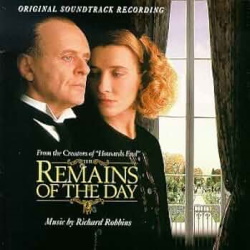
One thing I have to mention here – and the fact that I am mentioning it at all, considering how often I fail to recognize things like this as an issue in the first place, should tell you something – is the fact that the Remains of the Day album has unexpectedly appalling sound quality, with clearly audible distortion throughout much of the running time, hiss problems, and much more besides. Whether this was an issue with engineer Bill Somerville-Large’s original recording, or whether it was to do with the mastering by the people at Angel Records, is unclear, but anyone who finds that audio issues diminish a score’s enjoyability will certainly find that to be the case here.
However, from a compositional and dramatic standpoint, The Remains of the Day is worth exploring. It’s Oscar nomination was likely a result of it riding the coattails of the film itself, but even with that in mind it’s one of the most emotionally accessible scores of Richard Robbins’s career. It offers a compelling musical portrait of a man whose personal life is entirely subsumed by his devotion to duty, and who only discovers what his life truly meant long after he was able to do anything about it. It has that inherent Englishness to it that Merchant-Ivory productions always contained, and if that musical sound has never appealed to you, then this score is unlikely to be the one to final open the gates. However, anyone whose taste encompasses this type of work, or the similar-sounding work of composers like George Fenton, or Richard Rodney Bennett, or perhaps Geoffrey Burgon or Christopher Gunning, will find much to appreciate.
Buy the Remains of the Day soundtrack from the Movie Music UK Store
Track Listing:
- Opening Titles/Darlington Hall (7:25)
- The Keyhole and the Chinaman (4:12)
- Tradition and Order (1:49)
- The Conference Begins (1:31)
- Sei Mir Gegrusst (written by Franz Schubert, performed by Anne Murray) (4:11)
- The Cooks in the Kitchen (1:32)
- Sir Geoffrey Wren and Stevens, Sr. (2:38)
- You Mean A Great Deal To This House (2:20)
- Loss and Separation (6:17)
- Blue Moon (written by Richard Rodgers and Lorenz Hart) (4:54)
- Sentimental Love Story/Appeasement/In the Rain (5:20)
- A Portrait Returns/Darlington Hall/End Credits (6:48)
Running Time: 48 minutes 57 seconds
Angel Records CDQ-5502926 (1993)
Music composed by Richard Robbins . Conducted by Harry Rabinowitz. Orchestrations by Geoff Alexander. Recorded and mixed by Bill Somerville-Large. Edited by XXXX. Album produced by Richard Robbins.

Shop at the Movie Music UK Store

Member of the

 MOVIE MUSIC UK