THE NIGHTMARE BEFORE CHRISTMAS – Danny Elfman
 THROWBACK THIRTY
GREATEST SCORES OF THE TWENTIETH CENTURY
Original Review by Jonathan Broxton
If any film project perfectly encapsulates the professional relationship between director Tim Burton and composer Danny Elfman, it is their 1993 stop-motion animated fantasy musical The Nightmare Before Christmas. It tells the story of Jack Skellington, the ‘Pumpkin King’ of Halloweentown, the fantasy world charged with organizing the annual Halloween holiday. Despite being enormously successful, Jack has grown disillusioned of the same annual routine and wants something new; while wandering in the woods the next morning, he accidentally finds a door to Christmastown – the parallel land which organizes Christmas – and is enchanted by what he finds. Wanting to bring the Christmas spirit to Halloweentown, and despite the warnings of his unrequited love Sally, Jack decides that he will kidnap ‘Sandy Claws’ and take over Christmastown for himself – with predictably disastrous results.
The origins of The Nightmare Before Christmas go back to the early 1980s, when Tim Burton was an animator working for the Walt Disney company. He had an idea for a short film, or perhaps an animated special, based on a poem he wrote that was itself a macabre variation on the classic seasonal ode A Visit from St. Nicholas by Clement Clarke Moore. Disney initially considered Burton’s vision too weird and bizarre and shelves the idea, but then a decade later – with Burton having enjoyed considerable success with Beetlejuice, Batman, and Edward Scissorhands – the project came back to life. With Burton deep in pre-production on Batman Returns, directorial duties fell to one of his old friends and fellow Disney Animation alumni Henry Selick, and in the summer of 1991 he began the painstaking task of making an 80-minute stop motion animated film. Simultaneously, the decision was made to have the film be a traditional musical, and so Burton turned to his long-time friend and collaborator Danny Elfman to write both the songs and the score. Elfman was, of course, an experienced songwriter from his days with Oingo Boingo, and as such sought to combine that playfully ghoulish sound with a more traditional structure that evoked everything from Kurt Weill’s Threepenny Opera, to Cole Porter, George Gershwin, Rodgers and Hammerstein, and even Gilbert and Sullivan.
 The resulting work is perhaps the most quintessentially Elfmanesque of all Danny Elfman’s scores. His task was to create a musical world that would seamlessly blend the creepy elements of Halloween Town with the festive spirit of Christmas Town, somehow finding the perfect balance between darkness and joy through songs and score which are catchy and whimsical, but also juxtaposed with more poignant and introspective emotions. The concept of a ‘dark Christmas sound’ was something that Elfman had explored in both Batman and Edward Scissorhands, playing around with seasonal orchestrations in unconventional settings, but The Nightmare Before Christmas allowed Elfman to make that sound the focus of an entire project.
According to various interviews over the years, Elfman found himself especially drawn to, and empathizing with, the Jack Skellington character, and he drew parallels between Jack’s desire to grow beyond the confines of Halloweentown, and his own desire to grow beyond what he felt he could achieve as the front man of Oingo Boingo. Eventually Elfman would not only write the songs and the score, but also perform the singing voice of Jack; as such, Elfman’s involvement was pivotal in shaping the tone and narrative of the movie, and so in many ways The Nightmare Before Christmas is as much Elfman’s baby as it is Burton and Selick’s.
The soundtrack ultimately included eleven original songs in a variety of styles, but which all have the hallmarks of everything that has ever made Elfman’s music great. The orchestrations contain so many quintessentially Elfmanesque touches, from the prominent use of jazzy saxophones and wildly hooting clarinets dancing around behind the strings, to the use of sleigh bells and wordless female choirs adding a wintry sheen to the whole thing. Lyrically, the songs are fantastic, and have a rich vein of dark humor running through them; Elfman clearly allows the emotions and motivations of his characters to shine through, but there is also a great deal of clever wordplay, including rhyming couplets that would have made the Sherman Brothers proud. And then, in terms of structure, Elfman gives each of the main characters a unique motif that re-occurs across multiple songs, cleverly linking the characters together and allowing a coherent musical narrative to unfold. This all sounds as though it should be obvious – musical writing 101 – but the fact that so many composers do it badly in comparison to the amount of skill and intelligence Elfman shows here, suggests that it is not easy at all.
The “Opening” features beautifully enunciated narration by Patrick Stewart (on the soundtrack, at least; in the film it is performed by Ed Ivory), setting the scene and describing the world in which the film takes place. This segues into the first song, “This is Halloween,” which is performed by The Citizens of Halloweentown and introduces the town’s Halloween-centered lifestyle, although the multiple inhabitants – mummies, witches, vampires, even a ’clown with a tear-away face’ –seek to reassure us that although being scary is their job, they are not mean. It’s a terrific romp, bouncy and upbeat with a rhythmic core, but also with some unexpectedly delicate and elegant woodwind lines, snaking around underneath the sung verses.
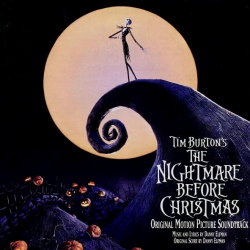
“Jack’s Lament” accompanies what is, for me, the most beautiful sequence in the film, and sees Jack striding through a graveyard, extolling his own virtues as the Pumpkin King, while also longing for… something… anything. Jack’s bony visage is silhouetted against an enormous yellow moon in the film’s most iconic image, and at times Elfman’s vocal performance becomes surprisingly tender and emotional. The sweep of the strings during the chorus is just gorgeous, while the playful saxophones and woodwinds that dominate the arrangement of the rest of the song give the whole thing an unexpectedly jazzy tone.
This segues into another perennial favorite, “What’s This,” which is sung by Elfman as Jack as he discovers the delights of Christmastown for the first time. The song has its roots in Gilbert and Sullivan’s fast patter songs, and sees Elfman bringing his sparkling festive orchestrations – sleigh bells and chimes, dancing strings and harps – to bear on the score for the first time. There’s a sense of magic and wonderment, combined with a charming sense of utter puzzlement, in Elfman’s lyrics and rapid-fire vocal delivery, which makes the whole thing a charming delight, and it has since gone down as one of Elfman’s most popular songs.
“Town Meeting Song” is clever in the way that Elfman tries to convey to the Citizens of Halloweentown the magic of what he saw in Christmastown, but they just don’t get it. This is reinforced by the fact that the underlying melody of the song is the same as the part of “Jack’s Lament” in which Jack is praising his own talents as the Pumpkin King, all sinewy saxophones and lilting light jazz. Jack trying to sing about the delights of Christmastown with the Pumpkin King melody is a perfect representation of why the townspeople don’t get it – they are enthusiastically hearing Jack’s Christmas words, but they are interpreting them through a Halloween point of view, which causes them to misunderstand it all. It’s a brilliant musical illustration of the Halloweentown problem that drives the entire plot of the film. This same idea runs through the subsequent “Jack’s Obsession,” which begins with a series of worried-sounding Citizens of Halloweentown fretting over their king’s state of mind over a spooky tick-tock rhythm, before Jack himself takes over the song, pondering the meaning of Christmas carols and snowflakes and teddy bears. A new theme emerges here, a sort of minor-key variation on the Pumpkin King melody but with a different tune, all of which backed by a flurry of orchestrations that intelligently combine the Halloween woodwinds with the Christmas chimes.
“Kidnap the Sandy Claws” is a fun little ditty performed by Elfman, Catherine O’Hara, and Paul ‘Pee-Wee-Herman’ Reubens as Lock, Shock, and Barrel, three mischievous ‘trick or treaters’ who Jack sends to kidnap Santa Claus, his equivalent in Christmastown, only for them to double-cross him in favor of Jack’s rival, Oogie Boogie. The song offers an increasingly twisted series of plans for how the trio will carry out their abduction, set to a playful but anarchic march, a festival of pizzicato strings and fanfare-like brass triplets. Speaking of Oogie Boogie, “Oogie Boogie’s Song” is a fantastic piece of New Orleans-style jazz and blues performed with bassy authority by Broadway veteran Ken Page as the boisterous gambling-obsessed bag of bugs who wants to usurp Jack. Oogie Boogie was modeled partially on the Hollywood bandleader Cab Calloway, and as such Elfman uses honkytonk pianos and bright, slinky brasses throughout the song, giving the character an iconic sound. This contrasts with the slower, introspective, subtly romantic “Sally’s Song,” performed by Catherine O’Hara as the rag doll who secretly loves Jack from afar and has terrible visions of impending doom. The melody that runs through the song is an undulating, darkly pretty tune that plays a major role in the score proper as a leitmotif for Sally, but more on that later.
Of course, Jack’s attempts to put a spooky spin on Christmas are a disaster, and in the aftermath of it all he sings “Poor Jack” as he realizes just what a mess he has made of things. Elfman’s beautiful, ‘twinkling melancholy’ sound runs through the song, which has a tonal style very similar to parts of the finale of Edward Scissorhands, while the second half of the song brings back the Pumpkin King melody from “Jack’s Lament” in a more determined and forthright, grandiose manner. The ”Finale/Reprise” offers a joyous return to the This Is Halloween melody, brilliantly counterpointed against a new verse of “What’s This” as the Citizens of Halloween discover Christmas Town for themselves. It all ends with a pretty and charming duet reprise of “Sally’s Song” as Jack and Sally cement their relationship with a kiss in the snow.
The score portion of the soundtrack is just seven cues totaling just over 25 minutes of instrumental music, but it’s some of the best score music Elfman has ever written. The cornerstones of the score, thematically, are the themes for Jack and Sally, which are lifted from “Jack’s Lament” and “Sally’s Song” respectively. The opening “Overture” runs through several song melodies arranged for the full orchestra, beginning with “What’s This,” and then segueing through the rambunctious “Making Christmas,” and the lush and lyrical theme for Jack. The subsequent “Doctor Finklestein/In the Forest” is a gorgeous tone poem that follows Jack’s initial trip through the dark woods in the wake of his ‘crisis of faith’ and contains numerous beautifully evocative passages that offset bulbous brass textures against dainty woodwinds and dancing strings. Much of the cue’s thematic content is based on the melodic ideas from “Sally’s Song,” which gives it a whimsical and charming flavor; the instrumental line in the song, ‘I sense there’s something in the wind,’ is repeated over and over, following Jack, cleverly suggesting that things are about to change.
The “Jack and Sally Montage” is a beautifully sorrowful exploration of the themes for Jack and Sally, in which the musical representations of the two characters intertwine and encircle each other. Just like the rest of the score, I love the orchestrations here; the way Elfman moves his music through different sections of the woodwinds – saxophones to clarinets to flutes – while the strings dance around them, shifting from bowed to pizzicato, is just delightful. His other idiosyncratic instrumental flavors – harp, celesta, accordions, and xylophones – give the piece its own unique flavor, and underneath it all the brass keeps a steady, mournful beat, like a depressed German oompah band. The final flourish – a dark, portentous burst of Sally’s theme on low strings – heralds the tragedy at hand.
“Nabbed” is a curious, inquisitive mash-up of Jack’s obsession theme offset against the ‘kidnap’ theme for Lock, Shock, and Barrel, and the Halloweentown theme. The whole thing has more than a hint of Prokofiev’s Peter and the Wolf to it, as it skips daintily around the entire orchestra, ranging from the highest flutes and strings to the lowest bassoons. The “Christmas Eve Montage” is a wonderful throwback to the furious festive action music Elfman wrote for the opening sequence of Scrooged back in 1988, playfully powerful yet dainty and intricate, while also referencing the bombastic rhythms from the opening titles of Beetlejuice. Elfman weaves a thematic web comprising Jack’s lament theme, Jack’s obsession theme, the Making Christmas march, and the What’s This Christmas Town theme, into an increasingly anarchic celebration of yuletide gone wrong, as Jack’s ‘Christmas presents’ start attacking the unsuspecting children of the world. I love the cue’s cascading celesta lines and the whooping and hooting clarinets, and then how the final moments of the cue start to become serious and tragic as the implications of Jack’s failure become clear, and Elfman foreshadows the Poor Jack theme.
“To the Rescue” is the score’s main action sequence as Jack and Sally work together to save Santa Claus from a terrible fate at the hands of Oogie Boogie. Here, again, the intricate thematic interplay is very impressive, as Elfman takes the What’s This Christmas Town theme (for Santa), the ‘kidnap’ theme, Oogie Boogie’s jazz theme, the Halloweentown theme, and even a major-key heroic version of Jack’s theme, and weaves them into a fast-paced and flamboyant piece of orchestral chaos that, again, reminds me of the finale of Beetlejuice. Sultry jazzy clarinets compete with more traditional orchestral strings, a circus calliope, and so much more, and it sounds like it should be a complete mess, but it works in spite of itself. The 5-minute “End Title” then offers a superb medley of song themes arranged for the full orchestra, beginning with Jack’s obsession theme, and then moving through Jack’s lament theme, This Is Halloween, a magical reprise of What’s This, Oogie Boogie’s jazz theme, and a second statement of Jack’s lament, before finishing with a fulsome final refrain of Making Christmas that concludes with the wettest, fartiest bass note imaginable. Perfect.
There have been numerous versions of the Nightmare Before Christmas soundtrack over the years, including foreign language versions of the standard OST, a 2-CD set released by Disney in 2006 that includes song cover versions by various pop and rock artists (Marilyn Manson, Fall Out Boy, Fiona Apple, and others), and of course the mammoth 2011 Danny Elfman/Tim Burton 25th Anniversary Music Box, which expands the original soundtrack release to more than 70 minutes with previously-unreleased additional material, various demos, and orchestra-only versions of the songs. I’m not reviewing them here because, frankly, it’s much too daunting a task, and some of the cover material is sub-standard when compared to the magically macabre original. The original soundtrack is enough.
Is Nightmare Before Christmas the quintessential Danny Elfman score? It certainly makes a strong case for itself and, considering the longevity and enormous popularity that the film, the characters, and the music has enjoyed in the thirty years since it was first released, his fans certainly think so too. You don’t play sold-out shows at enormous Los Angeles-area stadiums every Halloween unless there is a real, tangible connection. But, beyond its popularity, I think a case could be made for Nightmare Before Christmas being the best score of Danny Elfman’s career; it’s certainly in my top five. While it doesn’t have the super-hero power and bombast of a Batman, the anarchic energy of a Beetlejuice, or the emotional beauty of an Edward Scissorhands, what it does have is the essence of what makes Danny Elfman the artist that he is; his quirky and mischievous humor, his love of the grotesque and the bizarre, and his unexpectedly strong sense of pathos and sentimentality, all rolled into one. When you add these intangibles to a set of wonderfully unpredictable orchestrations, a keen dramatic sense, an intelligent thematic structure, and a set of clever songs with lyrics that range from the poetic to the insane, you get perhaps what is the most personal of all Elfman projects – a loving homage to two very different beloved holidays, and the persona that has tried to straddle them both for almost half a century.
Buy the Nightmare Before Christmas soundtrack from the Movie Music UK Store
Track Listing:
- Overture (1:48)
- Opening (narration by Patrick Stewart) (0:57)
- This is Halloween (performed by The Citizens of Halloweentown) (3:17)
- Jack’s Lament (performed by Danny Elfman) (3:14)
- Doctor Finklestein/In the Forest (2:36)
- What’s This? (performed by Danny Elfman) (3:06)
- Town Meeting Song (performed by Danny Elfman and The Citizens of Halloweentown) (2:57)
- Jack and Sally Montage (5:17)
- Jack’s Obsession (performed by Danny Elfman and The Citizens of Halloweentown) (2:46)
- Kidnap the Sandy Claws (performed by Danny Elfman, Catherine O’Hara, and Paul Reubens) (3:02)
- Making Christmas (performed by Danny Elfman and The Citizens of Halloweentown) (3:58)
- Nabbed (3:04)
- Oogie Boogie’s Song (performed by Ken Page and Ed Ivory) (3:17)
- Sally’s Song (performed by Catherine O’Hara) (1:47)
- Christmas Eve Montage (4:44)
- Poor Jack (performed by Danny Elfman) (2:31)
- To the Rescue (3:38)
- Finale/Reprise (performed by Danny Elfman, Catherine O’Hara, and The Citizens of Halloweentown) (2:44)
- Closing (narration by Patrick Stewart) (1:26)
- End Title (5:06)
Running Time: 61 minutes 09 seconds
Walt Disney Records 60855-7 (1993)
Music composed by Danny Elfman. Conducted Chris Boardman and JAC Redford. Orchestrations by Steve Bartek, Mark McKenzie and Marc Mann. Recorded and mixed by Shawn Murphy and Robert Fernandez. Edited by Bob Badami. Album produced by Danny Elfman and Tim Burton.
-
November 24, 2024 at 6:06 amThe Nightmare Before Christmas Movie Review: A Spooky Delight for All Ages - BeholdTheMagic.com

Shop at the Movie Music UK Store

Member of the

 MOVIE MUSIC UK