THE WAR OF THE WORLDS – Leith Stevens
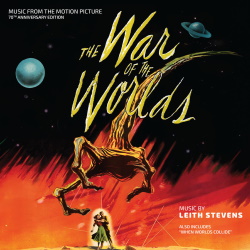 GREATEST SCORES OF THE TWENTIETH CENTURY
Original Review by Craig Lysy
In 1925 Paramount Pictures purchased the film rights to the 1897 H. G. Wells novel “War of the Worlds”. For twenty-six years the studio struggled due to technical challenges to bring the film into production under several producers – Cecil B. DeMille, Arzén Cserépy, Sergei Eisenstein, Alexander Korda, Watterson Rothacker and Alfred Hitchcock. Finally, in 1951, George Pal, who had gained success in the emerging science fiction genre with Destination Moon in 1950 and When Worlds Collide in 1951, was assigned production with a $2 million budget. Byron Haskin was tasked with directing, and Barré Lyndon would write the screenplay. Fort the cast, Pal once again went with lesser known actors, opting to maximize his budget for special effects. Gene Barry would star as Dr. Clayton Forrester, joined by Ann Robinson as Sylvia van Buren, Les Tremayne as Major General Mann, Bob Cornthwaite as Dr. Pryor, and Lewis Martin as Reverend Dr. Matthew Collins.
The story begins with the crash of a large object outside the small town of Linda Rosa California. An assessment team witnesses the object open and release three Martian war machines that possess offensive heat ray and death ray weaponry as well as defensive force fields, which make them impregnable. They proceed to decimate city after city with all conventional weapons proving to be ineffective. As a last-ditch effort to save humanity, the U.S. military resorts to an atomic weapon, which also proves to be ineffective. Yet soon the Martian ships collapse and crash, with their crews dying as they attempt to flee their ships. It is determined that bacteria to which they had no immunity, killed them. And we end with narration stating: “After all that men could do had failed, they were destroyed and humanity was saved by the littlest things, which God, in His wisdom, had put upon this Earth”. The film was a commercial success, wowing the public with its storytelling and special effects. Critical reception was unfavorable, and the film received three Academy Award nominations, including Best Sound Recording, Best Film Editing, and winning one for Best Special Effects.
 This marked a very successful fourth collaboration between producer-director George Pal and composer Leith Stevens, following “The Great Rupert” (1950), “Destination Moon” (1950), and “When Worlds Collide” (1951). Upon viewing the film Stevens understood that he would have to speak musically to the Martians, expressing their alien nature, their inscrutability, their horrific destructiveness, and their diabolic technological power. He also chose to imbue the film with a darker, and bleaker soundscape to reinforce the film’s visual narrative of humanity being pushed to the brink of extinction by an implacable enemy.
For his soundscape he composed four primary themes. The Martian Theme is in many ways as intangible and inscrutable as the Martian’s themselves. It offers a high degree of variability, sowing an eerie, bleak, foreboding and unsettling musical narrative that captures their alien nature. Stevens offers musically, a cold, descending pall of doom that snuffs out all life in its path, perfectly capturing the malevolence of the Martians. The End of All Things Theme speaks to the impending route of civilization and massacre of humanity. Its initial incarnation appears in the Main Title where it is heralded by horns bellicoso from which unfolds an ominous, oppressive and irresistible marcia del terrore. The march is empowered by strident horns bellicoso, a relentless cadence by drums brutale, with strings of woe weaving the piece together with an aura of hopelessness, which perfectly captures the malevolence, horror, and destructiveness of the Martians. Later in the film, as the route of civilization and massacre of humanity is unfolding before our eyes, it is transformed into a dirge, a lamentation for the end of all things. The Doom Theme offers melancholia, emoting with recurring six-note phrasing by strings tristi and woodwinds full of despair. It speaks to an impending sense of doom as the Martian’s implacable and destructive technological power manifests. The Faith Theme is associated with Pastor Collins personally, but also transpersonally for humanity itself as it faces extinction. It is expressed with solemn serenity as a pastorale religioso. Its final rendering when it is transformed into a paean of thankfulness to the Divine concludes the film gloriously.
“Main Title” offers a score highlight where Stevens masterfully establishes musically, the tone of the film’s narrative. We open atop horn bravura declarations of the “Paramount Pictures Signature” by Elsie Janis and Jack King, which supports the studio logo. Narration by Sir Cedric Hardwicke supported by a drum empowered marcia militare unfolds;
“In the First World War, and for the first time in the history of man, nations combined to fight against nations using the crude weapons of those days. The Second World War involved every continent on the globe, and men turned to science for new devices of warfare, which reached an unparalleled peak in their capacity for destruction. And now, fought with the terrible weapons of super-science, menacing all mankind and every creature on Earth, comes…”
Narration finishes at 0:15 atop a grotesque crescendo orribile, as the film title in bold red letters displays; “THE WAR OF THE WORLDS”. The opening credits commence supported at 0:22 by an extended rendering of the End of All Things Theme. It is heralded by horns bellicoso from which unfolds an ominous, oppressive and irresistible marcia del terrore. The march is empowered by strident horns bellicoso, a relentless cadence by drums brutale, with strings of woe weaving the piece together with an aura of hopelessness, which perfectly captures the malevolence, horror, and destructiveness soon to be unleashed by the Martians. At 1:19 we segue into “Introduction” where a visual tour of our solar system supports Sir Cedric Hardwicke’s narration;
“No one would have believed, in the middle of the 20th century, that human affairs were being watched keenly and closely by intelligences greater than man’s. Yet, across the gulf of space on the planet Mars, intellects vast and cool and unsympathetic regarded our Earth with envious eyes, slowly and surely drawing their plans against us. Mars is more than 140 million miles from the sun, and for centuries it has been in the last stages of exhaustion. At night, temperatures drop far below zero even at its equator. The inhabitants of this dying planet looked across space with instruments and intelligences of which we have scarcely dreamed, searching for another world to which they could migrate. They could not go to Pluto, outermost of all the planets, so cold that its atmosphere lies frozen on its surface. They couldn’t go to Neptune or Uranus, twin worlds in eternal night and perpetual cold, both surrounded by an unbreathable atmosphere of methane gas and ammonia vapor. The Martians considered Saturn, an attractive world with its many moons and beautiful rings of cosmic dust, but its temperature is close to 270 degrees below zero, and ice lies 15,000 miles deep on its surface. Their nearest world was giant Jupiter, where there are titanic cliffs of lava and ice with hydrogen flaming at the tops, where the atmospheric pressure is terrible – thousands of pounds to the square inch. They couldn’t go there. Nor could they go to Mercury, nearest planet to the sun; it has no air, and the temperature at its equator is that of molten lead. Of all the worlds that the intelligences on Mars could see and study, only our own warm Earth was green with vegetation, bright with water, and possessed a cloudy atmosphere eloquent of fertility. It did not occur to mankind that a swift fate might be hanging over us, or that from the blackness of outer space we were being scrutinized and studied – until the time of our nearest approach to the orbit of Mars during a pleasant summer season.”
The Martian Theme’s presence lurks and Stevens supports with an eerie, foreboding and unsettling musical narrative, which portends doom. The confluence of Stevens’ music, Hardwick’s narration and the visual effects team was spot on.
On the crowed main street of Linda Rosa California, people observe the crash of a massive fireball in the hills outside town. Forest rangers in a fire tower identify the crash site coordinates and a fire truck is dispatched. “The Thing” opens with racing strings of urgency a we see a firetruck speeding to the scene. Stevens supports the crew and townsfolk putting out fires that surround the crashed object with an agitato in which is woven brief foreboding horn declared quotes of the Martian Theme. With the fires put out an encampment is set up as the men await a team of experts to arrive. Steven sow unease with the Martian Theme lurking in the musical narrative. “Radioactive” offers musical subtlety and atmospherics. It reveals towns folk swarming the site, taking pictures, with townsman Buck out with a shovel hoping to find gold. Dr. Clayton Forrester arrives and engages in banter with teacher, and admirer Sylvia van Buren. Stevens supports with a portentous misterioso full of unease joined by recurring latent quotes of the Martian Theme. Dr. Forrester’s Geiger Counter is discovered to be registering radiation, and he makes the determination that the object is radioactive, but also apparently hollow given its crash impact crater signature. The foreboding musical narrative lightens at 1:44 when Pastor Collins pastoral Faith Theme joins as he offers Dr. Forrester lodging at his house, which he graciously accepts.
(*) “Town Dance” reveals a town dance with Dr. Forrester dancing with Sylvia along with other couples. Stevens supports by interpolating the festive fiddle driven tune “Flop-Eared Mule” by Zip Wilson. In “It’s Moving” Salvatore, Walsh and another guy sit at the site are supported by a musical narrative of unease as shimmering strings are joined by foreboding low register strings. At 0:28 an ominous two-note descent ushers in a latent, but menacing Martian Theme as a circular hatch begins to unscrew and frightens the men. A slowly building crescendo di paura stokes the men’s anxiety as the watch. The men conclude that these are Martians, want credit of being the first to meet them, make a white flag, and approach cautiously. “Heat Ray Dispenser” reveals the men being incinerated by the Martian ship’s heat ray, which also causes the town’s electrical grid to fail. Music enters atop an eerie Doom Theme, a repeating six-note motif for strings and woodwinds, as they discover that not only is the electricity out, but the phones, hearing aids, and people’s watches. In assessing the problem, Dr. Forrester discovers that their watches are now magnetized. An ominous two-note strike at 0:33 supports the discovery that the Sherriff’s compass now points to the crash site, not north. Dr. Forrester, Sherriff Bogany and an officer travel to the crash site and dire horns resound at 0:50 when they discover that the men and their car have been incinerated. The police officer flees in the car to warn the town, but at 1:03 an orchestral explosion of violence supports the Martian heat ray disintegrating the car. At 1:08 we segue into “Get The Military” carried by the Doom Theme as Clayton advises that they need to call in the military.
In unscored scenes it is revealed that Martian ships of war are landing across the globe and wreaking destruction for anything in their path. Colonel Heffner has surrounded the Martians in the gully and is prepared to engage should they try to leave. General Mann arrives to observe the operation, which suffers its first loss when a military plane dropping a flare to illuminate the gully is shot out of the sky by the Martians. They then fire upon the troop positions causing everyone to duck for cover. Colonel Heffner orders in tank mortar, artillery and missile launcher reinforcements to bolster his defensive line. In “Attempted Communication” offers a score highlight where the Faith Theme finds a stirring confluence with the pastor’s fateful walk to greet the Martians as he recites the Psalm 23. Stevens sow a sense of foreboding, and unease with a recurring Doom Theme as we see the military waiting for movement. The Martian ships ascend and begin to move forward out of the gully. The colonel orders his men to prepare to fire as Pastor Collins counsels trying communication first. The pastor departs the command bunker and advises Sylvia that an effort must be made to communicate with them. He asks her to go inside, and at 1:53 an orchestral surge initiates his walk towards the approaching ships. The Faith Theme, expressed with solemn serenity as a pastorale religioso supports the pastor’s fateful walk as he recites Psalm 23. At 2:23 the theme swells on a crescendo religioso, only to be silenced as the pastor is incinerated by the Martian heat ray.
In unscored scenes the colonel orders “Open Fire!” and the three Martian ships are subjected to a withering attack. Dr. Forrester and the general are shocked to discover that the ships are protected by an electromagnetic shield making them impregnable. The Martians retaliate firing both their primary heat rays, and two lateral death rays, which begin systematically incinerating the military’s weaponry. Dr. Forrester advises the general that conventional weaponry is useless and that they need to retreat and notify Washington. They flee as the Colonel Forrester and most of his command are incinerated. Later they call in a squadron of sixteen bombers as Dr. Forrester and Sylvia flee in a small turbo prop air force plane. They crash in the path of the Martians and are forced to flee on foot and hide. In Los Angeles General Mann briefs his command staff on the need to evacuate the city as the Martians are approaching and only 40 miles away. He them briefs the Pentagon that his losses were 60% men, 90% equipment and that the bomber squadrons payloads were ineffective, with all planes shot down. He relates that the Martian’s have electromagnetic shields that make them impregnable.
(*) “Wildlife Fleeing” reveals scenes of panicked birds, deer, and horses fleeing in mortal terror, driven by a terrifying musical narrative borne by frantic strings energico and dire horns. “Southwest Of Corona” reveals Sylvia asleep in Dr. Forrester’s arms supported by forlorn woodwinds of despair. As he looks at her, we see a nascent romanticism arise in his eyes. At 0:39 strings tenero voice his affection as he gently wakes her up. He sees a farmhouse in the distance, and they go there to find something to eat. In an unscored scene she cooks breakfast and reassures her that the Martians are mortal, have mortal weaknesses, and will be stopped. Their intimate respite is shattered when a Martian transport vessel crashes and slides into the house. After several hours Sylvia manages to wake Dr.Forrester who was knocked unconscious. In (*) “Surrounded”, the warbling sounds of the Martian warships envelop them, and their dire theme resounds as Dr. Forrester observes them through the blinds.
“The Scanning Eye” reveals an electronic trifold eye attached to a flex cable lowered from the craft. It enters the house through a window as Clayton and Sylvia hide. Stevens sow a diabolical musical narrative of terror as the device advances into the room empowered by a menacing motif for the eye of slithering, serpentine strings supported by low register terror. At 1:40 an eerie, rising and falling string motif supports the eyelid closing and the device withdrawing. As they move away Sylvia sees a Martian and Stevens sow tension as Dr. Forrester moves about, desperate to see its form. As he struggles to clear a stairway to the attic, the electronic eye returns. At 2:17 a rapidly surging crescendo of violence crests horrifically as Sylvia screams at the eye, which Dr. Forrester shears off with several axe strikes. In (*) “A Martian!” Stevens slowly builds tension, which swells ominously as we see a Martian sneak in and place his hand on Sylvia’s shoulder. She screams in terror as desperate strings surge when Dr. Forrester shines a flashlight on it that reveals the creature has the same trifold eye. A horrific orchestral shriek follows as he flings the axe that wounds the Martian, which screams and flees in terror. As they run upstairs to the attic, the Martian Theme remains pervasive. Dr. Forrester removes the wrap around the electronic eye and discovers the oozing liquid is blood. Sylvia becomes hysterical and screams, supported by a crescendo of horror, which dissipates he repeatedly shouts “Stop it!” and shakes her. A fleeting romantic passage follows as he smiles and comforts her. He leads her out the window to flee before the Martian’s strike. Dire horns resound as the Martian ship incinerates the farm house as Dr. Forrester and Sylvia escape unnoticed.
In (*) “Humanity On The Brink”, narration supports a montage of scenes showing desperate but futile resistance across the globe. Sir Cedric Hardwicke’s ends his narration with; “It was the beginning of the route of civilization, of the massacre of humanity”. Stevens supports with an extended exposition of the Doom Theme, bringing down on humanity a dark pall of death as the flame of hope flickers. I found the musical passage well-conceived and executed, achieving a perfect confluence with Hardwick’s prose and the horrific images of destruction. In an unscored scene the command team at the Pentagon discusses the grim news coming from all fronts. The Secretary of Defense authorizes the use of an atomic bomb at Puente Hills on the outskirts of Los Angeles. In “Clayton And Sylvia Arrive With Eye” they reveal the electronic eye and blood stained cloth to fellow scientists at the Pacific Institute of Science and Technology. They connect the device and power it up, discovering that the Martians see with a different spectrum of light. Their blood cells appear to suggest a primitive structure and anemia. Stevens supports the scene with a misterioso within whose notes are woven ominous quotes of the Martian Theme.
(*) “Humanity’s Last Hope” reveals the air force’s latest bomber, a flying wing taking off with the atomic bomb. Stevens sow suspense and tension as the plane lifts off. A scientist relates that if the A-bomb fails, the Earth will succumb in six days. Sylvia adds, saying, the same number of days it took to create it. The bomb is dropped and a massive explosion sends shock waves through the observation post. The Martian’s are unscathed and renew their attack. General Mann orders an evacuation of all cities, retreat into the mountains, and advises Dr. Forrester that humanity’s salvation lies with him and fellow scientists developing a countermeasure. Dr. Forrester sets in motion a plan that he now shares with his fellow scientists, saying we cannot beat the technology of their machines, so we must instead try to beat the Martians themselves, biologically. “Evacuation” reveals evacuation sirens sounding as police announce orders to evacuate. Stevens supports the montage of scenes showing the route of humanity along with Dr. Forrester and the fellow scientists leaving on trucks loaded with equipment with the End of All Things Theme rendered as a dirge. All seems lost when desperate crowds stop and commandeer the caravan, tossing out all the scientific equipment as Dr. Forrester and his comrades watch in horror.
“Deserted” reveals a bloodied and desperate Dr. Forrester running through deserted Los Angeles streets. Racing strings energico empowered by horns of doom and ominous declarations of the Martian Fanfare portend doom and carry his run. (*) “Clayton Finds Sylvia” reveals Martian ships proceeding down Los Angeles streets incinerating everything in their path, including city hall. Military police fail to coax Dr. Forrester into their jeep, and so depart as he proceeds to a place he knows Sylvia would go – a church. He hears a hymn being sung as he approaches. Inside during a sermon, he searches but does not find her. An organ solenne plays as he departs and searches another church where he finds Drs. Duprey and Bilderbeck. They have no idea where Sylvia is and he leaves to continue his search as Martian ships rain down Hell around him. He enters another church and searches as the congregation sings a mournful hymn and explosions light up the stain glass windows. He cries out “Sylvia!”, she responds, and they run to each other as a blast damages the church. Outside a Martian ship wobbles and crashes, followed by several others and silence envelops them.
“Martian Man Dies” reveals people slowly realizing silence and going outside where they see a dead Martian ship. A hatch opens and a Martian limb attempts to crawl out, only to collapse and change color. Dr. Forrester touches it and states that it is dead. Stevens supports the scene with the Martian Theme shorn of all its vitality, and strength, reduced to a slow dirge like expiration that weakens and dissipates into nothingness.
“Conclusion And End Title” reveals Dr. Forrester saying that we were all praying for a miracle. Celebratory church bells across the city are heard, buttressed by the Faith Theme, which rises up and gains strength, as we close with final narration by Sir Cedric Hardwick;
“The Martians had no resistance to the bacteria in our atmosphere to which we have long since become immune. Once they had breathed our air, germs which no longer affect us began to kill them. The end came swiftly. All over the world, their machines began to stop and fall. After all that men could do had failed, the Martians were destroyed and humanity was saved by the littlest things which God, in His wisdom, had put upon this Earth”.
As the Faith Theme blossoms, it is joined with interpolation of the of the last line of the hymn “Now Thank We All Our God” by Martin Rinkart; “In This World and the Next. Amen”. We conclude atop horns trionfanti in a glorious religioso flourish.
I wish to commend Dan Goldwasser and Chris Malone for restoring and reissuing Leith Stevens’s long coveted score for “War of the Worlds”. Monophonic source elements were restored, mixed, and mastered by the technical team, and while the audio quality does not achieve 21st century quality standards, the listening experience is good and does not diminish Stevens’ handiwork. At the nexus of the story is an invasion of Earth by an alien species intent on eradicating humanity to facilitate colonization. For most of the film the Martians are not seen, and so appear inscrutable. Stevens supports this musically with an eerie and cold stepwise crawling motion that closes with a foreboding tritone descent. Early in the film the theme is latent and lurking, becoming more overt after they initiate their attack. More compelling is his The End of All Things Theme, which speaks to the impending route of civilization, and massacre of humanity. In the Main Title it sets the tone of the film rendering the theme as an aggressive marcia del terrore, which portends the Martian attack, while latter it speaks to the attack’s aftermath, where it is shorn of its aggression and brutality, and instead rendered as a dirge. Juxtaposed are the two remaining themes with the Doom Theme offering melancholia and despair as humanity is exterminated, powerless to stop the Martians, versus the Faith Theme, which nurtures a kernel of hope for humanity’s survival. In scene after scene Stevens masterfully supports the unbearable and debilitating Martian brutality and carnage, yet with their surprising demise via deus ex bacteria, he lifts the pall of despair closing the film with a glorious paean of joy. Folks, La La Land offers a quality album that also includes another Stevens gem “When Worlds Collide”. Resurrecting these outstanding, science fiction scores of the 1950s is most welcome and I highly recommend purchasing this fine album.
For those of you unfamiliar with the score, I have embedded a YouTube link to the opening title sequence: https://www.youtube.com/watch?v=imYcxlL338s
Buy the War of the Worlds soundtrack from the Movie Music UK Store
Track Listing:
- Main Title / Introduction (3:16)
- The Thing (1:25)
- Radioactive (2:04)
- It’s Moving (1:53)
- Heat Ray Dispenser / Get The Military (1:48)
- Attempted Communication (3:12)
- Southwest Of Corona (1:26)
- The Scanning Eye (2:44)
- Clayton And Sylvia Arrive With Eye (1:17)
- Evacuation (3:02)
- Deserted (0:32)
- Martian Man Dies (1:20)
- Conclusion And End Title (1:05)
- Main Title (Orchestra Only) (1:13) BONUS
- End Title (Orchestra Only) (1:05) BONUS
- Prologue And Main Title (Film Version) (1:48) BONUS
- Heat Ray Dispenser Sound Effect (1:04) BONUS
Running Time: 25 minutes 27 seconds
La-La Land Records LLLCD-1630 (1953/2023)
Music composed and conducted by Leith Stevens. Orchestrations by George Parish, Sydney Cutler, Leon Shuken and Nelson Riddle. Recorded and mixed by Phil Wisdom. Score produced by Leith Stevens. Album produced by Dan Goldwasser and Chris Malone.

Shop at the Movie Music UK Store

Member of the

 MOVIE MUSIC UK