THE JOY LUCK CLUB – Rachel Portman
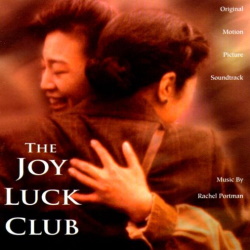 THROWBACK THIRTY
Original Review by Jonathan Broxton
Anyone who has read this website for any length of time will know that one of my favorite sub-genres of film music is the ‘east/west crossover,’ meaning scores which blend a western symphonic orchestra with specialist solo instruments from China, Japan, Korea, and other East Asian cultures; instruments like the shakuhachi, shamisen, taiko drums, erhu, dizi, pipa, and so many more. There is something wholly evocative about this style to me, the way the two types of instruments complement each other, one enhancing the beauty of the other. My love of this style goes back thirty years, and was originally influenced by this score – The Joy Luck Club by Rachel Portman – which was the first east/west crossover score I consciously heard.
The Joy Luck Club is a drama film directed by Wayne Wang, based on Amy Tan’s massively popular and influential 1989 novel of the same name. The movie tells the interconnected stories of four Chinese immigrant mothers and their American-born daughters, all of whom gather regularly to play mahjong and share their life experiences. The film explores the generational and cultural gaps between the mothers, who grew up in China, and their daughters, who are more assimilated into American culture, and through a series of flashbacks delves into the challenges and complexities of their relationships, while also revealing the sacrifices made by the mothers during their difficult pasts in China, as well as the pressures faced by the daughters to bridge the gap between their heritage and their American lives. The film stars Kieu Chinh, Tsai Chin, France Nuyen, and Lisa Lu as the mothers, and Ming-Na Wen, Tamlyn Tomita, Lauren Tom, and Rosalind Chao as the daughters, and was a modest success at the box office and with critics during the early fall of 1993.
 Although she had written for some fairly high profile British and American films before – The Woman in Black in 1989, Oranges Are Not the Only Fruit in 1990, Where Angels Fear to Tread in 1991, Used People in 1992, Benny & Joon and Ethan Frome earlier in 1993 – The Joy Luck Club was the score which properly introduced Rachel Portman’s music to international audiences, and cemented her reputation as one of film music’s outstanding new melodic emotionalists.
The score overflows with gorgeous evocations of Chinese culture, blended with the more familiar western sound, perfectly encapsulating the dichotomy at the heart of the story, with these deeply traditional mothers, still very much influenced by the past, clashing with their more modern and more liberated westernized daughters. The music is very, very beautiful, but it’s also underpinned with a bittersweet sense of sadness and regret, as if the music is pining for the country that China used to be before the mothers were forced to leave and flee to the west.
It’s a mostly monothematic score – but what a theme! It gets its first performance right out of the gate in “The Story of the Swan,” a haunting, lilting ethnic woodwind melody backed by a Chinese dulcimer which switches to an erhu after around 40 seconds, and then gradually picks up a sizeable orchestral backing led by warm, tender strings and woodwinds. The melody is quintessential Portman – there are echoes of and foreshadowings to essentially every score she wrote for the next 25 years – but at the time The Joy Luck Club came out hers was a new, fresh, unique sound, and it immediately caught the attention of fans and filmmakers alike.
The theme is ever-present throughout the score, and receives especially prominent performances in numerous subsequent cues, notably the slower and more intimate “Best Quality Heart,” “An-Mei’s Mother Returns,” the quietly devastating “Most Important Sacrifice,” and “Lindo’s Last Night” with its increased use of a Chinese dulcimer. Perhaps the most deeply emotional reprise comes in “June Meets Her Twin Sisters,” which underscores the scene where one of the daughters visits China to see the twin half-sisters her mother had been forced to abandon when the Japanese attacked China, an event which allows her to finally accept her Chinese heritage and make her peace with her mother. Portman accentuates the statement of the theme for more prominent brass, and with some of those luxurious layered strings that would go on to be a Portman hallmark.
A few other cues offer something different. “Escape from Guilin” is a more downbeat and somber variation on the theme featuring a more prominent solo trumpet performance and more emphasis on minor key harmonies and chord progressions, appropriately accompanying the story of one character’s heartbreaking escape from Taiwan after the outbreak of World War II. “Lindo’s Story” is light and pretty, and is carried by flutes, in an almost child-like and pastoral manner. “Upturned Chairs” has a curious, playful, inquisitive quality, again focused on woodwinds, while “His Little Spirit Had Flown Away” and “The Babies” are perhaps the darkest cues in the score – tragic and heartfelt remembrances of lost children, again with lots of minor key harmonies.
The “End Titles” offers a lusher and more stirringly symphonic performance of the main theme and its related variations, again with the prominent layered strings, that is just sublime, and at the very least this cue should have a prominent position in any Portman devotee’s collection.
One significant criticism of The Joy Luck Club could be that, for all its subtle variations, the score is very much a one-theme work, and if the theme doesn’t immediately capture you, then the whole score will be done for. Not only that, the pacing of the score tends to be somewhat one note – it’s slow, thoughtful, restrained, never once raising its voice – and for anyone who needs a little more variety or more energetic stimulation in their film music, they are likely to find this score on the dull side.
Personally, however, I fell in love with The Joy Luck Club from the first moment I heard it, and it retains a strong personal connection to my own film music history. It was the first Rachel Portman score I heard as a standalone album, and was the first east/west crossover-Asian fusion score I heard out of context, and those two things together captured my heart and imagination. It cemented Portman’s position as the most prominent and respected female film composer of her generation, and set her on the path to win her Oscar for Emma three years later. Not only that, as a loving, deeply touching evocation of what it is to be a Chinese woman in America, walking those narrow lines between tradition and modernity, the old and the new, the past and the future, it succeeds perfectly, bringing a layer of deeply rendered emotional pathos to the stories of these strong, proud women.
Buy the Joy Luck Club soundtrack from the Movie Music UK Store
Track Listing:
- The Story of the Swan (2:30)
- Escape from Guilin (5:35)
- Lindo’s Story (1:50)
- Best Quality Heart (2:27)
- Upturned Chairs (1:58)
- June Meets Her Twin Sisters (2:58)
- His Little Spirit Had Flown Away (4:33)
- An-Mei’s Mother Returns (1:50)
- Most Important Sacrifice (2:44)
- Tiger In The Trees (3:23)
- Lindo’s Last Night (3:32)
- The Babies (3:57)
- An-Mei’s New Home (2:38)
- Swan Feather (0:51)
- End Titles (3:15)
Running Time: 44 minutes 01 seconds
Hollywood Records HR-61561-2 (1993)
Music composed by Rachel Portman. Conducted by J.A.C. Redford. Orchestrations by Rachel Portman and John Neufeld. Featured musical soloists Masakazu Yoshizawa, Chris Fu, Shufeng He, Karen Hua-Qi Han and Jim Walker. Recorded and mixed by John Richards. Edited by Bill Abbott. Album produced by Rachel Portman.
Leave a comment

Shop at the Movie Music UK Store

Member of the

 MOVIE MUSIC UK
How does Rachel Portman’s score for The Joy Luck Club reflect the film’s themes of cross-generational trauma, resilience, and the power of storytelling?