BLUE BEETLE – Bobby Krlic
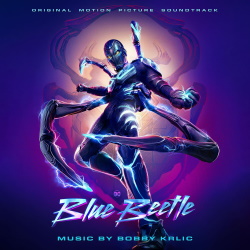 Original Review by Jonathan Broxton
There has been a lot of talk in Hollywood recently about the use of A.I. to create content. It is part of the ongoing strikes happening right now; the actors union SAG-AFTRA are concerned about digital image rights among other things, while the writers union WGA are concerned about their work being undermined by text-generating software like ChatGPT. So far the impact of A.I. on film music has been negligible, but there are certainly concerns about whether music-composing software, similar to what ChatGPT does for text, will eventually become a norm, potentially replacing human composers when it comes to creating music. The reason I’m talking about this in relation to the score for Blue Beetle is because, for perhaps the first time ever, I feel like I’m listening to a score generated by a bot.
Blue Beetle is a DC super hero movie directed by Angel Manuel Soto. It stars Xolo Maridueña – best known to date for playing Miguel Diaz in the Cobra Kai TV series – as Jaime Reyes, a Mexican-American teenager who finds himself in possession of an ancient relic of alien biotechnology called the Scarab. When the Scarab chooses Jaime to be its symbiotic host, he’s bestowed with an incredible suit of armor that’s capable of extraordinary and unpredictable powers – something which brings him into conflict with Victoria Kord, the ruthless CEO of a biotech company, who wants the Scarab for herself. The film co-stars Bruna Marquezine, Adriana Barraza, Damián Alcázar, Raoul Max Trujillo, George Lopez, and Susan Sarandon, and has been a modest box-office hit in the weeks since its opening. It has been praised for its positive portrayal of Hispanic culture in a comic book setting, but it does feel somewhat overly-familiar in terms of recent comic book super hero movies, coming across as a combination of left-over plot points from Spider-Man and Iron Man.
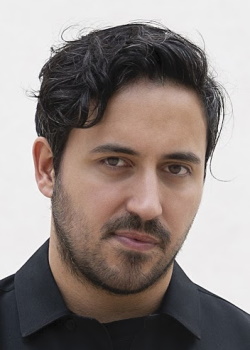 The score for Blue Beetle is by British composer and musician Bobby Krlic, who also records and releases albums under the name The Haxan Cloak. I’ve heard plenty of Krlic’s music before, in films like Midsommar, and in TV shows like The Enemy Within, The Alienist: Angel of Darkness, Snowpiercer, and Beef, among others. With the exception of Midsommar, some of which I thought was very effective in context, I haven’t been especially impressed with much of anything he’s written; he’s one of those dark ambient composers, prone to long periods of drawn-out droning chords and little bits of bloopy electronic manipulation. That’s fine. There are people who like that sort of music, and who find it appealing, but I am not one of them. Personal taste is personal taste. But when I heard he had been hired to score Blue Beetle, I was actually intrigued at how he might approach scoring a super hero film, with all the conventions that tend to come with that genre, from the melodic elements to the increased energy levels required for action sequences. Disappointingly, what he did was write the most blandly generic score I have heard in years.
I usually don’t like the word generic. It’s often passed around in a casually dismissive way to talk about anything you don’t like, and so as such I try to avoid using it as much as I can, but the score for Blue Beetle actually fits the dictionary definition of the word: having no particularly distinctive quality or application. And this brings me back to my opening paragraph about A.I. because, to me, the whole score feels like the sort of music that ‘FilmScoreGPT’ might spit out if you gave it prompts to write a contemporary super-hero score. All the usual clichés are present in abundance, even down to the use of the Hans Zimmer ‘braaam,’ which feels like it should have been considered passé a decade ago.
And, of course, none of this may be down to Krlic at all. He could have pulled out all the stops in his first draft, writing big heroic themes and interesting, complicated rhythmic music that enlivens the action and acknowledges the unique heritage of the character. But then maybe the director was nervous and wanted him to go in a less colorful direction. Maybe he got conflicting messages from producers that resulted in him having to water down different sections of his score. Maybe the director doesn’t like melodic or memorable music. I honestly don’t know. But the bottom line is that the score that eventually emerged from this miasma of differing opinions and focus groups is one that has no distinctiveness, no originality, and little to no innovation. There is nothing that gives it an identity of its own, that says ‘this is the score for “Blue Beetle”. It feels like it was written by a committee and generated by an algorithm that took elements from every DC super hero film, every contemporary electronic action score, and every piece of loud and obnoxious trailer music, but then removed all the interesting stuff.
It’s difficult to pick out highlights from a score like this. The orchestra is large and booming, the electronics are prominent and loud, but thematically and conceptually it feels like a bit of a void. There’s a highly processed three-note motif for brass that runs through much of the score and appears to be the recurring leitmotif for Jaime/Blue Beetle; it is heard all through the “Blue Beetle Suite” (which should be listened to first to get a sense of what the score is all about), and is then prominent in numerous later cues, notably “The Sphere,” “Manifest Fight,” and especially the two “Blue Beetle vs Carapax” tracks. Unfortunately, as an anthem for a super hero, it’s disappointingly inadequate, and pales when compared to the memorable DC thematic identities written for Wonder Woman, Shazam, Black Adam, and even this year’s The Flash.
Unfortunately, there’s no discernible identity for the villain of the piece Victoria Kord, no real identity for the relationship between Jaime and his love interest Jenny, and no real identity for the Scarab Khaji-Da. Krlic may have intended for one or more of the brief note clusters, or for a specific sound, to be a motif for these concepts, but they did not stand out to me. Furthermore, a lot of the score’s electronic manipulation is annoyingly shrill, especially the two-note ‘bee-boo’ texture that runs through most of the suite and then makes unwelcome guest appearances later in “Stratosphere Fight,” and others.
The rhythmic ideas that underpin much of the action – a combination of chugging string ostinatos, electronic beats, and live percussion – are more often than not disappointingly simple, barely changing from one cue to the next, and at times have the unsophisticated feeling reminiscent of early video game chiptunes. Brief passages within “Kord Tower Fight,” the otherwise relentlessly insufferable “Reyes House Attack,” “Activating the Bug Ship,” “Bug Ship to the Island,” and the two-part “Blue Beetle vs Carapax” sequence momentarily pique the interest with a certain different texture or different percussion pattern, but these are few and far between. In fact, the pairing of “The Cosmic Realm” and “Rebooting” might be the best cues on the album, as they finally adopt a tone that feels worthy of the characters aspirations, although even here the obnoxious electronic grating is still prevalent.
Worst of all, however, is the fact that, in my opinion, Krlic seems to have mostly messed up his emotional high points. The moments that are meant to be important and/or epic – like the moment Jaime first becomes Blue Beetle in “The Transformation,” or the revelation of what is found in “Ted Kord’s Lair” – feel cheesy and dated due to Krlic’s continual use of a very old-fashioned 1980s synth sound, which for me ruins the impact. Even the emotional moments – such as “Jenny’s Childhood” or the cue that underscores the tragic death of one of Jaime’s beloved family members from a “Heart Attack” – feel desperately under-played and overly-subtle, robbing the audience of any chance at a real emotional catharsis. Perhaps the only successful moments in this regard are the soothing and intimate “Sacrifices for the Greater Good,” which features a breathy vocal performance by Peruvian singer-songwriter and experimental artist Daniela Lalita, and the tender finale “Now We Can Cry,” which features a basic piano motif over a bed of warm strings, but stands out because it is so different to everything else in the score.
Everything else… I dunno. It just sort of groans and whines and hammers away incessantly, a sort of sub-industrial grunge noise combined with annoying electronic samples that fluctuate from aggressively harsh to whimsically bubbly, all backed by the most basic of orchestral textures.
One final frustrating thing is the fact that Krlic pays almost no attention to Jaime’s heritage. As I mentioned earlier, much had been made of the fact that Blue Beetle is DC’s first Hispanic super hero, and that is something that should be celebrated, but Krlic’s music ignores that almost entirely. I’m not saying that Krlic should have incorporated Mexican mariachi music or Cuban salsa or Puerto Rican reggaetón into his score – although, it might have been awesome if he had! – but I can’t help but feel that what he did write represents a massive missed opportunity for something different, something vibrant, something unique to *this* character and *this* story that no other DC super hero has. Again, maybe Krlic actually wanted to do that, but was steered in a different direction. I don’t know. Ultimately, only the brief guitars in the 54 seconds of “Nana’s Theme,” and the two Spanish-language covers of the songs “Blame It on the Boogie” and “Be My Baby” tacked on to the end of the album, acknowledge that Jaime’s cultural heritage is in any way important to the story.
I wish I liked this score more than I do; I really do. I really enjoy seeing new and interesting composers stepping outside their established comfort zones and seeing if they can accomplish something excellent in an unexpected setting. Unfortunately, like I said, Blue Beetle feels like the work of a composer significantly out of his depth, having to rely on every tired old superhero music cliché to make the score work, and who in doing so created a score which feels predictably generic at best, aggressively irritating at worst, and containing all the formulaic approaches that AI music generation software would inevitably create.
Buy the Blue Beetle soundtrack from the Movie Music UK Store
Track Listing:
- The Sphere (3:38)
- Victoria Kord (1:01)
- Stealing the Scarab (3:17)
- The Transformation (2:35)
- Stratosphere Flight (1:17)
- Jaime Wakes Up (2:46)
- Breaking into Kord (2:09)
- Kord Tower Fight (6:06)
- Ted Kord’s Lair (2:52)
- Healing (0:43)
- Jenny’s Childhood (2:19)
- Good News and Bad News (2:44)
- Before the Raid (1:16)
- Manifest Fight (0:54)
- Reyes House Attack (4:40)
- Heart Attack (3:21)
- Activating the Bug Ship (2:07)
- Dad’s Gadgets (3:28)
- Nana Leads (1:19)
- Bug Ship to the Island (1:05)
- Leaving the Bug Ship (3:44)
- The Cosmic Realm (3:59)
- Rebooting (3:28)
- Nana’s Theme (0:54)
- Blue Beetle vs Carapax Pt 1 (3:20)
- Blue Beetle vs Carapax Pt 2 (4:20)
- Sacrifices for the Greater Good (5:43)
- Now We Can Cry (2:42)
- Blue Beetle Suite (4:16)
- Será Que No Me Amas [Blame It on the Boogie] (written by Mick Jackson, Dave Jackson, and Elmar Krohn, performed by Damian Castroviejo) (4:10)
- Tú Serás Mi Baby [Be My Baby] (written by Jeff Barry, Ellie Greenwich, and Phil Spector, performed by Juventud Crasa) (2:51)
Running Time: 86 minutes 04 seconds
Watertower Music (2023)
Music composed by Bobby Krlic. Conducted by Tim Davies. Orchestrations by Tim Davies. Special vocal performances by Daniela Lalita. Recorded and mixed by Chris Fogel. Edited by Chris Fogel. Album produced by Bobby Krlic.

Shop at the Movie Music UK Store

Member of the

 MOVIE MUSIC UK