SEARCHING FOR BOBBY FISCHER – James Horner
 THROWBACK THIRTY
Original Review by Jonathan Broxton
Searching for Bobby Fischer is a chess-themed drama film directed by Steven Zaillian, which marked the directorial debut of the screenwriter of Schindler’s List. The film is based on the true story of Joshua Waitzkin, a 7-year-old boy with an exceptional talent for playing chess. After his skills are discovered, he starts receiving formal training from chess tutor Bruce Pandolfini. However, Josh’s natural ability for the game, as well as his fascination with the legendary chess player Bobby Fischer, creates a conflict within him. On one hand, he strives to excel in the game and becomes deeply involved in competitive chess tournaments. On the other hand, he battles with the pressure to balance his love for chess with a normal childhood. This dichotomy is further exacerbated by Josh’s parents, who have differing views on how to nurture their son’s talent: his father encourages his competitive side, while his mother wants him to enjoy a more well-rounded life. It’s a film about the pursuit of excellence, the complexities of talent and ambition, and the balance between nurturing a gift and maintaining a sense of innocence. It stars Ben Kingsley, Joe Mantegna, Joan Allen, Laurence Fishburne, and young Max Pomeranc as Josh, and I really enjoy it – it’s a slow burn, low-key movie that features some crackerjack dramatic performances and ends on an emotional high.
The score for Searching for Bobby Fischer was by James Horner, and was the sixth of the astonishing ten films he scored in 1993, following on the heels of titles like Swing Kids, A Far Off Place, Jack the Bear, Once Upon a Forest, and House of Cards. At this point in his career Horner was at the beginning of what I personally consider his golden period – within three years of this score he would write Legends of the Fall, Braveheart, Apollo 13, and The Spitfire Grill, all of which I consider to be up there with his all-time best. Searching for Bobby Fischer is another example of just how tremendous he was. The thing that Horner did so brilliantly – and which is probably what appeals to me about his music in the first place – is that he instantly got to the emotional heart of every story he scored. Horner had this astonishing skill to reach out and convey in music not only the emotions on screen, but also the subtext, so that you were able to feel more deeply the things that the director and the actors were trying to convey. Searching for Bobby Fischer is a score like that.
 The score is structured around four recurring ideas, plus one additional stylistic motif which would go on to become a beloved Horner staple through its adaptation into other scores. There’s a theme for Bobby Fischer himself, a warmly nostalgic melody full of hope and optimism, which acts as the score’s main melodic idea. There’s a theme for Josh, a youthful and ebullient piece that sometimes explodes into rapturous ecstasy, but which can also quiet down and offer introspective observations into Josh’s psyche. There’s a motif for the concept of chess itself, a series of four shifting chords that continually appear in the background of the score, often acting as a herald to initiate statements of other themes, or combining contrapuntally with themes to create intellectual linkages – Bobby and chess, Josh and chess, Josh’s family and chess, and so on. Sometimes they are complementary, and sometimes they stand at odds, illustrating the complicated relationship that exists between Josh and all these things. Finally, there’s a more restrained theme that relates to Josh’s relationship with his chess tutor Bruce, which is often conveyed as a pretty waltz.
These four ideas intertwine throughout the score, emerging as a compelling portrait of a brilliant but difficult childhood, and several cues stand out. The “Main Title” introduces both the main Bobby Fischer theme and the chess motif, elegant and pretty and beautifully orchestrated for strings and woodwinds, pastoral pianos, and those familiar bass note chords that Horner often used to emphasize a sense of drama or nostalgia, especially in scores like Field of Dreams. “Early Victories” initially reprises both those themes with magical innocence and wonderment, including a notably gorgeous solo horn performance of Bobby’s theme, but then offers the score’s first performance of Josh’s theme, a joyful explosion of delight and enthusiasm that gives voice to Josh’s initial discovery of his aptitude for, and love of, chess. The way the lyrical strings combine with the breathless piano line underneath it is just superb, vintage Horner.
There are several more attractive statements of Bobby’s theme and Josh’s theme running through cues like the restrained “Contempt,” and the playful “Josh vs. Dad,” the latter of which underscores the scene where young Josh easily beats his father at chess while absent-mindedly taking a bath (among other things), and which has some superb interplay between piano and harp. However, what’s really interesting is the cue “The Castle,” which re-introduces the propulsive accelerando rhythmic idea from the score for Sneakers that would later go on to be popularly known as Horner’s ‘genius motif’. It’s pretty much common knowledge amongst film music fans that Horner repeated himself, endlessly, taking ideas and textures and entire melodies from his older scores and re-using them in slightly different variations in newer ones. Horner was excoriated for this during his lifetime, but what has become more apparent in the years since his death is that Horner didn’t do this haphazardly, or lazily; instead, in my opinion, Horner’s highly specific emotional personality resulted in him reacting in very distinct musical ways to recurring ideas, themes, and concepts, across multiple movies, as if he was honing and refining it. The ‘genius motif’ is one of these.
As far as I can tell, Sneakers was the first time Horner used this idea, and there it was used to represent Ben Kingsley’s character, a computer programming genius. Here, in Searching for Bobby Fischer, he uses it to represent Josh’s genius at chess. He would later go on to use it in Bicentennial Man in 1999 (the whole film is about genius in science and robotics), and then again in A Beautiful Mind in 2001 (John Nash, math genius). I know that many people don’t like this trait that Horner had; they think it’s lazy, or whatever the pejorative-du-jour is. Personally, I think finding these conceptual links across multiple scores is absolutely fascinating, and that it gives some sort of insight into the way Horner’s mind worked. Either way, the use of this idea in “The Castle” is thrilling to me, but that’s not the end of its impact.
“Josh’s First Lesson” offers the score’s first statement of the lovely waltz-like theme for Josh’s chess mentor Bruce Pandolfini, arranged as a superb duet for clarinet and harp backed by the chord structure of the ‘chess motif’. “Trip To Chicago” is a standalone cue for piano and harp, the two instruments dancing around each other in a variety of flighty, fanciful, expressionistic ways. A much more dramatic version of Bobby’s theme anchors “Washington Square,” which layers the melody against both the chess chords and hints of the genius motif, and accompanies the epiphany Josh experiences while watching homeless men playing an aggressive, unrelenting version of ‘speed chess’ in the park – an event which triggers in Josh the idea that chess can be played in ways that suit you, rather than adhering to rigid tradition.
There are stark synthetic versions of several of the main themes at the outset of “Start Your Clocks/Master Class Points,” emphasizing Josh’s turbulent state of mind and his deteriorating relationships with his family, his teacher, and the game itself, before the cue resolves in its second half and presents a lush and tender oboe arrangement of Josh’s theme that has an air of Legends of the Fall about it. This leads into what is, for me, the score’s showstopper: “Josh and Vinnie,” which underscores Josh’s breathless game of speed chess with Laurence Fishburne’s character, a homeless street hustler and chess player who becomes Josh’s second mentor.
“Josh and Vinnie” opens with a pleasant rendition of Bobby’s theme, but quickly picks up the score’s most prominent performance of the ‘genius motif,’ as the speed chess game begins. The tempo of the piece becomes faster, and faster, and faster, and faster… building and building, corresponding with the pace of the game itself, until it eventually explodes into a soaring performance of Josh’s theme, as he rediscovers the sheer joy of playing for playing’s sake. It’s absolutely exhilarating on an emotional level, but also on a technical one: my old friend Julie Olsen Brown used to play a game wherein she would get us to lightly tap our thighs to the tempo of the accelerando, and try to keep up with it as it increased through the cue, as a way to illustrate just how fast it was going. We invariably failed to do so, and fell about laughing around the 2:20 mark.
“The Nationals” and “Final Tournament” underscore the film’s climactic sequence where Josh – having had his love for chess reignited – plays an important match against Jonathan Poe, another young prodigy whose talent has intimidated Josh throughout the movie. Horner shifts easily through all the score’s main thematic ideas, offers passages for frolicking pianos, a quick burst of the famous four-note danger motif in its languidly jazzy ‘Sneakers variation,’ gorgeously tender writing for woodwinds, and a reprise of the ‘genius motif’ for the moment when Josh remembers the tactics he learned from Vinny, and a tension-filled acknowledgement of Bruce’s theme when Josh notices his opponent make a critical error.
The track ends with a warmly sympathetic version of the main theme when Poe refuses to accept Josh’s sporting offer of a draw – and Josh wins anyway. This this leads into the 7-minute “Epilogue/End Credits,” which is a gorgeous final exploration of the score’s main themes in suite form; the first part of the End Credits provides the score’s most expansive exploration of Bruce’s theme, and the whole thing ends with a curiously un-resolved statement of Bobby’s theme that fades out wistfully, suggesting that Josh’s lifelong search for the essence of his chess idol continues.
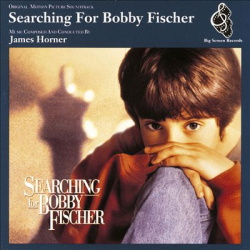
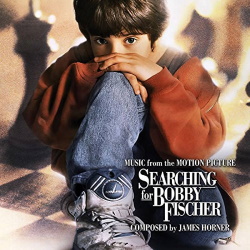 The original album for Searching for Bobby Fischer was released by the now-defunct Big Screen Records at the time the film was released, and presented a satisfying 50-minute program that I always enjoyed. The album was arranged a little oddly – it was sequenced completely out of chronological order – but I always liked the way the album flowed, and never felt that the sequencing was detrimental. Unfortunately, the demise of the record label resulted in the score being out of print for many years throughout the late 1990s and early 2000s; thankfully, in 2015, La-La Land Records and producer Dan Goldwasser released a limited edition 3,000-copy expanded album, remastered and re-sequenced in film order, presented in a handsome package featuring in-depth liner notes from writer Brian Satterwhite. If you never picked up the original, then this album comes highly recommended.
I love the score for Searching for Bobby Fischer. It’s one of my all-time favorite James Horner drama scores, and it holds a special place in my heart as it was one of the first Horner back-catalogue scores I discovered in my fledgling years as a film music fan. But, even without that personal connection, there is still a lot to recommend here: the gorgeous cache of recurring themes, the warm and nostalgic orchestrations, the terrific use of the ‘genius motif,’ and the exhilaration of the moments where Horner revels in Josh’s love of chess, and encourages us to love it with him.
Buy the Searching for Bobby Fischer soundtrack from the Movie Music UK Store
Track Listing:
- ORIGINAL RELEASE
- Main Title (3:03)
- Early Victories (3:30)
- Contempt (2:40)
- The Castle (2:04)
- Josh vs. Dad (3:18)
- Josh’s First Lesson (2:38)
- Trip to Chicago (3:24)
- Washington Square (2:45)
- Start Your Clocks/Master Class Points (4:06)
- Josh and Vinnie (3:31)
- The Nationals (3:25)
- Final Tournament (7:55)
- Epilogue/End Credits (7:10)
- LA-LA LAND EXPANDED RELEASE
- Main Title (3:05)
- Washington Square (2:43)
- Chess Piece in the Dark/Shirazi Game/Little Castle (3:44)
- Josh vs. Dad (3:17)
- Josh Wins in Chess Club (1:25)
- Josh’s First Lesson (2:35)
- Master Class Points (2:32)
- Josh Watches Team Leave/First Tournament (1:30)
- Start Your Clocks (1:42)
- Early Victories (Film Version) (3:28)
- Josh Sees Poe in the Park (1:17)
- Poe and Josh in Chess Club/Maybe It’s Better Not to Win (2:49)
- Contempt (Original Version) (2:44)
- Bobby Fischer Interview (1:23)
- Josh and Vinnie (3:25)
- The Nationals (3:23)
- Poe Watches Josh Advance/Certificate From Bruce (3:01)
- Final Tournament (Film Version) (4:56)
- Final Victory (1:45)
- Epilogue/End Credits (7:06)
- The Castle (Album Version) (2:24) BONUS
- Josh vs. Dad (Alternate) (3:18) BONUS
- First Tournament (Alternate) (1:12) BONUS
- Josh Sees Poe in the Park (Alternate) (1:20) BONUS
- Poe and Josh in Chess Club (Alternate) (1:44) BONUS
- Contempt (Alternate) (2:39) BONUS
- Josh and Vinnie (Alternate Opening) (0:59) BONUS
- Epilogue/End Credits (Alternate) (6:54) BONUS
Running Time: 49 minutes 29 seconds – Original
Running Time: 78 minutes 20 seconds – Expanded
Big Screen Records 9 24532-2 (1993)
La-La Land Records LLLCD-1355 (1993/2015)
Music composed and conducted by James Horner. Orchestrations by James Horner and Thomas Pasatieri. Recorded and mixed by Shawn Murphy. Edited by Jim Henrikson. Score produced by James Horner. La-La Land album produced by Dan Goldwasser, MV Gerhard and Matt Verboys.

Shop at the Movie Music UK Store

Member of the

 MOVIE MUSIC UK