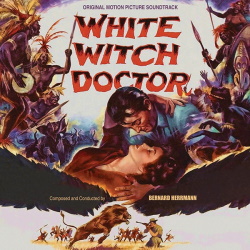
WHITE WITCH DOCTOR – Bernard Herrmann
 GREATEST SCORES OF THE TWENTIETH CENTURY
Original Review by Craig Lysy
20th Century Fox executive Darryl F. Zanuck was fond of adapting novels for the big screen and when he came across the 1950 work White Witch Doctor by Louise A Stinetorf he purchased the film rights and assigned Otto Land to production with a $2.02 million budget. Ivan Goff and Ben Roberts were hired to adapt the novel, but Zanuck instructed them to deviate from a literal retelling of the novel, insisting that they infuse the tale with romance, sex, physical excitement, and physical violence set against beautiful African vistas. Roy Ward Baker was tasked with directing, but was replaced by Henry Hathaway when he fell ill in Africa. A fine cast was assembled, including Robert Mitchum as Lonni Douglas, Susan Hayward as Ellen Burton, Walter Slezak as Huysman, Timothy Carey as Jarrett and Mashood Olabisi as Jacques.
The film is set in the Belgian Congo circa 1907 and follows the travels of Ellen Burton, a nurse who meets Lonnie Douglas, a game hunter who captures animals for zoos. Lonnie warns her of the danger of traveling upriver to join a woman doctor at her clinic. Yet he decides to accompany her with his hired guard Jacques as protection when his partner Huysman informs him that gold has been discovered near the clinic. Once there Ellen discovers that the doctor has died, angers the local witch doctor with her medical skills, and narrowly escapes an assassination attempt. The King is thankful when Lonni saves the King’s son from a lion attack and Ellen treats his wounds. Yet when Huysman arrives with an armed party searching for gold, Lonnie, who has fallen for Ellen, opposes him and is taken prisoner. He eventually escapes and is reunited with Ellen when Jacques sacrifices his life freeing him. The film was a commercial success, earning a profit of $480,000. Critical reception was mixed and the film did not earn any Academy Award nominations.
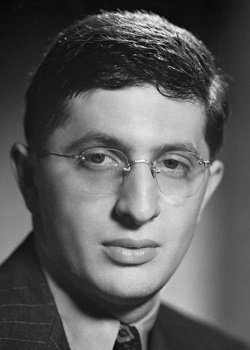 Director of Music Alfred Newman offered the scoring assignment to Bernard Herrmann. He was excited to take it on “White Witch Doctor” as it offered challenges he had never faced before. Set in Africa, it would call for indigenous nativist musical sensibilities to which he was unfamiliar. As such Herrmann did meticulous research, immersing himself in African scales, native instruments, exoticism and rhythms. Once this was accomplished, he augmented his orchestra with an expansive percussion section, which included African djembe, log drums, timpani, snare drums, marimba, maracas, gongs, and the eerie primal moan of the Serpent instrument whose grotesque timbre offered a truly unique aural signature.
For the architecture of his soundscape Herrmann embraced percussion with a fervor not seen before in his canon. The drum is the most primitive of all the instruments and most of the compositions of this score contain their presence. He also understood that he had to bring out the wonder, mystery and lurking dangers of the untamed jungle, as well as to juxtapose the colonial European and indigenous African cultures. For compositional structure, he embraced repeating motifs with succinct short phrasing, which he modulated throughout the score. The film brought out Herrmann’s best with its action scenes, grand vistas, and romantic intimate moments. When all was said and done, Studio executive Darryl F. Zanuck wrote to producer Otto Lang a laudatory note: “In every respect, this is a wonderful score. It captures realistically the mood, and has great class and distinction”.
Cues coded (*) contain music not found on the album. “Prelude” offers an astounding score highlight, where Herrmann once again opens a film with dazzling dramatic intensity. As the opening credits display in red script set against a paddlewheel ship churning up the Congo River, an orchestral onslaught storms, propelled by a ferocious array of nativist drums, kinetic woodwinds, blaring horns, and anvil strikes. At 1:05 four-note declarations by foreboding horns resound as script informs us that it is 1907 and steamer traffic on the Congo ends at the port of N’zem. As we enter the film proper, grim strings sounds over a mechanistic drum cadence as the paddle-wheeler churns upriver and docks at N’zem. In an unscored scene Lonni oversees his merchandise on the dock; caged animals that bear zoo destinations around the world. The merchant Mr. Huysman boards the ship and greets Mrs. Ellen Burton, a nurse. Her introduction to Lonni onshore goes south quickly as he is hostile to her presence in his domain.
“The Necklace” reveals that Lonni has had enough of the jungle and has decided to reject Huysman’s scheme to get gold upstream. He demands payment of the money owed him, and Huysman grudgingly gives him a necklace made of gold nuggets. When Huysman shows him on the map where the site is, he says there is opportunity for profit as it is proximate to where Ellen is to be taken. Herrmann supports texturally with a repeating, alluring eight-note string figure, portentous horns and siren-like English horn. In “The Question” Ellen arrives and asks Lonni for an update on their departure, and he acquiesces to Huysman’s offer. He informs Ellen that they will leave at dawn. As he escorts her to her quarters, languorous strings and woodwinds tenero weave a nocturne. At 1:03 an oboe dolororso joins as she answers his query about her husband, saying that she did not leave him, but was instead a widow. There is a palpable sadness in her revelation, and no sympathy expressed by him as he reminds her again of their dawn departure.
“Petticoat Dance” reveals that the boat is overloaded and Ellen is told she has to leave something behind. Rather than leave her hymn books, she chooses to leave one of her trunks of clothes. She gifts them to the village women, which Herrmann supports with a fanciful dance by xylophone animato and piccolo. As the native men row up river, their progress is supported by natives following along in the supply boat singing African folk songs (Not on the album). In an unscored scene they dock at some rapids, disembark, and transport their supplies to a site up river above the rapids where they will charter new boats. “The Village” opens with ethereal wonderment of the Jungle Motif atop flowing rivers of harp glissandi, chirping woodwinds, and muted horns, which create tranquility amidst the verdant jungle vistas. At 0:18 a pulsing ostinato portends danger as the path narrows and the expedition moves inland away from the river. At 0:24 a misterioso unfolds atop drums, rattles and woodwinds as they come upon a village where a medicine man is performing a death ritual. As Lonni and Ellen enter the village square an extended musical narrative that is foreboding and ominous supports. Their arrival causes the exorcist ceremony to stop and the chief and his son to emerge from the hut. Lonni is informed that the chief’s favorite wife is sick and that the medicine man has recommended killing her to rid the village of the evil spirits that possess her. At 1:59 soothing strings tenero soften the musical narrative as Ellen objects, and against Lonni’s counsel, offers to treat and save the woman. We close with the former foreboding musical narrative as Lonni reluctantly acquiesces to her insistence.
In “The Hut”, the Chief grants her access to his wife against the fierce protests of the medicine man. Grim strings and foreboding woodwinds support their entry into the hut and sustain the dark musical narrative. Herrmann drapes a pall of death over them, as Ellen assesses the woman and diagnoses an abscessed tooth, which must be extracted. As she prepares the woman for surgery, Lonni fetches her a plier. In “The Operation” Herrmann sow ethereal wonderment with his unique and trademark sonorities as Ellen anesthetizes the woman with ether and then extracts the tooth with the plier. (*) “Feast” reveals the chief wearing the tooth around his neck as a trophy, and hosting a celebratory feast in thanks to Ellen for saving his wife. The villagers celebrate with a drum propelled nativist danza esotica. As the chief again thanks Ellen, a woman performs what Lonni calls, an “Extraction ballet”, offering a solitary dance of thanks propelled vigorously with kinetic drum rhythms.
Later that night soft drums and native chanting close the day as Lonni posts a guard by Ellen’s tent, wary of retaliation by the medicine man who lost face. “The Leopard” offers an innovative score highlight, in which Herrmann sow primal terror. It reveals the medicine man stealthily approaching her tent wearing a leopard skin – a symbolic harbinger of death. Herrmann supports with the abyssal menace and horrific other-worldly sound of the Serpent, a low-register brass instrument, developed in the Renaissance era, which combines elements of horns with its trombone-like mouthpiece, and woodwinds with its tone holes along its serpentine shaft. Kindred woodwinds and muted dire horns buttress the Serpent’s utterances, which commence a slow building crescendo as he reaches the back of her tent. He slices open the tent and at 1:38 inserts a tarantula supported by tremolo strings. Tension builds as it crawls closer and closer to her face, yet she wakes, sees it and her screams sever the musical narrative. Lonni rushes in and kills the tarantula.
“Goodnight” offers a grim and foreboding soundscape as Lonni wishes Ellen good night, adding that she should be safe until morning as he will be standing guard. At 0:20 we segue the next day into “The Safari” where we see the expedition resuming its trek through the jungle. Herrmann reprises the ethereal wonderment of the Jungle Motif atop flowing rivers of harp glissandi, chirping woodwinds, and muted horns. At 0:29 a new ethnically rich woodwind borne motif supports as their trek continues. At 0:40 strings sereni and shifting chords support the expedition again aboard canoes. As the natives row up river, their progress is propelled by the steady cadence of their chanting. Later, Lonni tells Ellen that their destination is just around the next bend, however we see concern in his facial expression, and those of the natives as drums energico resound. He discloses that they must hurry as Dr. Mary is sick.
“Elegy” reveals Lonni and Ellen disembarking and walking to the hospital hut. As it comes into view, Herrmann sow unease with repeating woodwind figures, and strings grave joined by a wailing oboe of woe. At 0:37 the music darkens atop a forlorn flute and strings tristi as they peer into the hut through the mesh screens and see several people gravely ill. At 1:09 they soon find the native Utembo chanting by Dr. Mary’s bed supported by portentous, dire low register strings. They enter and Herrmann supports with a lamentation borne by wailing woodwinds and strings dolente as they discover she has died. At 1:39 we are bathed in religiosity as we see a grave mound marked with a cross, supported by horns solenne and church organ reverente. “The Birth” reveals Dr. Mary’s aide Utembo summoning Ellen to the bedside of a woman in labor. She has lost all her other babies in childbirth and begs that Ellen saves this one. Herrmann sow unease with bassoon grave, ominous horns, tremolo strings and eerie shifting chords to support Ellen’s preparatory efforts for the delivery. At 0:41 horns of tension support the birth, yet the baby appears stillborn as it does not cry. After several suspenseful slaps to the butt, the baby finally begins crying, much to the relief of all.
“Little Mama” reveals the joy of mother as Ellen gives her, her son. Lonni translates her words of prayerful thanks to ‘Little Mama’ – Lonni relates that Dr. Mary was ‘Big Mama’, and they now call her (Ellen), ‘Little Mama’. Herrmann supports the heartfelt moment with a melody of thanks by a solo clarinet delicato and strings tenero. “Defiance” reveals Ellen and Lonni arguing over her decision to stay, which he believes will end badly. Aggrieved strings support her defiance and his frustration. At 0:12 we segue into “Bakuba Boy” as Lonni informs Ellen that they are out of meat, which requires that she take up Dr. Mary’s other role as hunter provider. She takes a rifle and heads out with a guide. She tries to load her rifle and discovers she took the wrong bullets. Lonni arrives and agrees to assist and they head out to hunt. They encounter a boy from the Bakuba tribe who challenges a lion, his rite of passage to manhood. He wounds the lion with a spear but is injured. The lion attacks and Lonni is forced to kill to lion to save the boy’s life. A dire musical narrative unfolds on ominous strings in the aftermath as Ellen applies a turnicid to the boy’s arm. At 0:41 trumpet and tremolo strings support Lonnie’s discovery of a necklace of gold nuggets, which he places in his shirt pocket. The prior grim musical narrative resumes as they use a liter to transport the boy to hospital for treatment. In unscored scenes, later Lonni informs Ellen that he will take the boy back when he is ready to travel as we hear message drums informing the Bakuba that they are treating the boy and will bring him home when healthy. That night a contemplative Lonni takes a walk with his rifle and native music is heard in the background. He becomes angry when Utembo informs him that Ellen went to the river alone, and sets out to find her.
“Nocturne” offers the score’s supreme composition. Herrmann throughout his career was superb at writing nocturnes, and this one ranks as one of the finest in his canon. A languorous romance for strings with harp adornment unfolds as Lonnie walks through the jungle at night. He finds her and for once both let their guards down and converse without acrimony. At 1:08 a solo oboe pastorale and warm French horns join as she inquiries about his past, and then opens up about the loss of her husband. Both have regrets, and Herrmann masterfully subtly weaves an undercurrent of regret withing the nocturne. She asks if he will ever be coming back, and drops all pretenses, saying, that it depends if there is something to come back for. She becomes uncomfortable and suggests that they should be heading back. Yet at 2:53 resplendent violins d’Amore swell with warm French horns and harp adornment as he takes her into his arms and kisses her, which she accepts and reciprocates. He pleads for her to depart with him, yet she refuses as she remains committed to her husband’s dream here in Africa. Yet music descends into sadness with woodwinds tristi as he expresses bitterness as she departs choosing a dead husband over his love in the here and now.
In “The Abduction” Ellen returns and Utembo informs her that something is wrong with the Bakuba boy. She assesses, asks that Utembo fetch Lonnie, and Herrmann supports with a piano agitato. All hell breaks loose at 0:26 atop a musical tempest of violence as Bakuba warriors brandishing spears abduct the boy over Ellens protests that he is too weak to move. At 0:47 the piano agitato resumes as Lonni arrives and then sets off in pursuit at her beckoning. A diminuendo unfolds as we see him stop and return, realizing it is too dangerous to pursue them at night. She is disappointed and devastated and we close bleakly with a lamentation. In “The Shinbeck” ominous horns and tremolo strings sow tension as Jacques sees Huysman approaching in two canoes and alerts Lonni. He has come with armed mercenaries and he proposes taking the gold by force. They are interrupted by Bakuba message drums, which ask the ‘Little Mama’ be bought to their village. Ellen agrees to go and Lonni convinces Huysman to let him accompany her alone to not arose suspicions. He will then scout for the gold and call for Huysman at the right time. The natives refuse to accompany Ellen, but she is thankful and relieved when Lonni informs her that he will escort her.
“Bakuba Country” opens with dire horns bellicoso and deafening drums feroce as a panorama of Bakuba country is shown. At 0:18 an eerie misterioso supports the sight of Lonni and Ellen trekking through the jungle. At 0:29 ominous woodwinds and horns support the sight of two totems marking Bakuba territory. They trek on full of foreboding and carried with unease until 0:58 when Herrmann offers grandiosity atop horns magnifico and refulgent strings as they come to an impressive rope suspension bridge over a river. The resplendent music carries them atop the bridge, but midway dire horns resound as warriors approach from both sides. In an unscored scene they command Lonni to lay down his rifle and walk towards them. They are then escorted to the Bakuba village past throngs of villagers to the king’s enclosure.
In “The Skulls” they pass through a labyrinth until they reach an entry where human skulls are displayed on spikes. A horrific, dissonant orchestral shriek with drums of doom support. As they pass and enter the courtyard the spinechilling wail of the Serpent instrument, chirping woodwinds and grim drums sow fear. The king arrives, sits on his throne and holds court. His invitation was for ‘Little Mama’ alone, but he accepts Lonni’s explanation that he was needed to protect her passage, and to interpret. (*) “The King’s Son/Gangrene” reveals them being informed that the boy is the king’s son as they are escorted to him. Dire strings and forlorn woodwinds support their escort to the boy. As they arrive and she examines him, the music darkens as she surmises the move hurt him. She cuts his dressing and removes the herbs applied by the medicine man, but discovers the wound has festered and is gangrenous. She says his only hope is a Novocain IV, but she needs IV tubing. Lonni sets off to find an alternative as the natives dance and chant to drums so as to drive away the evil spirits. He secures a bowl and a hollow vine and they are able to treat the boy, easing his pain with a sedative.
“Morning” reveals the next day and Herrmann supports with a repeating four-note motif by languorous strings and woodwinds gentile as Lonni brings Ellen some native coffee. In “The King”, dire horn declarations empower a menacing musical narrative to support his arrival. He asks for a progress report and she says they will know in a few hours. The king makes a speech and departs. Lonni says that he said he was thankful of her efforts to save his son, and that she was the first white person who offered kindness and tried to help his people, instead of robbing, killing and destroying. This compliment overwhelms Ellen who is brought to tears. In “The Past” Herrmann offers great pathos with one of the score’s most beautiful and sad compositions. As Ellen weeps, she tells Lonni that she is undeserving of such praise. She then has a catharsis disclosing that she did not share in her husband’s dream of living in remote Africa as she wanted to live a life of privilege as a doctor’s wife. She refused to go and crushed his dream, causing him to die early from an illness he did not disclose to her. She says that she relented and said she would go to Africa if he recovered, but it was too late and he soon died. Lonni then adds, “So out of guilt, you tried to live his life for him?” She says what she really wants is purpose in her life and to help people by herself. Herrmann supports her catharsis with an aching, molto triste lamentation borne by weeping strings full of regret.
In (*) “War Council” message drums shatter Ellen and Lonni’s intimate moment. He says that the drums say a war council has been called as they watch a dead native’s body brought in. He has died from a gunshot, the council is angry, and glares menacingly at Ellen and Lonni. It is now Lonni’s turn to come clean and he relates that he is a fraud who has used Ellen as a cover to get gold. They are soon brought a spear point before the king. “Departure” reveals Lonni advising the king that the men are under his command and that he can stop them from killing his warriors. The king allows him to go, but retains Ellen as a hostage who he will kill should Lonni betray him. As Lonni informs Ellen, a foreboding drum cadence and strings tristi offer a dirge. At 0:44 a strings borne crescendo romantico buttressed by warm horns supports Ellen saying I am not afraid, and then passionately kissing Lonni. A diminuendo of uncertainty carries Lonni’s departure and Ellen’s imprisonment.
“The Camp” reveals Lonni returning to base camp, which Herrmann supports with unease, uncertainty and occult menace. Huysman greets him and rejects his assertion that there is no gold, producing the second gold necklace he found in Lonni’s trunk. One of his henchmen knocks Lonni out with his pistol butt and Huysman then orders him bound. “Jacques” reveals an unseen Jacques watching Lonni knocked out and bound. Herrmann chose to support with a passage with a repeating forlorn four-note motif, which ends with a kernel of hope, however the music was dialed out of the film. “The Three Doctors” opens with a hopeful four-note figure as we see a fiery sunset sky. We shift eerily at 0:05 to the king’s enclosure and see Ellen treating the king’s son as he and his two medicine men watch with skepticism. Herrmann sow unease with a reprise of the Serpent Motif. In “The Camp #2” we see Lonni laying on the ground with each limb bound and stretched. Huysman has run out of patience and demands Lonni rejoin them so they can all get rich. Jacques works unseen and rigs the dynamite and ammo to blow up. Herrmann reprises the music of “The Camp” cue, but with a more overt menace.
Huysman’s patience has run out and he pulls out his revolver in “Thirty Seconds”. He points it at Lonni’s head, declaring he has thirty seconds to regain his senses and agree to join the team. Herrmann supports with a foreboding, repeating woodwind borne four-note motif as Jacques lights the fuse and the dynamite explodes, causing Huysman and his men to run toward it to investigate. In “The Fight” Jacques uses the distraction to cut Lonnie free and gift him a gun, but he is mortally wounded and a firefight ensues. Lonnie kills one man and the others flee as Bakuta war drums are heard. Huysman remains and has a shootout with Lonni. Herrmann empowers the fight with dire blaring horns irato, with ever shifting drum rhythms and gong strikes. At 1:40 the drum rhythm becomes agitated as Huysman drops the gold necklaces and his ammo. A horrific two-note motif ratches up the tension as Huysman’s realizes his gun is empty. As he reaches out for more bullets and the gold nugget necklaces, he exposes himself and at 2:03 a chord of death resounds as Lonni kills him. A foreboding diminuendo supports the aftermath as Lonni carries Jacques’ corpse to a tent shelter. We close atop a brutal chord of death as the camera reveals Huysman’s dead body.
“Terror” reveals the medicine man fed up with Ellen’s treatment and slamming his pointed staff into the ground. Herrmann creates dizziness by supporting with a swirling torrent of trilling woodwinds. Ellen is exhausted, stands, and then faints. Lonni returns, runs to her, takes her into his arms, and we at 0:14 segue into “Recovery” as a thankful romance for strings supports her waking in his loving embrace. At 0:39 the music becomes foreboding as she tells him she has failed. Yet refulgent violins arise and usher in a paean of happiness as the camera shifts to the king’s son, who smiles at Ellen with thanks as a very happy king looks on. In the film drums energico support the joy of the villagers dancing in celebration as the king gifts Ellen a gold nugget necklace. We conclude at 1:21 in “The Finale” with horns dramatico as “The End” displays.
I would like to thank Bruce Kimmel, the late Nick Redman and Kritzerland Records for the reissue of Bernard Herrmann’s exotic score for “White Witch Doctor”. The remastering of the original source tapes offers excellent stereophonic audio quality. Herrmann was a perfectionist and when presented with films set in exotic locations, he was meticulous in his research and determination to realize authentic ethnic sounds and sensibilities. Well, I believe he succeeded on all counts, embracing drums as never before in bringing native African culture to life. He also masterfully succeeded in bringing to life the mystery, danger and beauty of the untamed African jungle. Most of the score is supported with succinct, repeating motifs, which sow unease, danger while also sustaining the film’s narrative pacing. However, it is with a number of set pieces that Herrmann’s brilliance as a composer shines. Cues such as the percussive kinetic ferocity of “Prelude”, the beautiful serenity and romanticism of “Nocturne”, and the aching pathos of regret in “The Past” offer testaments to Herrmann’s genius. Folks, this is a wonderful exotic score, which shows another side of Bernard Herrmann, and masterfully enhances an imperfect film, mitigating some of its flaws. I highly recommend this quality album for your collection.
For those of you unfamiliar with the score, I have embedded a YouTube link to ten-minute suite: https://www.youtube.com/watch?v=hrCbbQhMAaY
Buy the White Witch Doctor soundtrack from the Movie Music UK Store
Track Listing:
- Prelude (1:57)
- The Necklace (1:53)
- The Question (1:40)
- Petticoat Dance (0:57)
- The Village (3:07)
- The Hut (1:35)
- The Operation (1:13)
- The Leopard (2:10)
- Goodnight / The Safari (1:06)
- Elegy (2:10)
- The Birth (0:51)
- Little Mama (0:44)
- Defiance / Bakuba Boy (1:24)
- Nocturne (4:05)
- The Abduction (1:55)
- The Shinbeck (0:52)
- Bakuba Country (1:33)
- The Skulls (1:00)
- Morning (0:57)
- The King (0:35)
- The Past (1:40)
- Departure (1:13)
- The Camp (0:30)
- Jacques (0:33)
- The Three Doctors (0:33)
- The Camp #2 (1:14)
- Thirty Seconds (0:31)
- The Fight (2:53)
- Terror / Recovery / The Finale (1:33)
- Goodnight (Three Takes) (1:14) BONUS
Running Time: 43 minutes 38 seconds
Kritzerland KR 20029-9 (1953/2015)
Music composed and conducted by Bernard Herrmann. Orchestrations by Bernard Herrmann. Recorded and mixed by XXX. Score produced by Bernard Herrmann. Album produced by Bruce Kimmel and Nick Redman

Shop at the Movie Music UK Store

Member of the

 MOVIE MUSIC UK