HOCUS POCUS – John Debney
 THROWBACK THIRTY
Original Review by Jonathan Broxton
One of the most enduringly popular films from 1993 is Hocus Pocus, a children’s fantasy comedy with a spooky edge. Directed by Kenny Ortega from a screenplay by Mick Garris and Neil Cuthbert and a story by David Kirschner, the film stars Bette Midler, Sarah Jessica Parker, and Kathy Najimy as Winifred, Sarah, and Mary, the Sanderson sisters of Salem, Massachusetts, who were executed 300 years previously for practicing dark magic and witchcraft. In modern day Salem Max, a teenager new to town, inadvertently brings the sisters back to life on Halloween Night when he lights a black-flame candle in the witches’ former house while out trick-or-treating. Now, with the help of his younger sister, his girlfriend, and a talking cat named Binx, Max must stop the witches from stealing the life force of the town’s children, and achieving immortality. The film co-starred Omri Katz, Thora Birch, and Vinessa Shaw and, despite it not being especially successful at the time, has since become a popular kid’s Halloween cult classic.
The score for Hocus Pocus was written by the then 37-year-old composer John Debney, and it would quickly become his breakout score. Debney was born into a Hollywood family – his father Louis Debney was an executive for the Walt Disney company – and he began his musical life in various bands in college, before going on to attain a bachelor’s degree in music composition from the California Institute of Arts. He began his career working in the copying department at Disney, before going on to work for composer Buddy Baker, arranging music for pavilions and rides at the EPCOT Center at Walt Disney World in Florida, and then for Hoyt Curtin, the staff composer at the Hanna-Barbera animation studio. He spent much of the 1980s writing for numerous popular television series, including Star Trek: The Next Generation, Star Trek: Deep Space Nine, Scooby-Doo, and The Young Riders, the latter of which won him an Emmy in 1991. He wrote his debut theatrical score, Not Since Casanova, in 1988, but the success of Hocus Pocus, and the works that followed, soon earned him a place on the big-screen A-list.
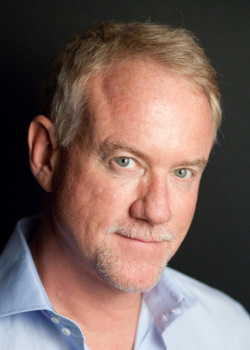 Interestingly, James Horner was originally slated to score Hocus Pocus, but when he became unavailable at the last minute, Debney was called in by writer/producer Kirschner (who was a classmate of Debney at CalArts, and had previously worked with him at Hanna-Barbera) and asked to score the film in two weeks. One of Horner’s cues – “Sarah’s Theme,” commonly known as “Come Little Children” – remained in the soundtrack as Sarah Jessica Parker sings a song to its melody on-screen, but everything else Debney wrote was new and, by and large, it’s excellent. Debney’s music is a big, thematic, emotional and exciting score for a 92-piece ensemble and a female choir, enhanced by all manner of spooky and devilish orchestrations that echo scores like The Witches of Eastwick, as well as the early work of Danny Elfman.
In terms of orchestration, Debney augments his symphony with some faux-medieval textures in the early scenes set in historical Salem – harpsichords, lutes, recorders, and various metallic percussion textures – but for the most part, once the film re-locates to the present day, these textures give way to contemporary orchestral and choral mayhem. Thematically, the score is built around three recurring ideas, the most prominent of which is a devilish and macabre waltz-like theme for the Witches themselves, which owes as much of a debt to Paul Dukas and Modest Mussorgsky as it does to John Williams and Danny Elfman. Then there are a pair of more intimate, tender pieces that represent Max’s warm relationship with his sister Dani, and his budding romantic relationship with his potential girlfriend Allison.
As you would expect, the theme for the Witches is everywhere throughout the score, but what’s clever about it is how Debney is able to deconstruct it down into its constituent elements and present different fragments of the theme in different settings, cleverly insinuating that the legacy and the curse of the Sanderson sisters looms heavily over the entire story. The theme is introduced in full, as one might expect, in the “Main Title,” a wonderfully riotous performance that combines frantic pacing and raucous comedy with an appropriately ghoulish touch. Thereafter, though, a lot of Debney’s statements of the Witches theme are obscured with musical sleight of hand – hocus pocus, if you will – under different tonal approaches, different orchestral and instrumental arrangements, and various deconstructions of its elements.
The second cue, “Garden of Magic/Thackery Follows Emily,” contains the score’s only significant in-context statement of Horner’s piece – ‘Sarah’s Theme’ – a beautiful and magical lullaby-like melody for piano and orchestra, the attractiveness of which belies its actual sinister intent: to act as a musical siren song to lure unwary children into the witches’ lair. As I mentioned, Sarah Jessica Parker sings creepily come-hither lyrics to Horner’s melody in the film itself, and you can hear this performance later in “Sarah’s Theme,” which backs Parker’s voice and Brock Walsh’s lyrics, with a gorgeous, lush orchestral arrangement of the melody.
After some ominous buildup, Sorcerer’s Apprentice-style mickey mousing, and allusions to its rhythms in the woodwinds, the Witches’ theme explodes fully into life in the second half of “Witches’ Lair,” becoming a rampaging light action cue full of menace and mischief. The mischief aspect is removed entirely in the much more ominous “To the Stake” and “Death to the Witches,” during which Debney presents the theme in bold, Gothic strokes. Later, in “The Black Candle,” near-subliminal references to the Witches theme peek from out of the darkness of Debney’s bombastic writing – ghostly, spectral echoes of the past, about to re-emerge. Then all hell breaks loose in the wonderful trio comprising “Witches on a Rampage,” “Graveyard Attack,” and “The Calming Circle,” during which Debney regularly allows the theme to resound intimidatingly on full-throated brasses, while also transposing it into the highest register woodwinds. Debney’s rich orchestration, his sense of scampering movement, and the wonderful combination of mischievousness and malice, are all praiseworthy here – the Sanderson Sisters are back!
The love theme for Max and Allison is introduced in “Meeting Allison,” and is a pleasantly light and whimsical John Williams-esque depiction of teenage love and suburban idyll; the woodwind melody that anchors the cue is lovely, and has echoes of the score for Not Since Casanova that Debney wrote in 1988. It comes back briefly in “Max Loses Shoes” and in “Hallowe’en,” where its tone reminds me of the more bucolic parts of James Horner’s Something Wicked This Way Comes, in the middle of “Resurrection,” and then in the “End Credits,” but other than that it is somewhat absent from a lot of the score, which is a shame because it has a strong emotional quality. The same can be said for Debney’s brother/sister theme, first heard in “Max and Dani,” which is similar in style to the love theme, and is filled with pretty pianos, tender strings, and elegant woodwinds. Some of the chord progressions in the brother/sister theme remind me of Jerry Goldsmith’s theme for Carole Anne from Poltergeist, which also might be an intentional homage on Debney’s part, considering that Carole Anne was the little sister in that family too. The brother/sister theme comes back prominently in the aforementioned “Graveyard Attack,” and then later in the expansive and bold “Springing the Trap,” to excellent effect.
Perhaps the most satisfying statement of the Witches theme comes in “Witches Flight,” wherein Debney arranges the theme for the most expansive version of his orchestra, full of flashing strings, brass fanfares, and magical choral accents, as the Sanderson sisters mount their broomsticks and soar over the rooftops of Salem, trying to put their wicked plans into practice. The 15-minute finale of the score – from “Max Fools the Witches” through to the end of “Witches Demise/Resurrection” – is a superbly entertaining sequence of devilish delights, featuring numerous statements of the Witches theme, the brother/sister theme, and the love theme for Max and Allison, amid a whole host of flamboyant, creative, expressive orchestral passages that combine action and suspense with comedy, mickey mousing, and more tonal references to Williams, Dukas, and others. “Winnie Catches Up” is a helter-skelter chase sequence, and “Witches Capture Dani” has some moments of grand guignol drama, including some wonderful writing for choir, while the finale of “Witches Demise/Resurrection” even has some faint echoes of E.T.
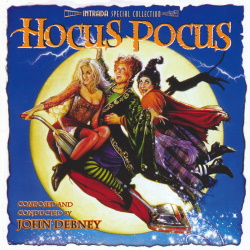
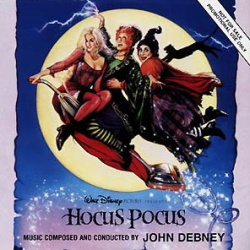 No soundtrack album was released at the time the film was released – a combination of Debney’s late arrival on the project, and the initially poor response to the film itself – but, late in 1993, Debney’s agency released a promotional CD containing 19 tracks from the film, in hopes of a future commercial release. However, this did not come to fruition, and for many years the score was one of the most highly sought-after works of Debney’s career, while the promo itself became a rare collector’s item. Thankfully, Intrada Records finally released a special complete edition of the score for Hocus Pocus in late 2013, rectifying a 20-year frustration for the millions of fans of the film.
Hocus Pocus is an important landmark in the career of John Debney, considering it was his first studio film, and his first time working with an orchestra of this size. While it’s true that it’s not the most original work ever – the stylistic influences from previous film scores and the classical repertoire are obvious and unmistakable – the fact that Debney wrote and recorded the thing in less than two weeks, as a late replacement, offers some mitigating circumstances. With those caveats in mind, the score is enormously enjoyable – a spooky Halloween delight filled with bold symphonic lines, memorable thematic ideas, creative touches in the orchestration, and more than a sprinkling of ghoulish magic.
Buy the Hocus Pocus soundtrack from the Movie Music UK Store
Track Listing:
- ORIGINAL PROMO
- Main Titles (1:17)
- Max Meets Allison (2:03)
- Halloween (0:40)
- To the Witches’ House We Go (1:41)
- Max Lights the Enchanted Candle (1:45)
- Escape from Witches’ Lair (2:06)
- Brother/Sister Theme (1:53)
- Witches on a Rampage (1:23)
- Graveyard Attack (3:03)
- Witches on Holiday (1:47)
- Who Stole the Brooms? (1:03)
- Witches Tricked/Safe Again? (2:46)
- Winnie’s Lament/The Capture (3:57)
- Setting the Trap/Scherzo (2:53)
- Brother/Sister Talk (1:22)
- Winnie Flies/Zombie Speaks (2:14)
- Witch Attack (4:47)
- Conflagration/Resurrection (4:51)
- End Titles (1:34)
- 2013 INTRADA RELEASE
- Main Title (1:31)
- Garden of Magic/Thackery Follows Emily (2:27)
- Witches’ Lair (5:43)
- To the Stake (0:27)
- Death to the Witches (1:11)
- Meeting Allison (2:05)
- Max Loses Shoes (0:38)
- Hallowe’en (1:12)
- Max and Dani (1:22)
- Divertimento #17 in D, K. 334 (written by Wolfgang Amadeus Mozart) (3:46)
- To the Witches’ House We Go (2:25)
- The Black Candle (2:24)
- Witches on a Rampage (4:26)
- Graveyard Attack (3:56)
- The Calming Circle (3:02)
- The Master (0:18)
- Fingers (1:09)
- Springing the Trap (4:39)
- Winnie’s Lament (3:06)
- Witches Flight (3:17)
- Sarah’s Theme (written by James Horner and Brock Walsh, performed by Sarah Jessica Parker) (2:11)
- Max Fools the Witches (2:54)
- Winnie Catches Up (0:49)
- Billy Speaks (1:31)
- Witches Capture Dani (4:52)
- Witches Demise/Resurrection (4:51)
- End Credits (3:19)
- Witches’ Lair Pt. 3 (Original Version) (0:31)
- Witches Take Dani (Alternate) (1:26)
- Winnie Catches Up (Alternate) (0:40)
- String Tremolo (0:24)
- End Credits (Alternate) (1:53)
Running Time: 43 minutes 21 seconds – Promo
Running Time: 74 minutes 09 seconds – Intrada Release
Promo (1993)
Intrada Special Collection Vol. 254 (1993/2013)
Music composed and conducted by John Debney. Orchestrations by Frank Bennett, Don Davis, Brad Dechter, Jerry Hey and David Loeb. Recorded and mixed by John Richards. Edited by Nancy Fogarty. Score produced by John Debney. Intrada album produced by Douglass Fake and Roger Feigelson.

Shop at the Movie Music UK Store

Member of the

 MOVIE MUSIC UK