OPPENHEIMER – Ludwig Göransson
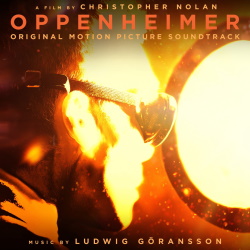 Original Review by Jonathan Broxton
Now I am become death, the destroyer of worlds.
In lesser hands, a movie about the life of J. Robert Oppenheimer could have been a dusty, staid affair. Oppenheimer, for those who don’t know, was a theoretical physicist who, in 1942, was recruited by the US government to lead the Manhattan Project, a top-secret military program created with one goal: to design and build a nuclear weapon before Adolf Hitler and the Nazis did the same, so that they could bring about the end of World War II. Oppenheimer and his colleagues successfully built several bombs over the course of many years, culminating in the detonation of two such devices over the Japanese cities of Nagasaki and Hiroshima in 1945. However, despite his ‘success’ and initial celebrity, Oppenheimer was haunted by the ethical questions that surrounded his creation, and suffered a great deal of personal and political turmoil in the years that followed. This latter issue was compounded by the fact that, early in his life, Oppenheimer had pro-communist opinions, and was friendly with many members of the US Communist Party – something that certainly wouldn’t fly with the House Un-American Activities Committee and the McCarthy-era politics of the 1950s.
As I said, in lesser hands, a movie about Oppenheimer’s life could have been dull, but in the hands of director Christopher Nolan the story becomes something close to brilliance. Nolan invigorates the story by cross-cutting between four time periods: Oppenheimer’s early life as he studies, meets his wife, and cements his reputation as a brilliant scientist; his work on the Manhattan Project from 1942-1945; the pivotal meeting in 1954 where Oppenheimer was interrogated about his ‘communist sympathies’ and had his governmental security clearance revoked; and then the 1959 senate confirmation hearings of Lewis Strauss, Oppenheimer’s long-time political nemesis, who had been nominated as Secretary of Commerce by U.S. President Eisenhower, but whose undermining of Oppenheimer in 1954 eventually led to his own undoing.
Nolan moves between each of these time periods seamlessly, clearly showing the interconnectedness of the different scenarios, and how it all eventually paints a riveting portrait of a difficult, complicated, brilliant man whose scientific genius remains a talking point to this day. Not only that, Nolan somehow is able to take such apparently impenetrable topics as quantum theory, nuclear physics, communist politics, and political one-upmanship, and make them easily understandable to the layman by explaining them verbally and visually in a variety of unusual ways – not an easy task.
The film is anchored by a brilliant performance from Cillian Murphy as Oppenheimer, who is by turns frustratingly pig-headed, and brilliantly charismatic, but also tortured by the impact of his own legacy. He is brilliantly supported by an astonishing cast: Emily Blunt as his long suffering but devoted wife Kitty, Robert Downey Jr. as the conniving but charismatic politician Strauss, Matt Damon as the dogged and forthright military man at the Manhattan project Leslie Groves, and the mostly naked Florence Pugh as Oppenheimer’s mentally unstable mistress Jean Tatlock, plus Josh Hartnett, Casey Affleck, Rami Malek, Kenneth Branagh, Benny Safdie, Jason Clarke, Tom Conti, Dane DeHaan, Alden Ehrenreich, David Krumholtz, Matthew Modine, Gary Oldman, and dozens of others, as the innumerable politicians, scientists, military men, and thinkers Oppenheimer meets throughout his life. Oh, look, there’s Albert Einstein! Enrico Fermi! Richard Feynmann! Niels Bohr! Werner Heisenberg! It’s astonishing, a who’s who of legendary scientific minds.
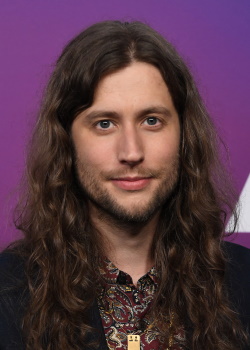 The score for Oppenheimer is by Swedish composer Ludwig Göransson, who continues his collaboration with Nolan after their critically-acclaimed work on Tenet in 2020, and who now appears to be firmly established as Nolan’s new go-to guy. Long-time readers of the site will know that, historically, I have not been greatly enamored with Christopher Nolan’s musical taste; while the scores for many of his films – notably Inception, Interstellar, Dunkirk, and the Batman Dark Knight trilogy – have legions of fans and have garnered critical acclaim and awards recognition, I have often found myself at odds with the prevailing positive opinion. I have found a great deal of that music to be lacking in emotional depth, favoring power and volume over nuance, and I found the score for Dunkirk to be quite damaging to the film in context. This is why I am pleased to say that the score for Oppenheimer is very good indeed; while it still contains many of the familiar Nolanscore tropes (large blaring orchestras, moments of overwhelming cacophony and dissonance), it also dials them back somewhat, giving the composer room to present music which is subtler, more emotionally fulfilling, and more intellectually interesting, at least to me.
A lot of the pre-release press for the score has been the usual hyperbole bullshit that often comes with the territory of tentpole movies like this. In an interview with NME Göransson is quoted as saying “One of the early ideas that Chris had was the use of the violin … Oppenheimer was a genius with a lot of complex layers underneath. With a solo violin, you can play the most beautiful, romantic vibrato. But then if you press down the bow heavily and change the speed, you can make something horrific, manic or neurotic in a split second Chris and I were constantly talking about going in and out of different emotions.”
Later in the same interview he talks about a scene where Niels Bohr lectures a young Oppenheimer at university and compares algebra to music; this results in a montage sequence where a series of abstract images float across the screen, accompanied by some of Göransson’s more challenging music. In that piece, he describes how “the tempo changes every four bars… and it gets faster and faster, so that by the end, it’s three times faster than when it started. At first I thought it was unplayable. We spent three days on that one sequence. It was just astounding to see how it grew.”
In another interview, with Variety, Göransson explains his thinking behind several different sequences. The beginning of the film “starts with a haunting melody, which starts off as an intimate solo violin. When you see him in class, there’s one person followed by four people joining him. So we added four violins, and when the whole class shows up, we have an entire orchestra come in, with more prominent harps, and piano.” For the film’s middle section, leading up to the detonation of the Trinity test bomb in the New Mexico desert, Göransson explains that he wanted to ratchet up the tension with “thumping basses and metallic ticking, like a clock, as the race to build the atomic bomb kicks off,” but then at the pivotal moment the film cuts to silence. “Once he presses the button, there’s no turning back. And that’s how it all builds up towards that piece of silence.”
All this is well and good, but the truth of the matter is that, despite all the PR-speak claims of unplayable music and apparently unparalleled creativity and ingenuity, Oppenheimer is at times a surprisingly approachable and conventional score – and this is a good thing, because it humanizes Oppenheimer himself. The use of warm harmonics, recognizable thematic ideas, and familiar string tones, allows the audience to connect with Oppenheimer on an emotional level, and makes the regrets and moral objections he voices later in life feel more intense.
If you want to resort to comparisons, the score for Oppenheimer feels to me like a mash-up between the minimalist orchestral writing of people like Carter Burwell, Max Richter, and the late Jóhann Jóhannsson, the more abstract and abrasive string writing often employed by composers like Jonny Greenwood by way of Igor Stravinsky and Krzysztof Penderecki, and the unexpectedly smooth electronic tonalities that were prevalent in the 1980s synth scores of artists like Vangelis and Tangerine Dream. Put that together with some of Christopher Nolan’s personal aesthetics – the big booming chords that Hans Zimmer wrote for Interstellar and Dunkirk, and that Göransson himself wrote for Tenet – and the result is this score.
The harsh, avant-garde, sometimes insect-like string figures in cues like “Fission,” the cascading and waterfall-like “Can You Hear the Music,” the sometimes dance-like “Gravity Swallows Light,” “American Prometheus,” and others, tend to represent the highly scientific side of the story; they have a sharp, inquisitive edge, and are difficult to connect with on an emotional level, much like the scientific concepts themselves that are discussed throughout the story. In several of these cues Göransson’s strings tumble and fall and collapse in on themselves – perhaps in a manner intended to depict the way a nuclear bomb is structured? – and while they sometimes very challenging, they add a level of intensity to the score that you can feel in your stomach.
The warmer string tones, which combine with delicate harp textures and occasional pianos, speak more to Oppenheimer’s personal life – his relationships with his colleagues, with his wife Kitty and his mistress Jean, and so on – and these are very prominent in cues like the aforementioned “Fission,” “A Lowly Shoe Salesman,” the classically elegant “Quantum Mechanics,” the unexpectedly soothing “Groves,” the Vivaldi-esque “American Prometheus,” and “Power Stays in the Shadows,” among others. There are even some hints of jazz in the thematic ideas in “Meeting Kitty,” which are as lovely as they are unexpected.
There is a more aggressive and rhythmic core to cues like “Manhattan Project,” “American Prometheus,” “Fusion,” and the hypnotic “Theorists” which have an insistent urgency and restlessness to them, capturing the ‘race against time’ element that drove the men and women at Los Alamos to work tirelessly to make their scientific breakthroughs. Electronic pulses and string ostinatos drive the percussive energy of the cues, and the growling, ominous, animalistic brass in “Fusion” is especially effective.
The zenith of all this is the heart-stopping pair comprising “Ground Zero” and “Trinity,” which underscore the fateful bomb test itself. The former cue combines dark electronic tonalities and aggressive pulses with what sounds like the sampled sound of a Geiger counter (this is what the score for Chernobyl wishes it could have been!) while the latter is a nervous, edgy scherzo for multiple layers of relentlessly shifting strings, that slowly builds and builds over the course of almost eight minutes, until the moment the bomb goes off. At times, in context, some of these cues can become a little overwhelming, which led some mainstream commentators to describe Goransson’s work as ‘operatic’. The score isn’t operatic at all, in the traditional sense; what they mean is that it’s prominent, front and center in the sound mix.
The final cues – “The Trial,” “Dr. Hill” – are less flamboyant and more interested in depicting shifting political allegiances and various legal shenanigans, and often employ that interesting Vangelis/Tangerine Dream-style smooth electronica to excellent effect, especially when it combines with the strings and their fascinating percussive patterns. The return of the jazz chords in “Kitty Comes to Testify” are a welcome reprise, and the foot-stomp percussion in that cue’s finale is important in context. The conclusive pair, “Destroyer of Worlds” and “Oppenheimer,” reprise the score’s main theme (previously heard in “Can You Hear the Music”) and rise to some quite impressive, imposing heights full of flashing string work, but tempered by moments of regret and intimacy.
There are going to be plenty of people who just don’t get the Oppenheimer score. Too loud, too in-your-face, not enough themes, too aggressive, too Christopher Nolan. And, you know, that’s fine. I have felt that before about many of the scores in Nolan’s previous films, so I can’t complain. But, for whatever reason, Oppenheimer spoke to me. I like the seemingly unusual combination of classical violins, smooth and glossy synths, and massively cacophonous orchestral vividness, and it seems to me that the different aspects of the score are cleverly addressing the different aspects of Oppenheimer’s personality. Despite all the pre-release PR hyperbole, I appreciate the intellectual component of what Ludwig Göransson is going for here. Plus, when compared with the scores in other Nolan films, the music in Oppenheimer is actually much subtler, more thematic, and more tonally appealing, and is less abstract and abrasive than one might have expected.
The film itself paints a compelling portrait of a complicated, brilliant man, whose scientific genius resulted in a breakthrough of terrifying consequence, the moral and ethical implications of which are still being debated today in terms of nuclear proliferation. When Oscar season rolls around in early 2024 I predict that Oppenheimer will be in the conversation for dozens of awards: for directing, for acting, for all its technical elements, and for Ludwig Göransson’s score, which is already being praised and predicted as a likely nominee. Contrary to my own expectations, I actually find myself in agreement with all this. It serves the film perfectly, is hugely effective in context, and offers an unexpectedly satisfying standalone listen.
Buy the Oppenheimer soundtrack from the Movie Music UK Store
Track Listing:
- Fission (4:38)
- Can You Hear the Music (1:50)
- A Lowly Shoe Salesman (3:34)
- Quantum Mechanics (3:00)
- Gravity Swallows Light (3:30)
- Meeting Kitty (5:47)
- Groves (3:03)
- Manhattan Project (3:01)
- American Prometheus (2:37)
- Atmospheric Ignition (3:28)
- Los Alamos (2:38)
- Fusion (3:55)
- Colonel Pash (4:57)
- Theorists (3:14)
- Ground Zero (4:21)
- Trinity (7:52)
- What We Have Done (5:45)
- Power Stays in the Shadows (4:10)
- The Trial (5:32)
- Dr. Hill (4:23)
- Kitty Comes to Testify (4:52)
- Something More Important (3:25)
- Destroyer of Worlds (2:54)
- Oppenheimer (2:16)
Running Time: 94 minutes 42 seconds
Back Lot Music (2023)
Music composed by Ludwig Göransson. Conducted by Anthony Parnther. Orchestrations by Thomas Kotcheff, Serena Göransson, Gregory Jamrok, Abraham Libbos and Joseph Zimmerman. Recorded and mixed by Chris Fogel. Edited by Amanda Goodpaster, Alex Gibson and Felipe Pacheco. Album produced by Ludwig Göransson.
Leave a comment

Shop at the Movie Music UK Store

Member of the

 MOVIE MUSIC UK
I might pick this one up at some point. I’ve personally never really been much of a fan of Göransson’s work (I know his work sounds unique and all, but I just don’t really get into it), but what I heard, sounded promising.
Amazing music, it is just so good.