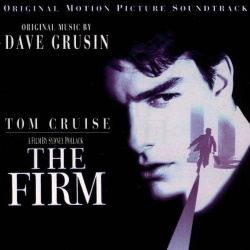
THE FIRM – Dave Grusin
 THROWBACK THIRTY
Original Review by Jonathan Broxton
The Firm was the first film adapted from the works of the massively successful novelist John Grisham, and is a crackerjack legal/political thriller. The film is directed by Sydney Pollack and stars Tom Cruise as a young and talented lawyer named Mitch McDeere, who joins a prestigious firm in Memphis called Bendini Lambert & Locke. Initially thrilled by the firm’s high salary and luxurious lifestyle, Mitch soon discovers that the firm is involved in criminal activities, and as he delves deeper into the firm’s workings, he uncovers a web of corruption, money laundering, and ties to organized crime; worse still, Mitch realizes that the firm’s previous associates who discovered the truth met with mysterious deaths. Faced with the dilemma of exposing the firm and risking his own life, or remaining silent and continuing to benefit from their illicit activities, Mitch decides to gather evidence against the firm for the FBI. As he investigates, he becomes entangled in a dangerous game of cat and mouse with the firm’s operatives, who will stop at nothing to protect their secrets. The film has a superb supporting cast, including Gene Hackman, Jeanne Tripplehorn, Ed Harris, Holly Hunter, Hal Holbrook, David Strathairn, Wilford Brimley, and Gary Busey, and was a strong critical and commercial success, grossing more than $270 million at the US box office, and receiving two Oscar nominations: one for Holly Hunter as Best Supporting Actress, and one for Dave Grusin’s score.
The professional collaboration between Grusin and director Pollack goes back all the way to 1974 and The Yakuza, and includes such lauded films as Three Days of the Condor, Bobby Deerfield, The Electric Horseman, Absence of Malice, Tootsie, and Havana. Political thrillers have tended to be their stock-in-trade, and most people consider their work together to be a great success, but I have never felt this way. I have written this before in some of my other reviews of Dave Grusin’s work, but I often find that his scores don’t really feel much like film scores in a traditional sense. As a jazz composer and musician his credentials are impeccable, and his music is always wonderfully written and performed and orchestrated but, with just a few exceptions, it often seems to play coincidentally with the film rather than being an integral part of it – essentially, it feels like a series of needle-dropped instrumentals rather than something inseparable from the film itself. The score for Absence of Malice, for example, actually feels wildly inappropriate in film context, undermining and at times actually ruining the dramatic tension between Paul Newman and Sally Field. I found this to be the case with several other Grusin scores too, including his Oscar-winning The Milagro Beanfield War. Thankfully, The Firm is one of the exceptions to this rule.
 The most interesting thing about The Firm is that it is a score written almost solely for piano. I’m sure there are other scores like this out there – Basil Poledouris’s score for It’s My Party immediately springs to mind – but for the most part it is very rare for a score to be based entirely around the performance of one instrument. The original soundtrack album contains seven tracks of original music running for just a hair under 30 minutes, and they all have a jazzy, infectiously groovy attitude that reflects the geographic location of the film in the southern American state of Tennessee.
“The Firm – Main Title” is a wonderful piece that overlays a languid, bluesy melody over a relentless percussive rhythm, capturing Mitch’s confidence and his sense of purpose and determination; he is a young hotshot who thinks he is joining the best law firm around, and that he is going to go on and change the world, and Grusin’s music captures that self-assured swagger. “Mitch & Abby” is a more romantic piece written for the relationship between Mitch and his lovely wife Abby – the love they have for each other, the optimism they initially have as Mitch starts his new job, and their hope that his success will bring them a better life. Little do they know. This music also sort of acts as Mitch’s conscience, the anchor to reality that helps him realize what Bendini Lambert & Locke are doing, and what he has to do to salvage his reputation and his relationship.
“Memphis Stomp” is an upbeat, rowdy jazz piece that captures the hustle-and-bustle of the legal world, the day-to-day grind of life at Bendini Lambert & Locke, and the whirlwind of new experiences that Mitch has to deal with as his career, his social life, and his wealth explodes in the initial months after his hiring. “Ray’s Blues,” on the other hand, is a low-key, introspective, world-weary piece of rhythm & blues related to David Straithairn’s character Ray McDeere, Mitch’s brother who was in jail for a manslaughter conviction. “The Plan” is similar in tone to the “Memphis Stomp” and has a propulsive, energetic internal rhythm accompanied by an array of excellent, flashy textures and accents that give the whole thing a sense of positivity, a can-do spirit of excitement that allows the plan that Mitch, Abby, and Holly Hunter’s chain-smoking legal secretary Tammy Hemphill have to come to fruition.
“Blues: The Death of Love & Trust” is darker and more restrained, and in parts reminds me very much of the music John Williams wrote for the legal thriller Presumed Innocent in 1990. “Mud Island Chase” is the music that underscores one of the film’s main action sequences, a helter-skelter foot chase through one of Memphis’s main recreation areas on the banks of the Mississippi River, as Mitch is pursued by two hitmen who want to prevent him from revealing what he knows to the authorities. Grusin’s music for the scene is aggressively rhythmic, threatening, at times quite abstract and angular; this cue also contains one of the only moments in the score where the piano is accompanied by other instruments – in this instance, ticking woodblock percussion, subtle synth accents, and what sounds like a plucked stand-up bass or a bass guitar way down in the mix. It’s a real surprise when the additional timbres come in, but it really helps make this scene in particular stand out.
The final cue, “How Could You Lose Me? – End Title,” is a variation on the love theme for Mitch & Abby, and is filled with a sense of relief to go with the tenderness and romance; now that their lives are no longer in danger from the firm at Bendini Lambert & Locke, the young couple is able to finally set aside their fears, and look to a better and safer future. There is a fun, groovy vibe running through the cue’s middle section too, relating to the reveal of what happens to Ray and Tammy, and their new life drinking piña coladas on the beach in the Cayman Islands. The album is rounded out by a bunch of fun Southern rock/blues songs performed by the likes of Jimmy Buffett, Lyle Lovett , and Nancy Griffith, among others.
 In 2015 La-La Land Records and producer Dan Goldwasser released a special 2-CD 3,000-copy limited edition of the soundtrack, expanded to more than two hours, featuring Grusin’s complete score, plus alternates and bonus tracks. It’s an excellent release that will especially appeal to fans of jazz piano writing, but as is usually the case these days I am perfectly satisfied with the original album, as it covers pretty much everything the score has to offer, and does so in a pleasingly succinct running time.
The Firm is a rather unique score which, for me, ranks among the best scores of Dave Grusin’s career. Unlike some of his other works, which felt somewhat disassociated from the films they accompany, The Firm works hard to create a mood and vibe unique to the project, and successfully captures the different aspects of Mitch’s relationship with his employers: the initial excitement of his hiring, the heady early days of wealth and success, the disturbing secrets he uncovers, the danger he and his family endure as a result, and the eventual relief and reconciliation when the bad guys are brought to justice. It also really shows that you don’t have to have a full orchestra behind you to craft a compelling piece of film music; Grusin’s emotional range while using a limited instrumental palette, and the dexterity of his piano performances, are worthy of all the praise he received.
Buy the Firm soundtrack from the Movie Music UK Store
Track Listing:
- ORIGINAL ALBUM
- The Firm Main Title (3:48)
- Stars on the Water (written by Rodney Crowell, performed by Jimmy Buffett (3:15)
- Mitch and Abby (2:22)
- M-O-N-E-Y (written and performed by Lyle Lovett) (3:15)
- Memphis Stomp (3:36)
- Never Mind (written by Harlan Howard, performed by Nanci Griffith) (3:42)
- Ray’s Blues (4:33)
- Dance Class (written and performed by Dave Samuels) (5:46)
- The Plan (4:43)
- Blues: The Death of Love & Trust (3:11)
- Start It Up (written and performed by Robben Ford) (3:43)
- Mud Island Chase (3:53)
- How Could You Lose Me? (3:39)
- EXPANDED ALBUM
- The Firm – Main Title (3:49)
- Main Title – Parts 2 and 3 (4:23)
- Mitch & Abby (2:22)
- First Day on the Job/Lamar Dazed/Memphis Stomp (2:25)
- Dead Lawyers/Mitch Returns Home Late (2:44)
- Mitch Visits Abanks/Secret Files/ Mitch Sees Couple Fighting on Beach (2:48)
- Blues: The Death of Love & Trust (3:13)
- Mitch Rents Car to Visit Ray in Jail/Mitch Talks With Ray in Jail (1:40)
- Mitch Leaves Lomax/Mitch Tells Abby of Visit to Ray/Lomax Dies/Newspaper Clipping/Voyles Leaves (2:00)
- Tarrance Threatens Mitch/Mitch Flies Home (1:05)
- Mitch Informs Firm of FBI/Abby Shocked (0:42)
- Mitch Tries to Copy Files – Xerox Alarm/Fried Egg Sandwich (1:34)
- The Photographs/The Cotton Exchange (1:41)
- Confession Blues (3:43)
- Mitch Alone on Beal Street/Switches Briefcases/Nordic Gets Photographed (2:38)
- Mail Fraud Is a Federal Offense/Dog Track/Abby Tells Mitch She’s Leaving Him/Nordic Fax (2:20)
- Mitch Gets Into Manager’s Office/Abby Phones Tammy (2:22)
- Ray Gets Out of Prison/Fax From Prison/Ray and Elvis on the Run (2:37)
- Avery Passes Out/Copy Secret Files/Abby Taking Files (1:34)
- Mitch Gets Into Avery’s Computer (1:41)
- Mitch Bolts/Avery Visits Abby at Schoolyard/Tarrance Gets Phone Call From Mitch (2:55)
- Mud Island – Drone (1:51)
- Ray Gets Into Sea Plane (0:38)
- Mud Island Chase/Stalking/Dead Nordic (5:32)
- Mitch Goes Home/Abby Returns (2:02)
- How Could You Lose Me? – End Title (3:32)
- The Firm Main Title (3:48) – Original Album Presentation
- Stars on the Water (written by Rodney Crowell, performed by Jimmy Buffett (3:15) – Original Album Presentation
- Mitch and Abby (2:22) – Original Album Presentation
- M-O-N-E-Y (written and performed by Lyle Lovett) (3:15) – Original Album Presentation
- Memphis Stomp (3:36) – Original Album Presentation
- Never Mind (written by Harlan Howard, performed by Nanci Griffith) (3:42) – Original Album Presentation
- Ray’s Blues (4:33) – Original Album Presentation
- Dance Class (written and performed by Dave Samuels) (5:46) – Original Album Presentation
- The Plan (4:43) – Original Album Presentation
- Blues: The Death of Love & Trust (3:11) – Original Album Presentation
- Start It Up (written and performed by Robben Ford) (3:43) – Original Album Presentation
- Mud Island Chase (3:53) – Original Album Presentation
- How Could You Lose Me? (3:39) – Original Album Presentation
- Lamar Dazed (Alternate) (1:11) BONUS
- The Photographs (Alternate) (1:22) BONUS
- The Cotton Exchange (Alternate) (0:58) BONUS
- Abby Tells Mitch She’s Leaving Him (Alternate) (0:48) BONUS
- Mud Island – Drone (Alternate) (1:50) BONUS
- Mud Island – Drone (Second Alternate) (1:50) BONUS
- Dead Nordic (Alternate) (0:44) BONUS
- The Photographs – Bees (1:23) BONUS
Running Time: 49 minutes 26 seconds – Original
Running Time: 123 minutes 17 seconds – Expanded
GRP Records MGD-2007 (1993) – Original
La-La Land Records LLLCD 1328 (1993/2015) – Expanded
Music composed and performed by Dave Grusin. Recorded and mixed by Don Murray. Edited by Ted Whitfield. Album produced by Dave Grusin and Larry Rosen. Expanded album produced by Dan Goldwasser.
Leave a comment

Shop at the Movie Music UK Store

Member of the

 MOVIE MUSIC UK
Great review, thank you. I think it’s a totally underrated score, an outlier even back then, in the 90‘s. Imagine a composer asking or even being asked to provide a piano only score for a thriller.