ONCE UPON A FOREST – James Horner
 THROWBACK THIRTY
Original Review by Jonathan Broxton
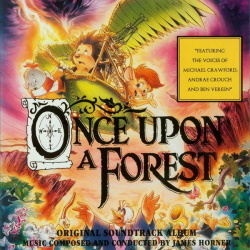
Once Upon a Forest is an animated adventure film with an environmental message, set in the tranquil world of Dapplewood, a lush and harmonious forest community. The story revolves around a group of small animal friends who must embark on a perilous journey to save Michelle, a young badger, who is exposed to toxic gas after a careless human truck driver spills it in the forest, and falls into a deep sleep. The group of friends – Abigail the wood mouse, Edgar the mole, and Russell the hedgehog, supported by their wise old mentor Cornelius – sets off on a quest beyond the borders of their familiar forest to find a rare medicinal herb, and along the way they face various challenges – including evading predators, navigating treacherous terrain, and surviving encounters with humans – while also learning about the delicate balance of nature and the interconnectedness of all living beings.
The film was directed by Charles Grosvenor for Hanna-Barbera Productions and 20th Century Fox, and had a voice cast that included Broadway megastars Michael Crawford and Ben Vereen, but unfortunately it was a critical flop and a commercial disaster, grossing just $6 million of a $16 million budget, and dividing audiences with its pro-environment themes. The film is mostly forgotten today, 30 years down the line, and that also includes its score, which despite being written by the great James Horner is one of his least-known and least-discussed works of the 1990s. This is a great shame because – and here’s a potential hot take – I personally think it’s one of the best and most beautiful animated scores of his entire career, standing easily alongside things like The Land Before Time, and in my opinion surpassing more lauded works like An American Tail.
 The score is rich, lush, and full of incredible sweeping themes, a wonderful, magical musical journey that encompasses many of Horner’s different compositional styles into one highly enjoyable album. In terms of tone, the score has a number of stylistic similarities to earlier works like Willow, the aforementioned The Land Before Time, Krull, and even Honey I Shrunk the Kids, while simultaneously foreshadowing the music he would write for House of Cards later in 1993, as well as the pastoral parts of things like The Spitfire Grill. This is all fuel for the fire for those who continually criticize Horner’s self-referential style, but I personally find the sound appealing and inviting, which gives the whole thing a familiar, friendly quality.
Thematically the score is strong, and several of them originate in the score’s three songs, all of which were written by Horner alongside lyricists like Andrae Crouch, Kelly Ward, Mark Young, and the ubiquitous Will Jennings. The cornerstone is the song “Once Upon A Time With Me,” which opens and closes the score, and is performed by Florence Warner Jones with the New London Children’s Choir. The song is simply spellbinding – an enchanting combination of Horner’s gorgeous, expansive melodic writing and Jones’ heartfelt vocals – and as the song progresses you can actually pick out different themes that come from different parts of the song: one from the opening chorus with the choir (“come away, come away, and your heart will understand…”), which is a little more mystical, and then one from the verse sung by Jones (“once upon a time we were flying…”), which is more expansive and open. The way the two melodic ideas play in counterpoint at the end of the song is just outstanding, and Horner’s orchestrations are bountiful and really make the entire thing soar.
The subsequent “Please Wake Up,” which is sung with depth and feeling by Michael Crawford as an elderly badger sitting in vigil by his sick granddaughter’s bedside, seems full of wisdom and sorrow and is one of the score’s definite high spots. Initially it’s based on a variation on the verse melody from “Once Upon A Time With Me,” but then it also has a new melodic idea based on this song’s chorus (“please wake up, please wake up, leave dark dreams behind…”) that drips with melancholic feeling. The only slight miscalculation comes with the rock track “He’s Back,” which is performed with admirable gusto by Ben Vereen as a gospel preacher bird, but nevertheless seems rather out of place compared with the rest of the score.
The score itself, in thematic terms, is based around these three ideas from the songs – the ‘Come Away’ theme, the ‘Once Upon a Time’ theme, and the ‘Please Wake Up’ theme – and each of them feature prominently in multiple cues, but what makes Once Upon a Forest really stand out are the orchestrations. Horner’s score unfolds almost like a tone poem, presenting different moods and textures, showcasing different lead instruments, and then often emerging into gorgeous passages for the full orchestra. The nine-minute opening cue, “The Forest,” is the standout for me, as it runs through each of the score’s main themes with a wonderfully romantic sweep, sparkling counter-melodies and accents, and genuine emotional depth. Horner always found a way to immediately get to the heart of his movies with his music, and the way he bridges the gap between the animation and the audience here is just outstanding, yet another example of how skillfully he could do that. Later in the cue there’s some effervescent, playful, pastoral passages for fluttering woodwinds, and some lightly comedic writing for a tuba and a dulcimer that echoes parts of Honey I Shrunk the Kids, and is just superb.
“Cornelius’s Nature Lesson” contains much of the same material and adopts a mostly similar tone, but does focus more on the score’s secondary theme for “the natural world,” while also briefly introducing the score’s darker action material. This action writing is developed further in the subsequent “The Accident,” which is the music that underscores the human-caused chemical spill in the forest that results in Michelle’s sickness. Horner’s music here is still orchestral and tonal, but much more turbulent, often verging on the violent; its darker tone is much closer to the sound of things like Krull and Willow, and is full of bombastic orchestral explosions, and even some moments of eerie light horror featuring a wordless choir and some creepy allusions to the chord structure of the ‘Please Wake Up’ theme.
“Bedside Vigil” is essentially an orchestral rendition of the ‘Please Wake Up’ theme, sans vocals, underscoring old Cornelius as he sits at Michelle’s bedside, and is sincere and tender without becoming maudlin – a fine balancing act that Horner always achieved. This then leads into another extended set piece, “The Journey Begins,” as the group of friends sets off out beyond their forest home to find a cure for their stricken friend. There are several more superb, poignant, fully orchestral renditions of the main themes; these lead into the first performance of the brand new ‘journey’ theme, a lively and spirited brass march full of optimistic adventurousness, and then some rousing fanfare-filled action passages that again seem to be inspired by scores like Willow and Honey I Shrunk the Kids with their intoxicating combination of high adventure and hidden danger. One passage of high, shrill string sustains towards the end of the cue even harks back to the score from Humanoids from the Deep from 1980 – a deep cut for the Horner aficionado!
“Flying” is one of those cues that saw Horner exploring through music the freedom and exhilaration of flight; something which, as we all know, was dear to his heart. It doesn’t quite have the same spine-tingling energy of something like The Rocketeer, and is perhaps instead closer to the flying music from the finales of Project X or An American Tail, but it still captures that same sense of awe and wonderment, combined with a feeling of trepidation and potential danger – the blasts of the famous four note ‘danger motif’ here are appropriate in context, and feel like visits from an old friend – while the off-kilter version of the ‘Please Wake Up’ theme seeks to remind everyone what is at stake.
“Escaping from the Yellow Dragons/The Meadow” is the score’s biggest and most expansive action sequence, and plays something like a ‘James Horner Great Action Moments’ compilation, bringing together the snare drums riffs and rampaging rhythms from Aliens, the crashing pianos from Sneakers, additional stylistic references to The Land Before Time, Krull, and Willow, and one sequence of notably brilliant flutter-tongued brass triplets, all infused with numerous thematic nuggets from both the songs and the Journey theme. It’s nothing we haven’t heard from Horner before, but it’s so well constructed, so fluid and organic, that it just works despite its familiarity. Towards the end of the cue he lets loose with one of the most majestic performances of the score’s main theme, further enhancing the emotional quotient.
The 10-minute finale, comprising “Flying Home to Michelle” and “The Children/Maybe One Day…, Maybe One Day,” wraps things up with more solid thematic statements, including the score’s most prominent rendition of the ‘Come Away’ theme, and some quite intense suspense material which brilliantly combines variations on the ‘Please Wake Up’ theme with the searching, pained string figures from the heart attack sequence in Brainstorm. The climax of the score, which accompanies the adventurers’ return to Dapplewood and their successful healing of the stricken Michelle, is sweetly moving and poignant and has echoes of Cocoon. It eventually segues into a final end credits refrain of the “Once Upon A Time With Me” song, again performed beautifully by Florence Warner Jones.
Following the unfortunate demise of Fox Records in the mid 1990s, Once Upon A Forest became one of the rarest Horner CDs on the market. Although the whole score is now available to stream online, which perhaps renders the whole thing moot for many, physical media collectors can still expect to pay top prices for it in on-line auctions. Personally, however, I think any price one might pay for this soundtrack would be worth every penny. This score is an unheralded and largely undiscovered Horner classic, filled to the brim with almost 70 minutes of the rich, powerful, expressive orchestral music that attracted so many admirers throughout his career, and I can’t recommend it highly enough.
Buy the Once Upon a Forest soundtrack from the Movie Music UK Store
Track Listing:
- Once Upon A Time With Me (written by James Horner and Will Jennings, performed by Florence Warner Jones) (5:56)
- The Forest (9:11)
- Cornelius’s Nature Lesson (3:41)
- The Accident (4:24)
- Bedside Vigil (2:15)
- Please Wake Up (written by Will Jennings, Michael Tavera, Kelly Ward, Mark Young and James Horner, performed by Michael Crawford) (2:36)
- The Journey Begins (8:08)
- He’s Back (written by Andrae Crouch, Sandra Crouch and James Horner, performed by Ben Vereen and the Andrae Crouch Singers) (2:00)
- Flying (4:49)
- Escaping from the Yellow Dragons/The Meadow (6:36)
- Flying Home to Michelle (6:32)
- The Children/Maybe One Day…, Maybe One Day (4:41)
- Once Upon A Time With Me/End Credits (written by James Horner and Will Jennings, performed by Florence Warner Jones) (5:56)
Running Time: 67 minutes 18 seconds
Fox Records 66286-2 (1993)
Music composed and conducted by James Horner. Performed by The London Symphony Orchestra and The New London Children’s Choir. Orchestrations by John Neufeld. Featured musical soloists Mike Taylor and Tony Hinnigan. Recorded and mixed by Shawn Murphy. Edited by Jim Henrikson. Album produced by James Horner.
Leave a comment

Shop at the Movie Music UK Store

Member of the

 MOVIE MUSIC UK
Great review. I find myself coming back to Horner’s score for Once Upon A Forest frequently as I age. Rewatching the movie is a nostalgia trip in its own right but its true staying power has always been the uncannily rich music. It’s fine that plenty of great, beautiful art won’t have its proper day in the sun, such is life, but I deeply appreciate the attention you’ve given it in this write up. It’s a tremendously gorgeous work and your writing has given means to meditate on it with a deeper appreciation. Cheers.
I agree 100% with your review Jon. One of my top5 scores of 1993 & one of my favourites animation scores of all time !