DAVE – James Newton Howard
 THROWBACK THIRTY
Original Review by Jonathan Broxton
There’s an old adage, which I’m paraphrasing, which says something like: “those who seek out power are the ones to whom it should not be given”. This philosophy is the heart of Dave, one of the best and most interesting comedy-dramas of the 1990s. The film stars Kevin Kline as Dave Kovic, the pleasant and genial owner of a temp agency in Washington, D.C., who, as a side job, capitalizes on his remarkable resemblance to US President Bill Mitchell by comically impersonating him at events. Dave is even occasionally hired by the Secret Service to impersonate the real Mitchell to allow him to carry out an extramarital affair – and it is while at one of these ‘clandestine’ events that Mitchell suffers a massive stroke and is left incapacitated. To cover it up, and to further his own political aspirations, Mitchell’s chief of staff Bob Alexander (Frank Langella) cooks up a scheme where Dave will continue to act as President, implicate the Vice President (Ben Kingsley) in a scandal, appoint Alexander in his place, and then ‘die’ for real, leaving Alexander in the oval office. However, Dave proves to be unexpectedly excellent at the top job, even reconciling with President Mitchell’s estranged wife Ellen (Sigourney Weaver), to the point where Dave wonders whether he shouldn’t have the job for real. The film co-stars Kevin Dunn, Ving Rhames, and Charles Grodin, and was directed by Ivan Reitman.
The score for Dave was by James Newton Howard, who in 1993 was hot off his recent Oscar nomination for The Prince of Tides, and his box office success scoring hits such as Pretty Woman, My Girl, and Alive, as well as critical successes such as Glengarry Glen Ross and Grand Canyon. Dave was his first collaboration with director Ivan Reitman – they would later work together on Junior in 1994 and Father’s Day in 1997, plus several other projects that Reitman produced – and the intelligence, warmth, and heart inherent in the story inspired Howard to write one of his loveliest scores of the decade.
 To capture the duality at the center of the story, Howard wrote two themes for Dave/President Mitchell – the first, is a warm, charming, almost fairy-tale like theme that reflects Dave’s optimism and innocent idealism, while the second is a more patriotic and determined piece that underscores Dave’s shenanigans inside the White House, and speaks to the sense of pride Dave feels at actually being able to make a positive difference from inside the corridors of power. As the score progresses Howard also introduces a third theme, a romantic, slightly wistful, love theme that represents the burgeoning relationship between Dave and First Lady Ellen Mitchell. Smaller motifs – including a pompous, officious, sometimes threatening thing for chief of staff Bob Alexander, and a sentimental motif for Ben Kingsley’s unfairly maligned Vice President Nance – come and go, but it is to these three core melodic ideas that Howard structures his narrative.
The “Main Titles” introduces the two main themes for Dave in quick session, beginning with Dave’s Theme surrounded by lovely, sprightly, magical sounding textures that focus on lithe strings, elegant woodwinds, and chimes. It smoothly segues into the more noble White House theme after the 1:05 mark, carried by warm brass, and then moves back and forth between the two, creating a lovely portrait of a wholesome central character. This piece has gone on to be a James Newton Howard classic – and a trailer music staple – and it’s not difficult to see why, with its easy lyricism and positive emotional impact.
“The Picnic” – which is presented out of chronological order – underscores a scene where Dave and Ellen escape from the White House together and enjoy an illicit moonlight picnic amid Washington’s memorials. This cue features a superb version of Ellen’s theme, the score’s love theme, a beautiful piece for strings, piano, hushed woodwinds, and solemn brass. There’s a lovely intimacy to this piece, two adults bonding, not over juvenile puppydog infatuations, but over shared morals and ideals, and Howard nails their relationship perfectly. It’s sentimental without being mawkish, tender without being overblown or manipulative, but also has a touch of melancholy to it, representing Ellen’s regret at her failed marriage to President Mitchell.
The rest of the score, as I mentioned, is basically filled with variations on these three core themes, sometimes with interesting orchestrations to illustrate a different aspect of the story. The version of the White House Theme in “To The White House” has a lightly militaristic, determined edge, with some added snare drums and pomp-and-circumstance to really drive home the seriousness of Dave’s new situation, before finishing with a lovely piano coda. There’s a similar militaristic vibe to “You’re On,” a fun Sousa-like march, which again accompanies Dave as he carries out various presidential duties with the glee of a new kid in school; the flourish in the finale is pure western Americana.
The love theme gets a lot of attention in the middle of the score, in cues like “Are You Threatening Me,” “She Hates Me,” “Do You Like Magic” and “The Tunnel,” many of which underscore the numerous scenes where Dave’s unexpectedly caring demeanor and eagerness to do the right thing begins to melt Ellen’s icy façade; she and the president have been estranged for years due to his infidelity. The initial antagonism between them sees the love theme arranged with bold percussive confidence in “Are You Threatening Me,” and then it has a caper-like edge in the comedically charming “She Hates Me,” which combines beautifully with Dave’s theme and the White House theme during its finale. The love theme then undergoes a romantic change in “Do You Like Magic” in a scene where Ellen observes Dave going out of his way to help a shy child in an orphanage, and then catches him glancing at her legs – something her real husband hadn’t done in years.
There’s a presidential seriousness to “Dave Passes Out,” and then a surprising amount of warmth and intimacy in the delightful “How’d You Get Started,” which underscores the scene where Dave and Vice President Nance bond over their political idealism, and Dave realizes that he has been manipulated by Bob into framing him – and this in turn galvanizes him to put things right. This all leads into the film’s climax, “Into the Fog,” when Dave – having faked his own ‘death’ while giving a speech during a joint session of congress, and brought the real incapacitated President Mitchell back into public view – strolls away from an ambulance into the misty pre-dawn, silhouetted by lights, as Ellen watches him leave. Howard beautifully blends Dave’s theme, the White House theme, and the Love theme together into a moving tribute to Dave’s good heart, and to his new romantic relationship with Ellen, and allows each of the themes to swell gorgeously. The “End Titles” again offers a wonderful combination of all three main themes, played at their effortlessly pleasant, harmonic, major-key best; this type of unashamedly emotional scoring was rife throughout the 1990s, and I miss the fact that directors now seem to find this sort of sentiment overly-manipulative, because I adore it.
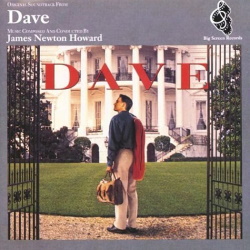
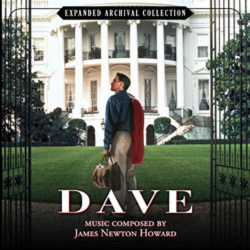 The original album for Dave was released by Big Screen Records as a tight, but satisfying, 35-minute album that hits all the highlights of the score. In 2013, acknowledging the 20th anniversary of the film, La La Land Records and producer Dan Goldwasser released a 3000-unit limited edition album of the full score in a more sensible chronological order, with improved sound, and an expanded running time of more than 60 minutes. The album also features several bonus tracks, as well as exclusive liner notes from writer Julie Kirgo. It is absolutely recommended to fans of the film, and anyone who wants to hear more of this excellent music.
For me, Dave is one of James Newton Howard’s best scores of the 1990s, and one of my favorite comedy scores of all time. The trio of main themes are all superb, and the way Howard blends them all together in such effortless fashion is outstanding; the love theme for Dave and Ellen is at times especially poignant. Anyone who enjoys orchestral, thematic, unashamedly emotional scoring with a dash of Americana and a whole heap of charm and magic will find this to be an absolute delight.
Buy the Dave soundtrack from the Movie Music UK Store
Track Listing:
- 1993 ORIGINAL RELEASE
- Main Titles (2:58)
- The Picnic (4:13)
- To the White House (3:04)
- You’re On (2:02)
- Are You Threatening Me? (3:25)
- She Hates Me (3:12)
- The Teaching Montage (1:07)
- Do You Like Magic? (2:24)
- Dave Passes Out (1:11)
- The Tunnel (1:49)
- How’d You Get Started? (2:01)
- Into the Fog (3:40)
- End Titles (4:14)
- 2013 EXPANDED RELEASE
- Main Title (2:59)
- Secret Service/Bicycle (0:43)
- You’re On (2:00)
- To the White House (1:53)
- Is This Legal?/Sleep Tight/Reed Talks to Press (2:12)
- Back tTo Work (0:53)
- The Teaching Montage (1:07)
- She Hates Me (3:12)
- The Balcony/Bob to Reed’s Office (1:45)
- Limo to Shelter (1:04)
- Ellen Watches Dave (1:17)
- Murray Comes/1812 Overture (1:28)
- $656 Million (1:10)
- Are You Threatening Me? (1:53)
- Ellen Finds Out (1:30)
- Ellen and Dave Pack/The Tunnel (2:15)
- The Picnic (4:12)
- Let’s Get to Work (1:11)
- Bedrooms/Bob Drops Bomb/Keep Moving (2:51)
- How’d You Get Started?/Congress (2:05)
- Dave Passes Out (1:11)
- Into the Fog (3:39)
- Ellen Volunteers (1:52)
- End Titles (4:13)
- To the White House (3:03) Album Mix
- Do You Like Magic? (2:25) Album Mix
- Are You Threatening Me? (3:24) Album Mix
- How’d You Get Started? (2:00) Album Mix
- Hail to The Chief (Source Music) (0:25) Bonus
- Secret Service (Alternate Version) (0:12) Bonus
- Back to Work (Alternate Version) (0:41) Bonus
- Bob to Reed’s Office (Alternate Version) (0:28) Bonus
- Limo to Shelter (Alternate Version) (1:05) Bonus
- End Titles (Alternate Version) (3:59) Bonus
Running Time: 35 minutes 20 seconds – Original
Running Time: 66 minutes 17 seconds – Expanded
Big Screen Records 9 24510-2 (1993) – Original
La-La Land Records LLLCD 1234 (1993/2013) – Expanded
Music composed by James Newton Howard. Conducted by Marty Paich. Orchestrations by James Newton Howard, Brad Dechter, Frank Bennett and Chris Boardman. Recorded and mixed by Shawn Murphy. Edited by Jim Weidman. Original album produced by James Newton Howard. Expanded album produced by Dan Goldwasser.

Shop at the Movie Music UK Store

Member of the

 MOVIE MUSIC UK