JESUS – Patrick Williams
 Original Review by Jonathan Broxton
I’ve come to the conclusion that Patrick Williams doesn’t get the recognition he deserves. Williams is an Emmy Award-winning, Oscar nominated composer who, like many others, writes consistently excellent music for movies which get no attention whatsoever. Over the last five years or so, Williams has been involved with several highly respected TV movies and small-scale features, including Geronimo, The Siege at Ruby Ridge, the Bette Midler vehicle That Old Feeling and the period drama The Grass Harp, but his music hardly ever sees the light of day on disc. That is why it is so gratifying to see his efforts on Jesus, the self-proclaimed “epic mini-series” based on the bible stories, rewarded in this way.
The story of Jesus has been often told. As the pivotal figure of the Christian faith, the actors who have portrayed him on-screen – Max von Sydow in The Greatest Story Ever Told, Jeffrey Hunter in King of Kings, Robert Powell in Jesus of Nazareth – have all described of their deep emotions at being asked to give life and voice to the man whose words and deeds remain the moral cornerstone of much of the world’s population. How this new adaptation will fare amidst these legendary productions remains to be seen, but producers Lorenzo Minoli and Judd Parkin have spared no expense in securing esteemed acting talent, boasting a cast list that includes Gary Oldman, Jacqueline Bisset, Jeroen Krabbe, Armin Mueller-Stahl and young Jeremy Sisto in the lead role. Behind the scenes too, director Roger Young has once again teamed up with his regular composer, Patrick Williams. The result could well be the best TV score of the year.
 According to Jon Burlingame’s liner notes, Williams specifically avoided the clichéd organ-and-choir approach of Biblical epics of the past, colouring his orchestra instead with a surprisingly large amount of percussion, an unexpected but effective electronic element, and some superb vocal work. Wisely, though, Williams has not completely disassociated himself from the tried and tested formulas of religious film music. His string work is like listening to Alfred Newman’s vibrato all over again, and his brass phrasing recall the Miklós Rózsa’s best moments. As one would expect, there is a certain amount of reverence in Williams’s themes, but this is not “church music” in any way shape or form. Noble-sounding brasses bolstered by searching strings characterise many of the cues, with the solo trumpet motif for Jesus’s earthly quest acting as the thematic anchor throughout the score.
The electronic dissonance and heavy percussion, which features in the opening moments of the ‘Main Title’ and in subsequent cues such as ‘Zealots’ and ‘Satan’, is intended to act as a recurring leitmotif for the temptation of Christ, and these moments allow the score to develop a much appreciated dark side. For the most part, though, Jesus is a score about beauty and passion. ‘Joseph Dies’ is actually rather reminiscent of the work of Ennio Morricone, especially through its use of solemn recorders, while ‘Walking on Water’, ‘Raising Lazarus’ and the superb ‘Jesus Arrives’ all feature multiple cymbal clashes to usher in increasingly lush performances of the main theme.
As one might expect, there is also a great deal of tragedy inherent in the score – ‘Searching for Jesus’, the quietly harrowing ‘The Last Supper’, ‘The Passion’ and the almost unbearably sad ‘The Crucifixion’ contain those wonderfully dramatic chord progressions that are virtually impossible to put into words but which tear at the heartstrings with each and every note. The solo female voice in ‘Temple, The Early Days’ whets the appetite for Sarah Brightman’s subsequent performance of ‘Pie Jesu’, the haunting Latin chant taken from Andrew Lloyd Webber’s “Requiem”, which was made popular last year by Welsh child star Charlotte Church.
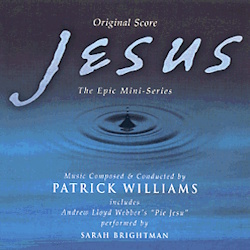
The only quibble one may have with Jesus is the score’s actual presentation – the CD cover art bears one of the least inspiring designs I have ever seen, and although Burlingame’s notes are well written, there is very little information about the series itself. Of course, all this has no effect on the music itself, which I cannot recommend too highly. Patrick Williams’s themes are strong, the emotional content high, and the performances consistently superb. Although the music does maintain a fairly constant tone throughout, and although some may find the score’s inherent stateliness a touch tedious, I personally find this score to be a stimulating, intensely rewarding emotional journey.
Track Listing:
- Main Title (2:54)
- Joseph Dies (2:35)
- Searching for Jesus (2:36)
- Temple, The Early Days (2:38)
- Healing the Sick (3:09)
- Zealots (1:51)
- Walking on Water (2:50)
- Raising Lazarus (2:59)
- Jesus Arrives (1:27)
- The Last Supper (3:53)
- Satan (5:18)
- Gethsemane (1:25)
- Taken to Pilate (1:57)
- Pie Jesu (written by Andrew Lloyd Webber, performed by Sarah Brightman with Paul Miles-Kingston and the Winchester Cathedral Choir) (3:53)
- The Passion (1:53)
- The Crucifixion (4:17)
- Jesus Has Risen (2:26)
- I Am With You (1:58)
Running Time: 50 minutes 17 seconds
Angel 7243-5-56984-2-1 (2000)
Music composed and conducted by Patrick Williams. Recorded and mixed by Charles Pollard. “Pie Jesu” conducted by Loren Maazel, orchestrated by David Cullen and Andrew Lloyd Webber. Mastered by Doug Sax. Album produced by Patrick Williams.

Shop at the Movie Music UK Store

Member of the


