WONDLA – Joy Ngiaw
 Original Review by Jonathan Broxton
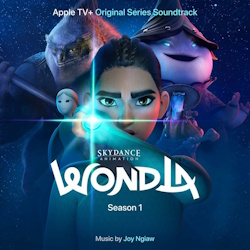
WondLa is an animated science-fiction adventure TV series produced by Skydance Animation which aired on Apple TV+ for 20 episodes across three seasons between 2024 and 2025. It is an adaptation of the 2010 children’s novel The Search for WondLa (and its sequels) by Tony DiTerlizzi, and follows the adventures of Eva, a teenage human girl who grows up in a state-of-the-art bunker, assisted by ‘M.U.T.H.R,’ a robot caretaker. However, after an attack on the bunker by unknown assailants on her sixteenth birthday, Eva suddenly finds herself on the surface of a strange planet called Orbona, which is inhabited by aliens, and which appears to have no other humans. With the help of Otto, a friendly giant sentient tardigrade, and a cantankerous alien named Rovender Kitt, and guided by a faded picture containing the word ‘WondLa,’ Eva sets off across the planet to find others like her, and hopefully establish a new home. The show stars Jeanine Mason as the voice of Eva, and has a fun supporting voice cast that includes Teri Hatcher, Brad Garrett, Alan Tudyk, John Ratzenberger, Shohreh Aghdashloo, Simon Pegg, and Dwight Schultz, among others.
The composer for all three seasons of WondLa is Joy Ngiaw. Born in Malaysia in 1994, then raised in China, she moved to the United States to attend Berklee College of Music in Boston, and then moved to Los Angeles in 2016 to work in film. She started out assisting composers like Jeff Russo, Leo Birenberg, and Zach Robinson on some of their TV work, and then started scoring short films and TV episodes of her own in 2018. She scored the short film Blush for Skydance Animation in 2021 and this led directly to her being hired for WondLa – her first major work – in 2023. To say that Ngiaw has a stellar career ahead of her is an understatement; her score for WondLa is magnificent, a big, bold, adventurous, classic orchestral score that will delight lovers of old-fashioned Hollywood symphonic bombast.
 Over the course of three seasons, Ngiaw wrote some of the best and most traditionally satisfying music anywhere on American television. However, in an interview with Tomasz Ludward for the IFMCA Ngiaw also explains that a large part of the score saw her exploring a vast array of world instruments to represent the various alien tribes, and which would sit alongside the orchestra, adding a fascinating layer of flavor and color. For one character, Darius, Ngiaw uses tuned water bowls, glass harmonicas, and bells. For another character, Besteel, Ngiaw uses pitch bending on her orchestra to create a sound reminiscent of a monster’s growl, and then adds a heavily distorted Chinese erhu to achieve a ‘haunting and foreboding effect.’
Another character is accompanied by African instruments like the bolon Malian harp, the kalimba Zimbabwean lamellophone, and the balafon Malian xylophone, and yet another character’s sound is defined by plucked instruments from Korea and China layered against a Mongolian choir. In addition to these instruments there are also a large number of vocal textures – breathing sounds, hums, and chants, some of which were performed by Ngiaw herself – as well as sampled musique concrete sounds of everyday objects which were turned into percussive sounds after running them through processing software.
The main theme of the score is the main WondLa theme, which represents the main character Eva, and her identity is all over the score, anchoring her at the core of the story, but as the score develops Ngiaw introduces multiple melodies for different settings, characters, and concepts, which ultimately results in WondLa being a true leitmotivic work. However, even with all this explanation of interlocking themes and ideas, world music instruments and choirs and vocals, the score would be nothing without Ngiaw’s talent for action and emotion, and here the score truly excels.
I’m not going to go through each album track-by-track, but will instead pick out several highlight pieces that I thought were truly exceptional. From the Season 1 album the “Eva (End Credits)” offers perhaps the most satisfying statement of the main WondLa theme. There is a huge, soaring scope to the vocals in “Solas.” The openness of the themes in “The Arsian Sage,” “Otto’s Flight,” and “We Will Meet Again” remind me very much of the joyous world music sound from James Horner’s Avatar. The gentle lyricism in “The Walking Trees” is beautiful. The quirkiness of “Palace of Junk” is a neat and fun diversion. There is a slithery, duplicitous quality to the slurred strings in “Darius,” and I love how some of the chord progressions from his theme appear to mirror those of Eva’s theme. There are couple of fantastic guttural action cues in “Pillar Guards” and “Stay Away from My Family,” either side of the album’s emotional high points, “Why Am I Here” and “To Be Your Mother,” a pair of searing cello laments.
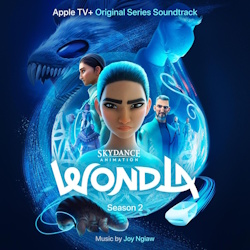 The music from the Season 2 is darker and a little more sophisticated than the music from Season 1, recognizing the character development that Eva goes through, and as such for me Season 2 album is a leap forward. The best thing about Season 2 is the action music, which is at times absolutely monumental. Dramatic pieces like “Cadmus’s Compass,” “Ripping Mycelium,” the thunderous “Desert and Bones,” and the massive, tumultuous “Faunus Invaded” really raise the stakes considerably; that dark march at the end of “Cadmus’s Compass” is especially terrific, as are the fabulous howling horns in combination with what sounds like didgeridoos in “Faunus Invaded”.
One other Season 2 cue worth special acknowledgement is “The Heart,” which plays in the season finale episode (although it is the first track on the album). Ngiaw herself considers the cue to be the best representation of the emotional center of the story – she says ‘it captures the purest expression of Eva’s connection to Orbona, her sense of love and hope’ – and she describes it as quiet conversation between solo cello and solo violin, which then gradually swells as the full string section joins, reflecting the character’s empathy and compassion. It really is quite sensationally beautiful, a career highlight for Ngiaw to date.
Elsewhere, cues like the soaring “No Them, Only Us,” the tranquil “Protect Yourself,” the majestic “Faunus End Credits,” the magical “Dawosu,” and “Reaching Faunus” offer similarly exceptional emotional content, including some powerful moments of vocal and choral work, and some excellent variations on the main WondLa/Eva main theme. The phrasing of the nativist vocals and some of the specific percussion sounds Ngiaw uses in several of these cues are again very reminiscent of James Horner’s Avatar, which is something I greatly appreciate. I also very much liked the effervescent futuristic new-age synth sound of “Welcome to New Attica,” which adds a new dimension to the score as a whole, and which continues through subsequent cues like “Sanctuary Chase” and “Rendezvous Point”.
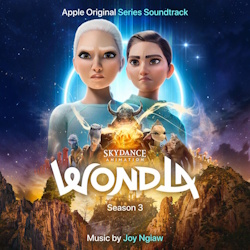 The Season 3 album is, essentially, a direct continuation of the sound from Season 2 – both seasons aired in their entirety in 2025 – but, even with that, there are still some notable highlights. The “WondLa Themes Suite” that opens the album is unexpectedly powerful, with a slightly heavier emphasis on electronics that give the statements of Eva’s theme an interesting new tone. The combination of electronic textures, vocals, and world music percussion sounds continue to be prominent, with cues like “Eva Eight,” the bold and inspirational “Born of the Earth,” the spiritual and ethereal “Regrowth of Orbona,” “Creatures of Orbona,” “Your Future, Your Choice,” and the rousing “Leader of the Sanctuary Born” leaving an especially prominent mark. The James Horner/Simon Franglen/Avatar influences continue to be prevalent throughout all these cues, and again this reaches directly into my personal sweet spot for musical taste.
The action music in cues like the epic “Race to the Tunnel,” the heraldic “Fours Do More,” the oppressive and sinister “Outnumbered,” the harsh and dissonant “Pillar Guards Standoff,” the intricate “Escaping Solas,” the optimistic and hopeful “We Can Save Them,” the apocalyptic “Attack of the Pillar Guards,” and the rousing and adventurous “Stopping Project Sunshine” is deeply impressive. The cello writing in “Help Her Understand” is devastatingly beautiful, as are the gentle solo pianos and ethereal voices in “Orbona Needs,” the emotional strings of “The World That Will Be,” and the angelic voices of “Pawn, Not Player”. The final flourish of the main theme for Eva in “Not Goodbye” and “Farewell to WondLa” end the score – and the series entirely – on a lush, powerful high.
Earlier this year I quipped on Facebook that “somebody needs to give Joy Ngiaw a Star War to score,” and I still absolutely stand by that sentiment. The music in WondLa, across all three seasons, suggests that Joy Ngiaw is a composer with a huge career ahead of her – she can write memorable themes and complicated action, she structures her music intelligently, her use of countless different world music styles gives each new cue a fascinating tonal dimension, and once in a while she hits you with a moment of emotion that breaks your heart. I can’t recommend it highly enough. Now that WondLa is over Ngiaw can start exploring other aspects of her personality – she’s got the Kevin James romantic comedy Solo Mio coming out next month – and I can’t wait to see where she goes next from there.
Buy the WondLa soundtrack from the Movie Music UK Store
Track Listing:
- SEASON ONE
- Eva (End Credits) (1:33)
- Solas (1:01)
- Lacus (1:18)
- The Arsian Sage (0:56)
- Otto’s Flight (1:14)
- Not Meant to Be Alone (1:35)
- Waking Up in Orbona (0:50)
- Chase on the Surface (0:55)
- The Walking Trees (1:11)
- Palace of Junk (0:57)
- Road to Lacus (1:02)
- Meeting Darius (1:33)
- Gifts Given (1:06)
- Given Gifts (1:37)
- Pillar Guards (0:51)
- We Will Meet Again (1:23)
- The Lost Pathfinder (0:57)
- Why Am I Here (2:56)
- Stay Away from My Family (1:19)
- Who is the Monster (1:30)
- To Be Your Mother (2:57)
- Here to Take You Home (1:08)
- Meego and Friends (performed by Christopher Swindle and Danny Jacob) (1:02)
- SEASON TWO
- The Heart (2:35)
- No Them, Only Us (4:00)
- Cadmus’s Compass (2:43)
- Heart of the Forest (1:02)
- Ripping Mycelium (1:20)
- Protect Yourself (1:46)
- Faunus End Credits (1:33)
- Desert and Bones (1:43)
- Dawosu (1:37)
- Reaching Faunus (1:20)
- Eva’s Vision (1:18)
- Faunus Invaded (4:57)
- Welcome to New Attica (1:00)
- Sanctuary Chase (2:36)
- Rendezvous Point (1:59)
- Seeking Reentry (2:00)
- Out of Place (1:48)
- Back to the Beginning (0:53)
- New Attica End Credits (1:31)
- Requiem for Orbona (1:33)
- SEASON THREE
- WondLa Themes Suite (1:33)
- Eva Eight (2:06)
- Born of the Earth (3:52)
- Help Her Understand Us (2:05)
- Orbona Needs (3:33)
- Race to the Tunnel (1:49)
- Regrowth of Orbona (3:25)
- Fours Do More (1:07)
- Rise of Eva (0:40)
- Creatures of Orbona (2:33)
- Outnumbered (1:18)
- Pillar Guards Standoff (1:25)
- The World That Will Be (2:37)
- Escaping Solas (3:17)
- Meeting Arius (1:21)
- Your Future, Your Choice (1:43)
- Reunion with Friends (1:18)
- We Can Save Them (2:05)
- Heart in Hand (2:07)
- Leader of the Sanctuary Born (2:37)
- Pawn, Not Player (3:01)
- Attack of the Pillar Guards (2:30)
- Stopping Project Sunshine (2:46)
- Not Goodbye (2:50)
- Farewell to WondLa (1:56)
Milan Records (2024-2025)
Running Time: 30 minutes 51 seconds – Season 1
Running Time: 39 minutes 14 seconds – Season 2
Running Time: 55 minutes 36 seconds – Season 3
Music composed and conducted by Joy Ngiaw. Orchestrations by Gregory Jamrok, Abraham Libbos and Joe Zimmerman. Additional music by Theron Kay, Cali Wang, Peter Lam, and Roberto Prado. Recorded and mixed by XXXX. Edited by XXXX. Album produced by Joy Ngiaw.
-
February 6, 2026 at 8:01 amMovie Music UK Awards 2025 | MOVIE MUSIC UK

Shop at the Movie Music UK Store

Member of the

 MOVIE MUSIC UK