WASHINGTON BLACK – Cameron Moody
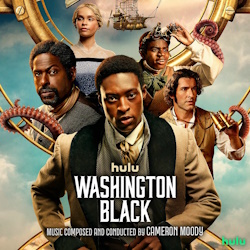 Original Review by Jonathan Broxton
Washington Black is a new Hulu drama-adventure TV series based on the 2018 ‘bildungsroman’ novel of the same name by Canadian-Ghanaian author Esi Edugyan. The story follows the adventures of George Washington ‘Wash’ Black, who is born into slavery on a sugar plantation in Barbados in the early 1800s. When a brutal new overseer named Erasmus Wilde takes charge of the plantation, Wash is unexpectedly chosen to be the assistant to Erasmus’s brother Christopher, nicknamed ‘Titch,’ a kindhearted inventor who is also secretly an abolitionist seeking to end slavery. Titch teaches Wash to read, write, and appreciate scientific exploration, introducing him to a world of wonder. However, a traumatic event forces Titch and Wash to flee Barbados in a flying machine, and their escape sets them on an adventurous globe spanning journey across the Americas to Nova Scotia, the Arctic, then to London, Morocco, and beyond, all with Erasmus’s slave-hunting henchman Willard hot on their trail. The show was written by Selwyn Seyfu Hinds, produced under the auspices of showrunner Kimberly Ann Harrison, and stars Ernest Kingsley Jr. and Eddie Karanja as the younger and older Wash, with Rupert Graves, Tom Ellis, Billy Boyd, and Sterling K. Brown in major supporting roles.
Every year, without fail, a composer emerges as a great new talent in film music circles and, for me, in 2025 that composer is Cameron Moody. Born in Georgia, he went to high school in Massachusetts, college in New York, and is now based in Los Angeles, where he has already established quite some pedigree: in 2021 he made history by becoming the youngest ever winner of ASCAP’s Henry Mancini Music Fellowship Award, and then in 2024 he became the youngest composer ever to be selected as a fellow in the highly coveted NBC/Universal Composers Initiative. Beginning in 2021 he began working with composer Michael Abels, who had been one of Moody’s ‘zoom tutors’ at NYU, and he wrote additional music for him on projects like Nightbooks, Nope, The American Society of Magical Negroes, and the Star Wars TV series The Acolyte. Other than a few short films and a 2023 History Channel documentary about John F. Kennedy, Washington Black is Moody’s first project as solo lead composer. It won’t be his last.
Without wanting to sound condescending or patronizing, it is amazing to me that Cameron Moody is this good, this young. Moody is 22. He was born August 29, 2002, the week after Signs opened in movie theaters. I’m sure people will come at me with other names from film music history but, as I write this, only two other composers from recent decades stand out to me as being this good at this tender age – one is James Horner, who was 29 when he scored Star Trek II in 1982, and the other is Cliff Eidelman, who was plucked from obscurity in 1988 at the age of 24 to score his debut film Magdalene. And, without a word of hyperbole, Moody has the potential to have a similar career trajectory as them, if enough people hear the score for Washington Black and take the time to really investigate it.
 This score is terrific. It’s big and lush and symphonic, filled with themes, and has a wonderful sense of drama and adventure. It’s gorgeously orchestrated, full of delicate and whimsical touches, and has a rich sound that makes outstanding use of the full ensemble. And, best if all, it shows a real understanding of narrative and storytelling structure, which allows the score to unfold naturally, bringing out all the right emotions, and taking the listener on a journey as grand and sweeping as the one Wash and Titch have. I’m going to keep repeating this, so forgive me for doing so, but Cameron Moody is 22. He has all this dramatic sensitivity and musical ability in his arsenal at the age of 22. It’s astonishing.
One thing that people will immediately pick up on is the fact that much of Moody’s music has the essence of John Williams in it. There’s no getting around it – there is a ton of Harry Potter in this, a little bit of Rey’s Theme from The Force Awakens, a little bit of War Horse, a little bit of Tintin, a little bit of Hook, a little bit of The Book Thief, a little bit of a lot of other things – and Moody will likely acknowledge this himself, so if that bothers you, well, that’s your loss. Many people try to emulate John Williams, and most of them fail miserably, but Moody has succeeded admirably. There’s something about the way he uses his woodwinds, the way he phrases his strings, the way he harmonizes certain instrumental combinations, which scream vintage Williams, and it’s just lovely hearing someone do this so well, with such style. As time goes on, as he writes more scores, Moody will undoubtedly develop characteristics that become identifiable as his own, but for now – well, there are certainly much worse composers than John Williams that he could have chosen to emulate.
The score’s main theme is Wash’s Theme, which is introduced fully in the first cue “Washington Black (Main Titles),” and is present in numerous cues thereafter. What’s interesting about this theme is its development; at the outset, when the character first appears, it is simple and innocent, a festival of lithe woodwinds and tinkling celestas backed with larger symphonic forces, but then as the series progresses and Wash grows older and matures, the music illustrates this growth. There is a sense of awe, inquisitiveness, and charm to the theme, matching the personality of the character, and this is something that also allows Moody to use this theme to underscore Wash and Titch’s moments of scientific discovery. The theme is very malleable too – sometimes Moody states the entire theme, sometimes just the first few notes – and it’s also very open to different arrangements: for example, in cues like “Wash Flies” and “Brand New Adventure” it is carried by the whole orchestra, whereas in others it is stripped down to just one or two solo instruments.
The score’s second major theme is the theme for Halifax, Nova Scotia, which is the first place that Wash and Titch visit after escaping from the Barbados Plantation, and where they meet Medwin, Angie, and Tanna, the first free black people Wash has ever seen, and who encourage and nurture his scientific expertise and sense of adventure. The Halifax theme is grand and epic, primed to send Wash on his incredible journey, and the scope of the music reflects that. Cues like the bustling, energetic “Welcome to Halifax” and the more thoughtful but still wonderfully emotive “Leaving Halifax” feature the Halifax theme prominently, and are two of my favorite moments in the score – proud and robust and brimming with confidence.
There are couple of other character specific themes dotted through the score. The first is for Willard and his band of hunters, whose job is to track down and kill runaway slaves, specifically Wash. Willard’s theme is a short, sharp burst of dark energy, a three-note motif that heralds his malevolent presence whenever he appears on scene. The first major performance of his theme appears at the 2:14 mark in the ominous “Willard and the Hunters,” a mass of low brass often flanked by tribal percussion or a soft choir, and then there are significant statements later during both “I Protect My People” and “Captured”. On the flip side of this is the theme for Barrington the pirate, who Wash and Titch encounter when they crash their Cloud Cutter onto his ship. Barrington’s values of respect and honor have a major influence on Wash, and Moody’s music for him reflects that. The statement of his theme at 0:51 of “Barrington” is carried by noble but understated brass before swelling into something more poignant, and then later at the beginning of the otherwise anguished “Not Our People” the music is softly melancholy.
A lot of the rest of the music is scene or location specific. For example, the music in the sequence that takes place in the Arctic – cues like “The Arctic,” “Rescue/Toboggan Ride,” “Frozen Plain,” the harsh and dissonant “Abandoned,” and then later in the cello-heavy “Valediction” – captures perfectly the barren, icy beauty of the place, but also its inherent danger, with a combination of big open chords, cooing choirs, and a sense of scope and majesty. There’s some vibrant material in “Rescue/Toboggan Ride” that bodes well for Moody writing something more intensely energetic and action-packed in the future.
Other cues of note I really liked include the tenderness and warmth of “Tanna Meets McGee,” the gorgeous writing for oboes and strings throughout “Kit’s Prayer,” the trepidation that turns to enchantment in “Titch’s Cabin,” the percussive energy of “Finishing the Project,” the folksy violins and fluttery woodwind whimsy of “Beach Romance,” and the magical cascades of pianos and chimes in “The Flying Man and the Musician”. Elsewhere, there is a sense of tragic revelation running through “Why I Left,” “Enacting the Plan” is witty and playful, and “Medwin and Angie” features another set of emotive oboes that build to a gloriously romantic finish.
The North Africa sequence comprising cues like “To Morocco” and “Crossing the Desert” sees Moody living out all his Lawrence of Arabia fantasies, there is some lovely angelic choral work at the end of “Closure,” the “Love Scene” features the most traditionally romantic rendition of Wash’s theme in the entire score, and the compound cue “Building the Wind Sailer/Flight/To Dahomey” has a charming sense of vibrant wonderment. Everything leads up to the score’s pièce de résistance, the one-two punch of “Mother” and “Finale,” an 8-minute-long conclusion in which there is little to no dialogue in context, which means that Moody has to carry the emotion for the duration. The cue feels like a convergence of all of the themes in the show, with especially stunning renditions of Wash’s theme throughout “Mother” and then in the last 20 seconds of the finale track that jubilantly illustrates the happy ending for Wash and ends things with a satisfying sense of closure.
I really cannot recommend Washington Black enough, especially to those who are drawn to that rich and expressive John Williams sound, and want to hear an exceptionally accomplished homage to that. And as for Cameron Moody, this is one of the most impressive mainstream debuts in years. Not only did he compose all of this himself, he conducted and orchestrated it too, and in doing so he shows a level of orchestral sophistication, emotional intelligence, drama, and narrative structure, way beyond his years. Like I keep repeating, he’s only 22. Composers twice, three times, his age don’t have what he has at his fingertips. Mark my words; he’s going to be a superstar.
Buy Washington Black soundtrack from the Movie Music UK Store
Track Listing:
- Washington Black (Main Titles) (1:08)
- Welcome to Halifax (2:28)
- Tanna Meets McGee (1:02)
- Willard and the Hunters (2:28)
- Kit’s Prayer (1:09)
- Wash Is Summoned (1:24)
- Titch’s Cabin (1:47)
- No More Cane Fields (1:10)
- Reunion at the House (0:44)
- Finishing the Project (0:48)
- Beach Romance (2:43)
- Wash Flies (2:15)
- Barrington (2:21)
- The Flying Man and the Musician (1:44)
- I Protect My People (2:27)
- Why I Left (1:23)
- Reliving the Past (1:17)
- Our Survival (1:19)
- News of Engagement (1:09)
- Captured (1:48)
- John’s Choice (2:46)
- Brand New Adventure (1:03)
- Enacting the Plan (1:33)
- Issue With the Larger World (1:37)
- Not Our People (3:45)
- We Should Go Find Him (1:46)
- The Arctic (0:58)
- Rescue/Toboggan Ride (3:09)
- RSL Outpost (1:35)
- Frozen Plain (0:58)
- Abandoned (1:43)
- You Running Away Again? (1:32)
- Medwin and Angie (3:15)
- Leaving Halifax (2:36)
- Valediction (4:48)
- Stay With Us (1:41)
- Photo (0:42)
- Faith Sold (1:15)
- Revealing the Truth (1:41)
- To Morocco (0:40)
- Crossing the Desert (2:40)
- Closure (4:43)
- The Love Scene (1:23)
- Building the Wind Sailer/Flight/To Dahomey (6:31)
- Mother (3:11)
- Finale (4:57)
Hollywood Records (2025)
Running Time: 95 minutes 02 seconds
Music composed and conducted by Cameron Moody. Orchestrations by Cameron Moody. Recorded and mixed by Scott Michael Smith. Edited by Maximilian Rubell and Robin Whittaker. Album produced by Cameron Moody.
Leave a comment

Shop at the Movie Music UK Store

Member of the

 MOVIE MUSIC UK
Incredible. Incredible!
I got my mom into John Williams and movie music years ago. Her favorite Williams soundtracks to listen to are The Terminal and War Horse. When she hears this, she’ll be in heaven.
For as long as I’ve been familiar with John Williams, I’ve thought, with sadness and resignation, that no one would ever be able to manipulate an orchestra with such graceful restraint ever again, or to create such a luscious, delicate, gossamer musical environment.
After listening to the first 10 tracks, I am happy to say that John Williams can finally retire. The future of movie music is secure.
The maestro is dead. Long live the maestro!