Quincy Jones, 1933-2024
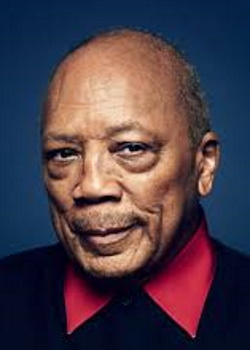 Composer Quincy Jones died on November 3, 2024, after a short illness. He was 91 years old.
Quincy Delight Jones Jr. – known to all as ‘Q’ – was born in Chicago, Illinois, in March 1933. Jones grew up in a challenging environment, with his mother battling schizophrenia and his father working as a carpenter and semi-professional baseball player. When he was ten, his family moved to Seattle, Washington, where he met future jazz great Ray Charles. The two became fast friends, and Jones, a natural musician, learned trumpet, piano, and arranging. He attended Seattle’s Garfield High School and later earned a scholarship to study at the prestigious Berklee College of Music in Boston. However, he left before finishing to tour with jazz great Lionel Hampton, marking his entry into the world of professional music.
In the 1950s, Jones moved to New York City and became immersed in the jazz scene, working with icons like Miles Davis, Dizzy Gillespie, and Count Basie. He also collaborated with major record labels as an arranger and conductor. By the late 1950s, Jones was touring Europe and later moved to Paris, studying composition and orchestration under Nadia Boulanger, a legendary music teacher.
Jones’s career in film scoring began in earnest in the 1960s. He broke new ground as one of the first black composers to work extensively in Hollywood. His breakthrough came in 1964 with The Pawnbroker, directed by Sidney Lumet. The score for The Pawnbroker was revolutionary, blending jazz, classical, and soul elements, and it established Jones as a talented and versatile film composer.
His film scoring work expanded, and over the course of the next decade or so he composed scores for major films like In Cold Blood (1967), In the Heat of the Night (1967), The Italian Job (1969), Bob & Carol & Ted & Alice (1969), They Call Me Mister Tibbs! (1970), and The Getaway (1972), among many others. Jones frequently used orchestral arrangements blended with jazz, pop, and funk influences, creating unique soundscapes that matched each film’s mood and tone.
In 1978 Jones adapted and arranged the music for the screen version of the hit Broadway musical The Wiz starring Michael Jackson and Diana Ross, and in 1985 he wrote the music for director Steven Spielberg’s big screen adaptation of Alice Walker’s classic novel The Color Purple, in what would be his last major score. Jones was also a prolific television theme writer, penning memorable tunes for shows such as Ironside, Banacek, and Sanford and Son, and winning an Emmy for his score for epic TV mini series Roots in 1977.
In 1968, Jones became the first African American to be nominated for an Academy Award for Best Original Song for “The Eyes of Love” from the film Banning. Jones was also nominated for an Academy Award for Best Original Score for his work on In Cold Blood, making him the first African American to be nominated twice in the same year. He received further Oscar nominations for For Love of Ivy in 1968, The Wiz in 1978, and The Color Purple in 1985, which he shared with his arrangers/orchestrators Jeremy Lubbock, Rod Temperton, Caiphus Semenya, Andraé Crouch, Chris Boardman, Jorge Calandrelli, Joel Rosenbaum, Fred Steiner, Jack Hayes, Jerry Hey. and Randy Kerber.
Beyond film scores, Jones achieved remarkable success as a producer. His relationship with Michael Jackson – which began after they worked together on The Wiz – and his production work on Jackson’s albums Off the Wall (1979), Thriller (1982), and Bad (1987) are legendary. Thriller, in particular, became the best-selling album of all time, with Jones’s production and arrangement skills contributing significantly to its success. These collaborations not only defined Jackson’s career but also raised Jones’s profile globally. Over the decades he worked with many other celebrated artists, including Frank Sinatra, Aretha Franklin, Ella Fitzgerald, Peggy Lee, Sarah Vaughan, Dinah Washington, Paul Simon, and Lesley Gore, notably producing the smash hit songs “It’s My Party” and “You Don’t Own Me” for the latter. For his work as a producer and arranger Jones won 28 Grammy Awards out of 80 nominations, and over the course of his life he received other honors such as a Kennedy Center Honor, the Jean Hersholt Humanitarian Award, an honorary Oscar, and the Grammy Legend Award.
After the 1985 American Music Awards ceremony, Jones used his influence to draw most of the major American recording artists of the day into a studio to record the song “We Are the World” to raise money for the victims of famine in Ethiopia; this reflected Jones’s life-long career as an activist and proponent for social change, which began in the 1960s with his support of Martin Luther King Jr. He also founded the Quincy Jones Musiq Consortium to promote music education, and was an avid supporter of arts education initiatives.
Jones was married three times, to Jeri Caldwell, Ulla Andersson, and actress Peggy Lipton, with whom he shares two daughters, actress Rashida Jones and writer Kidada Jones.

Shop at the Movie Music UK Store

Member of the

 MOVIE MUSIC UK