Gerard Schurmann, 1924-2020
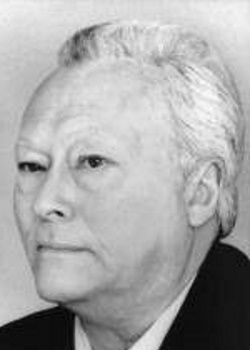 Composer and conductor Gerard Schurmann died at his home in the Hollywood Hills, California, on March 24, 2020, at the age of 96, following a period of declining health.
A distinguished figure in both film and concert music, Schurmann was best known for scores including The Long Arm, Horrors of the Black Museum, Konga, Dr. Syn, Alias the Scarecrow, The Bedford Incident and The Lost Continent. He was also an accomplished orchestrator whose work included two of the great epic scores of the 1960s, Exodus and Lawrence of Arabia.
Gerard Schurmann was born in Kertosono, Java, in the Dutch East Indies, on January 19, 1924, to Dutch parents. His mother was an accomplished pianist, and music became an important part of his childhood. He moved to England at 17 during the Second World War and served with the Royal Air Force, eventually using his talents as a pianist to provide musical entertainment for servicemen.
After the war Schurmann briefly worked as cultural attaché at the Netherlands Embassy in London while continuing to perform and compose. Encouraged by conductor Eduard van Beinum, he became associated with Dutch radio orchestras in Hilversum, but his principal ambition was composition. An important mentor was British composer Alan Rawsthorne, whose friendship eventually helped Schurmann enter the film industry.
His first feature score was for the Anglo-Dutch wartime drama Not in Vain (1948), but his British film career began in earnest at Ealing Studios with The Long Arm (1956), starring Jack Hawkins, and The Man in the Sky (1957). Further assignments included The Camp on Blood Island (1958), The Two-Headed Spy (1958) and Cone of Silence (1960), establishing him as a composer capable of forceful, economical dramatic writing.
Schurmann became especially familiar to enthusiasts of British horror and science fiction. Horrors of the Black Museum (1959) featured appropriately lurid and threatening music, while Konga (1961) accompanied the increasingly bizarre story of a scientist and his enormous killer ape. For Disney’s Dr. Syn, Alias the Scarecrow (1963), Schurmann created a colorful adventure score balancing period atmosphere with excitement and mystery.
One of his finest film works was James B. Harris’s Cold War thriller The Bedford Incident (1965), starring Richard Widmark and Sidney Poitier. Schurmann deliberately used music sparingly, creating a tense, modernistic orchestral score whose increasing dissonance mirrored the psychological deterioration aboard an American destroyer pursuing a Soviet submarine. He subsequently wrote the music for Hammer’s extraordinary fantasy adventure The Lost Continent (1968), replacing an earlier score by Benjamin Frankel. Schurmann combined large-scale orchestral horror writing with lighter jazz and bossa nova elements, creating one of the most unusual scores of his career. He also composed for Attack on the Iron Coast that year.
Schurmann was equally valued as an orchestrator. He worked on Ernest Gold’s Exodus and, most famously, Maurice Jarre’s Lawrence of Arabia (1962), helping transform Jarre’s musical ideas into the sweeping orchestral sound heard in the finished film. His exceptional command of orchestration remained one of the defining characteristics of his music.
After the late 1960s Schurmann increasingly turned away from cinema to concentrate on concert composition. His major works included the Violin Concerto, Concerto for Orchestra, Piano Concerto, Variants for Small Orchestra and the striking Six Studies of Francis Bacon, inspired by the paintings of the British artist. He returned occasionally to film, notably with the Italian historical drama Claretta (1984). He moved permanently to the United States in 1981.

Shop at the Movie Music UK Store

Member of the


