STRINGS – Jørgen Lauritsen
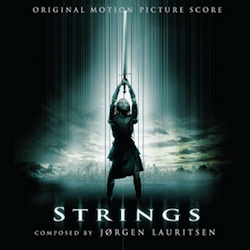 Original Review by Jonathan Broxton
Strings is a Danish film directed by Anders Rønnow-Klarlund, with a cast comprising solely of wooden puppets. The story is an epic tale filled with myth, fable, Norse mythology and fanstastical sword-and-sorcery, which brings to mind such British classics as Excalibur and King Arthur. The film follows the fortunes of a young prince named Hal Tara (voiced by James McAvoy) who, following the death of his father, the King, seemingly at the hands of his sworn enemies, must venture out of the royal city to seek revenge before he can take up the throne. However, as he journeys through his kingdom-to-be and meets his subjects, Hal discovers a few shocking home truths about life in the real world – and finds true love where he least expects it in the shape of the beautiful Zita (Catherine McCormack).
With a supporting voice cast that includes heavyweight British actors such as Julian Glover, Derek Jacobi, and Ian Hart, Strings oozes thespian class. With moody cinematography, atmospheric lighting emphasising shadow and texture, and innovative design, Strings creates a world which is both alien and foreign – despite all the protagonists obviously being antique wooden puppets, the director cleverly incorporates the marionette strings into their world: an idea beautifully realised when a baby, newly carved, comes to life after six strings descend from the heavens and attach themselves to baby’s limbs.
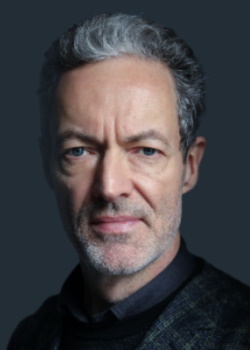 The score for Strings is by Jørgen Lauritsen, a Danish composer who, having worked with a number of successful and popular orchestras and artists in his homeland, is beginning to break out into the world of international movie scoring. Since first coming to prominence in the mid-1990s, Lauritsen has written concert pieces for ensembles ranging from pianos duets to string quartets, jazz combos and big band, choirs and full symphonic orchestras. Among his most notable works are “Night Light” and “Dance of the Full Moon”, written in 1995 and performed by the Danish Radio Sinfonietta; “Mixed Love”, a 1996 stage musical; “Gone Was The Chicken”, a 1997 commission by the Choir of Sankt Annæ Gymnasium which featured lyrics by Danish writer Preben Thomsen; “Dance of the Clogs”, a piece for symphony orchestra debuted by the Ålborg Symphony; “Crystal in Darkness”, a 1999 composition for string quartet performed by the Art Ensemble of Copenhagen, and “Rhythms Across”, a piece for percussion ensemble which received its premiere in Odense in 2001.
Uniquely, Lauritsen is also a music producer and vocal coach for Disney Scandinavia, having been involved in the re-recording of character voices and songs for films such as Treasure Planet, Piglet’s Big Movie, Brother Bear, Tarzan 2 and The Jungle Book 2. For the latter film, Lauritsen also wrote and recorded an original song, “The Boy and the Bear”, which plays over the end credits of the Danish version of the film. During his career, Lauritsen has worked with the the Metropol Orchestra Holland, the Prague Philharmonia, as well as all the major Danish symphony orchestras, including the orchestra of the Danish Royal Theatre. Away from the world of film, Lauritsen has worked with young Danish rappers Nik & Jay, arranged Gershwin songs for Swedish vocalist Lisa Nilsson, worked on Danish productions of the classic musicals of Andrew Lloyd-Webber. He has conducted and arranged music for dozens of stage musicals, TV shows, concerts and CD-recordings across Scandinavia, and has worked as a music director, consultant, coach and pianist/keyboard player for many popular music artists, including Per Gessle of Roxette and Nina Persson of The Cardigans.
Lauritsen’s score for Strings is an orchestral, lush, sweeping affair with several sequences highlighting several solo instruments and vocalists, as well as the impressive performances by the Danish Radio Sinfonietta which, despite comprising just 44 performers, gives the impression of a much larger ensemble. “Jhinna’s Farewell” is a beautiful piece for a solo female vocalist with a rich orchestral backing, which actually brings to mind the work of Ennio Morricone, specifically his collaborations with the legendary Edda Dell’Orso on Once Upon A Time in America and others. Lauritsen’s masterful use of percussion ushers in a sweeping final statement of theme, which later receives a tender recapitulation on solo harp in the “Love” cue, illustrating the romantic relationship between Hal and Zita.
The sadly short “Mountain Climb” references the recent Lord of the Rings scores, cleverly recapturing the same sense of scale and adventure Howard Shore achieved through spacious brass writing and undulating, blustery woodwind motifs. “The Trap” is a tight, impressionistic action cue, filled with rigid percussive rhythms and woodwind textures, while the magnificent finale, “Hal’s Theme”, begins with a heartbreaking, Schindler’s List-inspired violin solo, segues into a touching solo piano rendition of Jhinna’s theme (performed by Lauritsen himself), before swelling into a rich, sublime, fully orchestral denouement which easily stands as one of the most satisfying cues of 2005 to date, and more than indicates that, should Lauritsen achieve his aim of becoming a major name in film music circles in future, he will be a force to be reckoned with.
In addition to the six cues on Lauritsen’s promo CD, there are a further two cues which can be streamed via Lauritsen’s website at http://www.lauritsen.org – the raw, dissonant “Burning Strings” and a lavish, extended “Suite”, a moving piece built around a recurring 3-note motif, and which was commissioned as a concert piece by director Rønnow-Klarlund and which was played for the crew on the set to provide atmosphere.
Track Listing:
- Jhinna’s Farewell (2:54)
- Kharo is Dead (2:08)
- Mountain Climb (1:05)
- Love (2:57)
- The Trap (2:15)
- Hal’s Theme (3:42)
- Bonus Web-Only Track: Burning Strings (0:42)
- Bonus Web-Only Track: Suite from “Strings” (5:11)
Composer Promo (2004)
Running Time: 20 minutes 54 seconds

Shop at the Movie Music UK Store

Member of the


