LOVER’S PRAYER – Joel McNeely
 Original Review by Jonathan Broxton
It’s not very often that I’m forced to eat my words, but I have to admit that Joel McNeely has astounded me recently. It’s common knowledge that I came down like a ton of bricks on The Avengers, Virus and Soldier, three scores hardly worth the manuscript they were written on. I considered his return to form on the TV movie Sally Hemings, while undoubtedly a lovely piece of work, as nothing more than a long-overdue redressing of balance: easily his best score since the days of Iron Will, but nothing to get excited about. Against all expectations, especially my own, his new score for Lover’s Prayer is better yet, a full-bodied orchestral romance that completely knocks the stuffing out of everything he has written in the past.
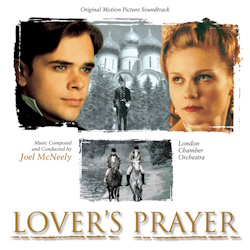
I know nothing about the film, other than that it also goes by the alternate title of All Forgotten, and has yet to open anywhere. It’s directed by Reverge Anselmo, stars Kirsten Dunst, Julie Walters, Geraldine James and Nick Stahl, and judging by the pictures that adorn Varése’s tasteful liner notes, seems to be some kind of period costume drama. It seems to me that, having been the butt of much criticism over the last few years, Joel McNeely has sought to re-evaluate himself and his career. He’s really not done much since Soldier at the back end of 1998, Varése re-recordings notwithstanding, and has re-emerged from his self-imposed sabbatical with a more lush, classical sound which is a 1000% improvement over his earlier work.
 Lover’s Prayer is a true delight for anyone who appreciates scores that swell with romantic emotion. Although the first few moments of the ‘Main Title’ feature James Horner’s trademark four-note motif from Willow and others, as do ‘Denis and Mashenka’ and ‘Death and the Maiden’ later in the album, the music soon moves on and finds McNeely at his thematic best. From a rhapsodic piano opening and a gentle solo oboe, the London Chamber Orchestra swells to perform the first rendition of the recurring central melody, a haunting, longing piece that forms the cornerstone of the entire score. It’s actually more European than American in tone, in the same mould as John Williams’ Jane Eyre and Gabriel Yared’s most recent works, albeit with a greater historical connection than the Frenchman.
Neo-classicism is the name of the game in the rest of the score, with McNeely’s music revelling, in the main, in a series of sweepingly beautiful cues. The main theme is regularly reprised, notably during ‘Goodbye’ and the stunning ‘End Credits’, in which the orchestra rises to glorious new heights. ‘Reunion’ and the exceptional ‘Jealousy’ once again features a series of superb vibrato flourishes in the string section, similar to those heard in Sally Hemings, adding a touch of baroque magic to the proceedings. Some of the piano performances, especially those in the lovely ‘We Shall Be Friends’, have an element of Mozart to them – not because of any particular level of genius in the content, but more in the way in which they are performed, and in their overall tone. Quite where this aptitude for splendid classical pastiche came from I have no idea, but if he continues down the road he is on currently, I can see him developing into a formidable romantic composer in years to come.
The large-scale and vibrant ‘Suitor’s Dance’ is another highlight, resounding to a series of haughty brass performances with an intoxicating rhythm that one can visualise being performed in a glittering ballroom. Conversely, the dark and slightly threatening ‘Death and the Maiden’ perfectly highlights the versatility of McNeely’s main theme, offsetting the melody with a series of oppressive trumpet chords that lend it a definite sense of dread. It may be a little naughty to name his cue after Schubert’s legendary classical piece, but it works all the same.
Somewhat surprisingly, ‘Zanaida Again’ is a little reminiscent of Basic Instinct, with the subtle tick-tock percussion undercurrent and soft, stark string lines that typified Jerry Goldsmith’s work present here. Cleverly, ‘Redemption and Retribution’ is a slow re-working of the main thematic material, recapitulating the melodic content one note at a time, creating a mood of sombre reflection. The final cue, ‘Nocturne’, is a lovely solo piano version of the main theme performed by Clifford Benson
After spending far too much time slaving away on family adventures and pointless science fiction trash, Joel McNeely finally seems to have found his niche in the romantic costume drama genre. It’s perhaps pertinent to mention that, unlike so many recent scores by major composers, Lover’s Prayer is all McNeely’s work – composed, conducted and orchestrated. We could be hearing the real voice of McNeely for the first time here. So is he the new John Williams? Not likely. But the argument for him being the new Georges Delerue is looking like another matter entirely.
Track Listing:
- Main Title (4:15)
- Reunion (3:21)
- We Shall Be Friends (4:04)
- The Pheasant (1:27)
- Suitor’s Dance (1:53)
- Denis and Mashenka (2:04)
- Death and the Maiden (3:27)
- Jealousy (3:08)
- The Pond (3:12)
- Goodbye (2:59)
- Zanaida Again (2:40)
- Redemption, Retribution (2:58)
- End Credits (2:59)
- Nocturne (performed by Clifford Benson) (4:48)
Running Time: 43 minutes 50 seconds
Varése Sarabande VSD-6173 (2000)
Music composed and conducted by Joel McNeely. Performed by The London Chamber Orchestra. Orchestrations by Joel McNeely. Recorded and mixed by Jonathan Allen. Edited by Chuck Martin. Album produced by Joel McNeely and Jonathan Allen.

Shop at the Movie Music UK Store

Member of the


