COLDITZ – Richard Harvey
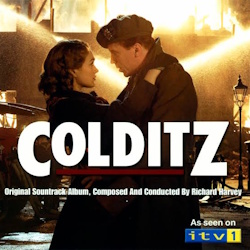 Original Review by Peter Simons
A remake of the classic 1970s television series, Colditz is a gripping World War II drama about British soldier Jack Rose (Tom Hardy) who is planning his escape from Germany’s infamous Colditz prison. His attempts to make a getaway have less to do with the actual imprisonment, and more with the news that his best friend Nicholas (Damian Lewis) is having an affair with his wife Lizzie (Sophia Myles) back in London. The show premiered on the UK channel ITV1 on 27th March 2005 to much critical and popular acclaim.
Directed by Stuart Orme, who has two dozen TV-films to his credit though none of them are particularly well-known, it may come as somewhat of a surprise to learn that Richard Harvey is the composer for Colditz, as Orme has been working almost exclusively with Colin Towns for the last decade and a half. Only occasionally has the director worked with other composers, most notably Arthur B. Rubinstein (The Heist, 1989) and Christopher Gunning (The Last Train, 1999). While Harvey may still be relatively unknown in Europe and America, he has had critical and popular success with his scores for Animal Farm and Luther. Surprisingly, the composer proves quite popular in Asia, where he has scored several productions, such as The Legend of Suriyothai and Prom Piram, for which he won a Suphannohong (Thailand’s equivalent of an Oscar). His score for the docu-drama The Great Within: The Story of the Forbidden City, about the imperial palace in Beijing will soon be released on CD.
Expectations for Colditz were high, to say the least. Harvey is capable of coming up with some stirring melodies and one would hope that he was asked to do just that for this epic war-drama. Any doubt that may have existed (not so much in Harvey’s abilities, but in the director’s vision for the story) are put to rest right at the beginning of the opening track “Farewell / Escape from Switzerland”, as the composer kicks off with an unashamedly lyrical main theme for strings and brass. Within two minutes the album delivers exactly what you would expect (or hope for) from this composer for a project like this. After a stirring crescendo the main theme gives way for more suspenseful music with occasionally dissonant brass and frantic electronic percussion. Amidst the action music Harvey hints at a secondary theme, but he is not the kind of composer to exploit a melody every time he gets close to it.
 “Welcome to Colditz” is a somewhat sinister cue focusing on the orchestra’s lower registers, with timpani, trombone and bass-piano defining the deliberately slow pace while strings and horns perform a ominously undulating motif not unlike anything Christopher Young might have done. “Contrasting Fortunes” and “Turning the Guard/Double Crossed” are the first of several cues that seem strongly influenced by Hans Zimmer’s score for The Thin Red Line, especially the more ethereal cues (“Light” for example) from that score. Harvey employs similar chord progressions, an identical ever-present high string noise and virtually the same use of woodwind instruments. “McGrade Finds Lizzie” introduces a new romantic, yet melancholy theme that makes use of solos for oboe and violin; while “Jack Story” almost sounds like something Harry Gregson-Williams might have written. This is not to jab at the quality of Harvey’s work, but merely to point out referential similarities. The cue presents a delicate and downbeat theme for piano.
Sneaky music for plucked strings, bass piano and low brass makes up the bulk of “Weaving a Plan”, which also features a motif similar to John Williams’ Ark-motif from Raiders of the Lost Ark; while “The Spoils of War” is a fairly uneventful cue for slow strings and electronic percussion. Things start to cook with “Burning Passion” as strings race up and down the scales and the use of brass intensifies, effortlessly evoking a sense of drama and urgency. Harvey also presents an 8-note swaying motif which will play a more significant part in the 7-minute “Confrontation” later on the album. “A Different Story” is a dramatic cue for strings and woodwinds, though the piano also makes a brief appearance, before making way for “Colditz Castle”, one of the album’s highlights as it features several of the soundtrack’s core melodies including a heartfelt performance of the main theme by solo trumpet.
A short, single but gorgeous little motif that was first heard in “A Different Story” now launches “A Moving Encounter” before the “McGrade Finds Lizzie”-theme makes a reappearance, and before the passionate 8-note motif takes centre stage. This cue is another high point, cleverly combining several of the score’s key elements. Deep basses and sinister chords make up the greater part of “Give Me Something”, whereas “Only the Good Die Young” has a lighter, almost uplifting, yet no less dramatic, sound to it. Another album highlight is “Heat of the Moment”, when Harvey’s main theme is given another chance to excel through a rousing string arrangement, and as even a choir finds its way into the arrangement.
“Alone” and “The Letter” see the elusive parts of The Thin Red Line revisited, with the latter cue even featuring some unearthly sound design. Jack’s theme is reprised in “I Love the War”, before the central theme gets another poignant performance. The album continues with two slightly uneventful cues, “Death of an Artist” and “Sleepless Dream”, until the McGrade-and-Lizzie theme is reprised by strings, woodwind and soft choir in “Collisions”. The main theme seems to form the basis for the menacing “Resolution”, although the notes are altered so much it’s easy to miss this subtle manifestation. “Confrontation” is a lengthy track that for the most part can be considered underscore, with Harvey cleverly overlaying the string section with synthesizer pads, lending them an otherworldly quality. This is also the cue where that 8-note motif really pays off and makes an achingly dramatic impact. “Liberation” is a surprisingly mysterious cue with plenty of unexpected key changes and Horner-ish synthesizer noises. Harvey brings the album to a more than satisfying end with a reprise of the main theme in its full, portentous glory. If only he could have sustained that big finale a little bit longer…
Recorded in Bratislava with the Slovak Radio Symphony Orchestra, the performance is absolutely flawless. The mix is crisp and clean, though it does seem to emphasize the basses a tad too much, but this is only a minor gripe. Another virtually trivial drawback is the album’s lengthy running time. Due to the understated nature of the music, many cues tend develop quietly and slowly, if at all. Harvey has made an admirable effort to keep things moving by constantly infusing his tracks with a melodic or rhythmic undercurrent. In fact, the composer employs so many themes it could almost be argued that the score is leitmotivic in its nature. Nevertheless, the album tends to feel quite long and it might have benefited from a slightly shorter running time by excluding a handful of cues that could be considered mere underscore. As with any soundtrack, it is easy to point out similarities to other scores. This is in no way meant derogatory towards Harvey, it is merely meant as an indication as to what type of score he has crafted here. Fans of slow, brooding, dramatic scores like Hans Zimmer’s The Thin Red Line or Angelo Badalamenti’s A Very Long Engagement should find much to enjoy. Those who are familiar with Harvey’s previous works will surely recognize his personal style in the counterpoint writing and particularly in the string and woodwind arrangements. Colditz comes highly recommended.
Track Listing:
- Farewell/Escape from Switzerland (4:01)
- Welcome to Colditz (2:06)
- Contrasting Fortunes (3:47)
- Turning the Guard/Double Crossed (5:23)
- McGrade Finds Lizzie (1:33)
- Jack’s Story (2:15)
- A Lover’s Portrait (2:10)
- Weaving a Plan (2:00)
- The Spoils of War (1:41)
- Burning Passion (1:58
- A Different Story (5:23)
- Colditz Castle (2:42)
- A Moving Encounter (2:57)
- Give Me Something (1:52)
- Only The Good Die Young (1:49)
- Heat Of The Moment (2:22)
- Alone (2:13)
- The Letter (2:32)
- I Love the War! (3:16)
- Death of an Artist (1:54)
- Sleepless Dream (1:22)
- Collisions (4:09)
- Resolution (2:15)
- Confrontation (7:18)
- Liberation (3:01)
- Reacquaintance/End Credits (2:01)
Running Time: 74 minutes 00 seconds
EMI 7243-4-7478-2-8/VTCD710 (2005)
Music composed, conducted and orchestrated by Richard Harvey. Performed by The Slovak Radio Symphony Orchestra. Recorded and mixed by A.A. McLelland. Album produced by A.A. McLelland.

Shop at the Movie Music UK Store

Member of the


